Principles of Ayurveda: What Everything Else Is Built On

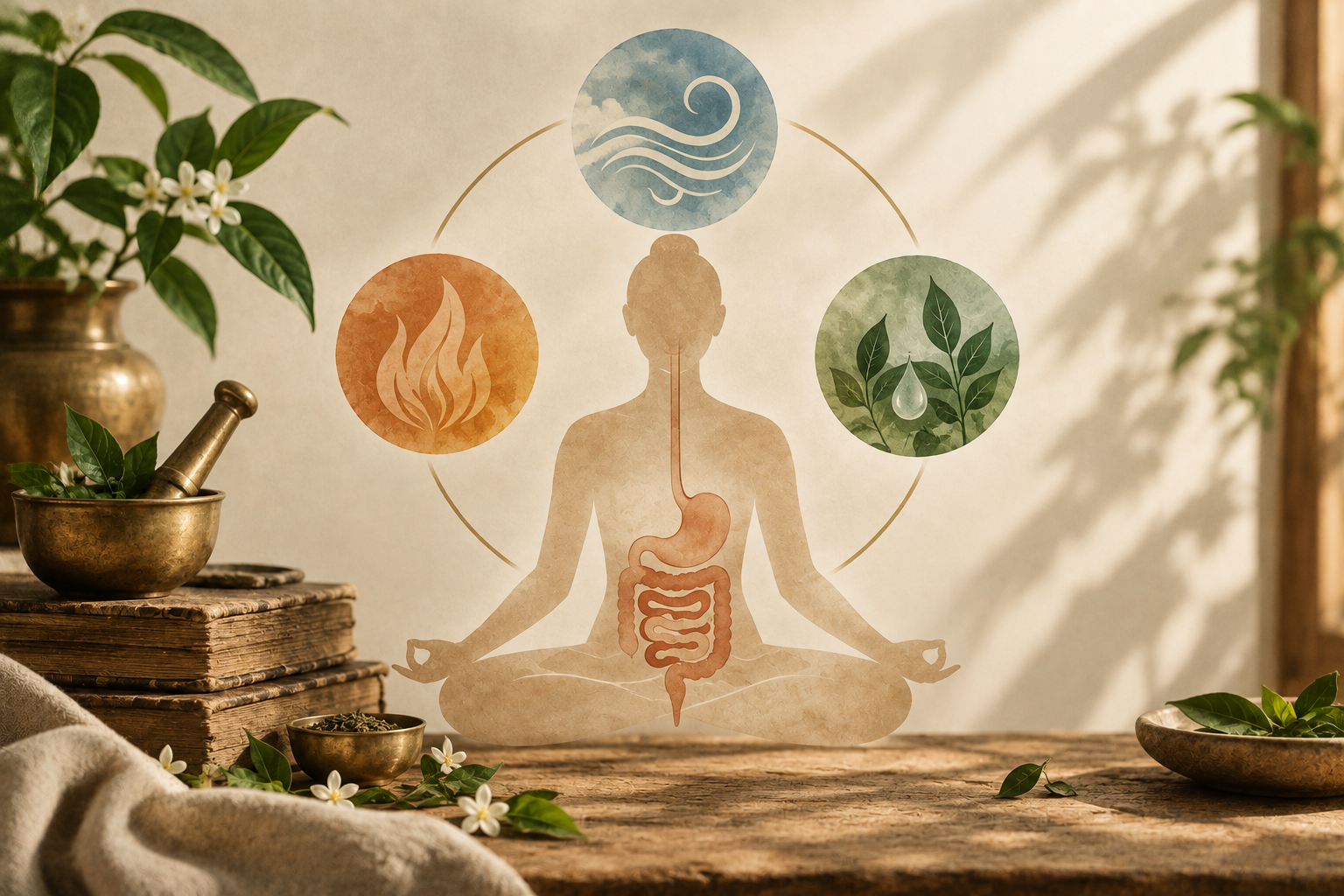
Today, let’s go back to the very beginning.   Before Doshas, before Agni, before all the specific topics we usually talk about, there is a bigger question. What is Ayurveda actually trying to do?   Most people think of it as a system to treat disease and yes, it does that. But that is only half of it.   Ayurveda comes from two Sanskrit words, Ayur meaning life and Veda meaning science. Therefore, Ayurveda translates to the science of life, and it cares just as much about keeping a healthy person healthy as it does about treating someone who is unwell.   In the Indian way of thinking, life has four goals. Dharma, Artha, Kama and Moksha.  And none of these are possible if your body and mind are struggling. So, health was never the end goal, it was what made everything else possible.   Now, to understand how Ayurveda looks at the body, you need to start with one idea. Pancha Mahabhuta.   We experience the world through five senses. Sight, touch, hearing, taste and smell. Ayurveda says everything around us can be understood through five elements that go with these: Akasha, Vayu, Agni, Jala and Prithvi. Space, air, fire, water and earth.   And this isn’t only about nature. Your body is made of these same elements, so is your food and so is your medicine. Even ordinary water isn’t just Jala. It carries all five, with one leading.   This is why Ayurveda never saw the body and the world as two separate things. What is outside you keeps becoming what is inside you, through food, water and air. And when the balance shifts within, your body tries to correct it. It lets go of what is in excess and asks for what is lacking. In a way, that is what a craving really is.   From these five elements come the three Doshas. Vata, Pitta and Kapha.   Vata is mostly space and air. It is movement. Breathing, speaking, and everything in your body that needs to be pushed forward.   Pitta is mostly fire. It is transformation. Digestion, forming blood, vision, memory, turning one thing into another.   Kapha is mostly water and earth. It is moisture and stability. It softens food for digestion, helps you taste, and nourishes the senses.   Something I always want people to understand is that these three are not sitting in separate corners of the body. They are everywhere but the concentration varies. Vata is mostly in the intestines and bones, Pitta is in the stomach and blood, Kapha in the chest and joints. When they are balanced, they hold you up. When they are disturbed, that is where disease begins.   Then come the Dhatus, the seven tissues that form the body’s structure. Rasa, Rakta, Mamsa, Meda, Asthi, Majja and Shukra. Plasma, blood, muscle, fat, bone, marrow and reproductive tissue.   And this matters because Doshas don’t affect the body randomly. The Dhatus are the first place they act. So, when you look at how a disease really develops, it almost always passes through them.   Which brings us back to Agni.   The food you eat comes from outside. It is unfamiliar to your body, and it has to be broken down and made into something your body can use.   Agni is what does that.   But there is not just one Agni. There is the main digestive fire in the gut. There are five Bhutagnis that turn the elements in your food into elements your body recognises. And there are seven Dhatvagnis, one for each tissue, turning nutrients into that specific tissue, step by step.   That is why Ayurveda treats Agni almost as the body itself. When someone comes in with a problem, a Vaidya often looks first at the state of their Agni. Because if that isn’t working well, nothing else will. Most Ayurvedic medicines are designed with this in mind.   Now here is the part I find the most personal.   Prakriti.   Ayurveda believes every person is unique, and Prakriti is the reason. At the time of conception, the Doshas present decide your natural constitution. It could be Vata, Pitta, Kapha, a mix of two, or a balance of all three. And it stays with you for life.   That is why Ayurveda says it treats the person, not the disease. Two people with the same illness may need very different treatment. Someone with a Vata Prakriti is more prone to Vata problems, so they are advised to avoid what aggravates Vata. A Pitta person is given cooling things. A Kapha person, warming things.   And the mind is part of this too. Prakriti is also described through Sattva, Rajas and Tamas, because Ayurveda never saw disease as only physical. The mind affects the body, and the body affects the mind. Which is why even a physical illness sometimes comes with steps for the mind.   Even medicines are understood this way. They carry the five elements as well, so Ayurveda looks at their taste, called Rasa, their qualities, called Guna, their potency, Virya, and their effect after digestion, Vipaka. And then there is something none of these can explain, the medicine’s special action, called Prabhava. Two medicines can be alike in every other way and still act differently because of this.   Now, none of this is meant to be memorised in one sitting. But if you step back, you can see how it all connects. The elements make the Doshas. The Doshas affect the tissues. Agni keeps the whole thing running. Prakriti decides how all of it shows up in you and the same logic carries over to food, medicine and even the mind.   That is what makes Ayurveda a system, and not just a collection of remedies.   And I think that is the real takeaway. When you understand these basics, you stop seeing Ayurvedic advice as random rules, like eat this, avoid that. You… Continue reading Principles of Ayurveda: What Everything Else Is Built On

Why Your Body Isn’t Just “Tissues and Waste”

Most people, the moment they start reading about Ayurveda, land on this word, Dosha, almost immediately. Vata, Pitta, Kapha. And usually, the very first explanation they get is something like “Dosha means fault” or “Dosha means fluid,” and honestly, that explanation doesn’t help at all.   If anything, it makes the whole thing feel more confusing than before you started.   So let’s actually slow down and ask a more basic question first. What is the body even made of, according to Ayurveda?   Before we even get to Dosha, there are two other categories worth understanding, Dhatu and Mala, because once you see how these three relate to each other, Dosha suddenly makes a lot more sense.   Dhatu refers to everything in your body that’s meant to stay. Your blood, muscles, fat, bones, the fluid in your spinal cord, reproductive tissue, all of it.   These are structurally very different from each other, obviously, but they share one thing in common, none of them are meant to leave your body under normal circumstances.   When they do leave, by injury or bleeding or some other accident, your body doesn’t feel relieved. It feels depleted, anxious and weak. That’s the signature of a Dhatu, its presence sustains you, and its loss destabilizes you.   Mala is the exact opposite category. This is everything your body is meant to get rid of, stool, urine, sweat, and so on. And here’s the interesting part, getting rid of these isn’t a failure of the body, it’s actually a sign of it working properly.   Holding onto waste for too long doesn’t protect you, it burdens you. A Mala that overstays starts creating problems rather than preventing them.   So while Dhatu is defined by staying, Mala is defined by leaving, and both, in their own way, keep the body functioning.   Now here’s where it gets genuinely interesting, because Dosha doesn’t fit into either of these categories. It refuses to follow the rule.   Think about saliva for a second. It’s produced inside your body, moves through your salivary glands, briefly steps outside the boundary of your internal tissue system into your mouth, and then re-enters your body as you swallow it along with your food.   It doesn’t stay put like a Dhatu, and it doesn’t fully leave like a Mala either. It does something in between, and that “in between” behavior is exactly what defines a Dosha.   It moves out into contact with the world, and then brings something back in, and this back-and-forth movement is precisely what makes digestion, absorption, and basically your entire relationship with the outside environment possible.   This is such an important shift in how to think about Vata, Pitta, and Kapha. They’re not things that cause or lead up to a disease. They’re the functional bridges that let your body interact with everything you eat, breathe, and absorb from the world around you.   Vata handles movement, what you take in. Pitta governs transformation, converting of one thing into another. Kapha manages binding, lubrication, and the way things hold together and connect.   Without these three doing their job constantly, your Dhatus would never get built, and your Malas would never get properly separated out and removed.   And here’s something that genuinely surprised me the first time I really understood it, this dual-direction movement of the Doshas happens twice a day, in the gastrointestinal tract specifically.   If something you’re consuming regularly doesn’t actually suit your body, that excess starts getting expressed back out, sometimes as an unusually sour or pungent sensation, sometimes as a sweet, sticky feeling.   This isn’t randomness, it’s your body’s own feedback system, quietly telling you that whatever you keep feeding it in excess isn’t being absorbed the way you assume it is.   Most of us just don’t know how to read that signal.   This is also why identifying someone’s Prakriti, their natural constitutional dominance of one or two Doshas, matters so much in how Ayurveda actually treats a person. Two people can eat the exact same meal and metabolize it completely differently, purely because their underlying Dosha balance is different.   What nourishes one person can genuinely unsettle another. This is the entire logic behind why Ayurveda has never really believed in one-size-fits-all diet advice, it was never really about the food.   It was always about how well your Doshas are managing the exchange between what’s outside you and what needs to become a part of you.   So the next time someone tells you Dosha simply means “fault,” it’s worth remembering that it’s actually closer to the opposite. It’s not what goes wrong in the body. It’s the very mechanism that allows the body to keep working, keep exchanging, and keep staying alive in the first place.   If ideas like this interest you, our courses on Charaka Samhita and Ashtanga Hridayam go much deeper into how Dosha, Dhatu, and Mala work together as the foundation of the entire Ayurvedic system.  

Dinacharya in Ayurveda: The Art of Living in Rhythm With Your Body

What comes to your mind when you hear the word Dinacharya?   You might think the words morning routine, right?   And what does your morning routine include?   Waking up early, brushing your teeth, scraping your tongue, drinking warm water, exercising, meditating, and perhaps some oil pulling. Then you begin your day feeling particularly disciplined.   Yes, some of these practices are indeed part of the Ayurvedic approach to daily living, but Dinacharya is much bigger than this list of things that we do.   It extends far beyond waking up and going to bed. Even the way we eat, the timing of our meals and the way food is prepared can influence how we experience our day-to-day health.   I recently spoke about some of these in my new YouTube video, “5 Ayurvedic Eating Habits I Wish Everyone Knew | Part 1.” If you want to understand how everyday eating habits can be approached, I go into this in much more detail there.   [Watch: 5 Ayurvedic Eating Habits I Wish Everyone Knew | Part 1]   Ashtanga Hridayam has an entire chapter dedicated to Dinacharya, and Vagbhata begins the chapter with a very simple instruction:   “Brahme muhurte uttishthēt.”   Wake up during Brahma Muhurta.   Now, what exactly is Brahma Muhurta?   A Muhurta is a traditional unit of time, approximately 48 minutes. Brahma Muhurta refers to the period before sunrise, traditionally beginning two Muhurtas, or approximately 96 minutes, before sunrise and lasting for about 48 minutes. So, depending on the time of sunrise, it generally falls somewhere around 1.5 hours before sunrise.   And there is a reason Ayurveda places such importance on this particular window.   This is considered a time dominated by Vata, the Dosha associated with movement, lightness and subtle activity. It is the transition between night and day. The environment is quieter, there is less sensory stimulation, and the mind is considered to be more receptive and clear.   The chapter then talks about Danta Dhavana, using twigs from specific trees like Arka, Nyagrodha, Khadira, and Karanja, chosen for tastes that are Kashaya (astringent), Katu (pungent), or Tikta (bitter). And it specifically mentions cleaning your teeth without hurting the gums, “dantamaamsaanyabaadhayan.”   It’s such a small detail, but it tells you something important about how nothing is too minor to matter. Even your mouth, the very first point of contact between you and your food, gets its own careful instruction.   The body is made up of all these small things, and the way you care for them every day eventually becomes part of your overall health.   From Danta Dhavana, the text moves into Anjana, or the care of the eyes. Vagbhata recommends Sauviranjana as a daily practice for the eyes and mentions Rasanjana at intervals for cleansing.   Again, what stands out to me is the attention to detail. The eyes are not treated as something separate from the rest of the body. They are another part of the body that needs regular care. And when you think about how much of our day today is spent looking at screens, this idea of simply paying attention to the condition of our eyes feels particularly relevant.   Then comes Nasya, Gandusha, and Dhoomapana, with the use of Tambula. These practices belong to a very different medical context, and they should not simply be copied into a morning routine without understanding who they are intended for and under what circumstances.   But what is interesting, and what I want to point out here, is how comprehensive the total idea of daily care was.   From the mouth, nose, eyes, skin, the head, and all the senses, everything had a place in Dinacharya. There was an understanding that health was made up of all these systems that need to be cared for continuously. It was not about waiting for something to go wrong and then addressing it.   And then we come to Abhyanga, which is one of the most recognisable practices today. Vagbhata says, “Abhyangam acharet nityam.” He recommended regular oiling of the body, emphasising particularly on the head, ears, and feet, and describing benefits related to the skin, vitality, strength and sleep.   I have also made a detailed video about Abhyanga, if you wish to understand the practice in more detail. [Watch the video here.]   Then finally comes Vyayama, or exercise.   Exercise that is appropriate can bring lightness to the body, improve our capacity for work, support digestion and help reduce excess fat. But we must understand that exercise is not the same for everybody, and it is certainly not meant to be excessive.   Vagbhata actually gives detailed instructions about who should exercise, how much they should exercise and when exercise should be avoided. He says that exercise should be done up to approximately half of one’s capacity, rather than pushing the body beyond what it can comfortably tolerate.   And I think this is an important distinction.   And Dinacharya doesn’t just stop with the physical body.   This is where I find the chapter particularly interesting, because Vagbhata gradually moves from taking care of your body to how you conduct yourself.   He speaks about using words that are truthful, measured and pleasant:   “Kāle hitam mitam brūyād avisaṃvādi peśalam.”   Speak at the right time. Speak what is beneficial, measured, truthful and pleasant.   He speaks about compassion, generosity, humility and how we should conduct ourselves even when dealing with people who may not treat us well in return.   And this tells us something important about what Ayurveda actually meant by health.   It was never only about physical health. The way you conduct yourself is also part of your well-being.   The way you speak, the way you behave, the conflicts that you create, the anger you hold on to, and the way you treat other people all become part of the environment in which your body and mind have… Continue reading Dinacharya in Ayurveda: The Art of Living in Rhythm With Your Body

Satva, Rajas and Tamas: The Three Forces Behind How We Think and Act

When we look at something that already exists, we tend to focus on what we can see. To us, in our mind, a book is a book, a building is a building and a person is a person.   But let us go a little deeper, what made that thing come into existence in the first place? What happened before we could see the finished form? What allowed an idea to become reality?   According to the Ayurvedic understanding of nature, three fundamental qualities are involved in this process: Satva, Rajas and Tamas.   These are not substances in the ordinary physical sense. They are the principles that influence how things are conceived, developed, organised and eventually brought into a definite form.   They also influence how we think, respond to situations and behave.   From an idea to something real   Think about something as simple as a printed page.   Before the page existed, someone first had an idea. They imagined that information could be communicated through a page.   Then came the practical process where the paper had to be selected, its size had to be decided, the text had to be organized and the printing process had to be worked out.   Only then could the page actually be produced.   This can be understood through the three qualities.   Satva is associated with clarity, awareness and the emergence of an idea.   Rajas is associated with activity, movement and the effort required to bring that idea into action.   Tamas provides stability, limitation and resistance to further alternatives. It allows something to settle into a definite form.   All three have a role.   An idea without action remains an idea while an action without direction becomes scattered and without some form of limitation or stability, nothing is ever finalised.   This principle can be observed everywhere, from something as simple as making a page to something as complex as the development of a living being.   Satva, Rajas and Tamas in the mind   Ayurveda extends this idea beyond the physical world and applies it to Manas, or the mind.   Every person has Satva, Rajas and Tamas in relative dominance.   This explains us why two people can experience exactly the same situation but respond to it completely differently.   This is where understanding the predominance of Satva, Rajas and Tamas becomes important.   The Satva-dominant mind   A person in whom Satva is more prominent tends to be curious, observant and interested in understanding things.   They want to know why something happened.   If they fall ill, they may want to understand the cause, the relationship between their habits and their symptoms, and what they can do to improve their situation.   They may also be better able to remain composed during difficult circumstances. Instead of immediately reacting, they tend to step back, understand what is happening and work towards a solution.   This does not mean that a Satva-dominant person does not experience pain, fear or distress. Rather, their ability to understand and process the situation can influence how they respond to it.   The Rajas-dominant mind   Rajas is associated with movement, activity and constant engagement.   A Rajas-dominant person may be more expressive about both pleasure and discomfort. They may actively seek experiences, stimulation and reassurance.   If something happens to them, they may not necessarily be interested in understanding the deeper cause immediately. What they often need first is clear guidance and reassurance.   Once they feel confident about the course of action, they may be able to move forward.   Their mind is active and constantly responding to what is happening around them.   The Tamas-dominant mind   Tamas is associated with resistance, confusion and difficulty in moving forward.   A Tamas-dominant person may struggle to understand or accept what is happening around them. When they are facing a difficult situation, fear and apprehension may become stronger.   They may repeatedly question advice, seek opinions from several people and still find it difficult to make a decision.   Even with the outcome seeming clear, they may find it difficult to take a first step.   This is also why the same advice might not help every person, as they might not react to it in a similar way.   Why this matters in Ayurveda   For Ayurveda, treating a person is not limited to identifying physical symptoms.   The way a person perceives, expresses and responds to those symptoms also matters.   Let us take an example, someone may experience severe pain but barely express it while there is another person who may express relatively mild pain very dramatically. Someone else may not even understand that their symptoms require attention.   Now, the individual’s mental state might affect the way they communicate or show signs to understand about their condition.   If a practitioner judges the severity of a condition only by outward expression, there is a possibility of misunderstanding the situation.   Ayurveda’s understanding of Satva, Rajas and Tamas also highlights something that is often overlooked in modern conversations about health.   Two people can have similar physical circumstances but very different experiences of illness. Our perception, emotional response, understanding and behaviour can influence how we deal with what is happening to us.   This does not mean that mental qualities magically determine whether someone will recover. Nor does it mean that a person’s illness is simply a result of their mindset.   Rather, the Ayurvedic framework recognises that the mind is part of the individual’s overall experience and therefore deserves attention during care.   Three qualities, one constantly changing mind   Satva, Rajas and Tamas should not be understood as three permanent personality categories.   They are present in everyone, in different proportions, and can change depending on circumstances.   A person may be calm and thoughtful in one situation, highly restless in another and completely withdrawn in a third.   The important… Continue reading Satva, Rajas and Tamas: The Three Forces Behind How We Think and Act

Ama: When Digestion Is Incomplete

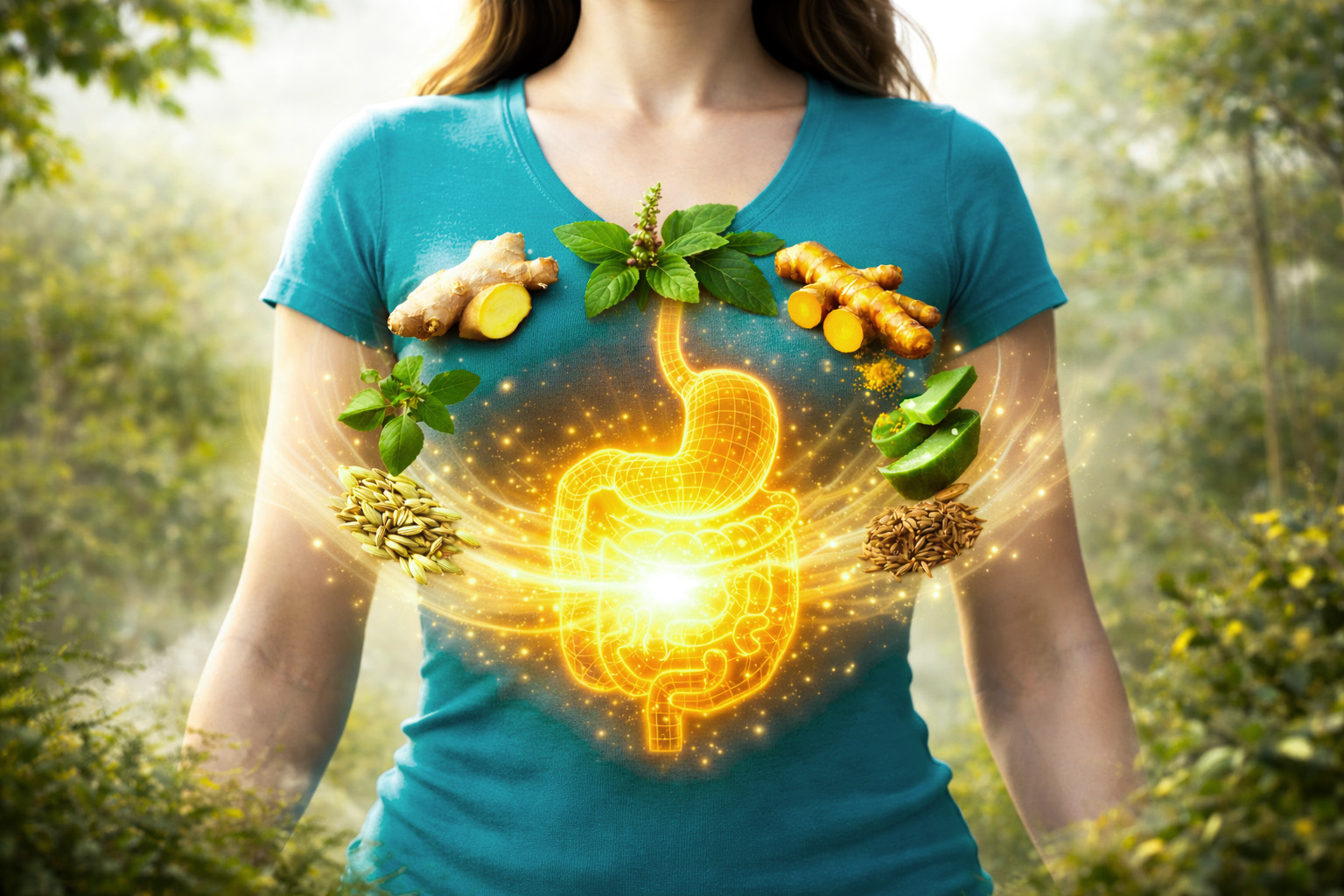
After you have had your meal, there might be times when you feel heavy. It is not exactly tiredness, but you do not feel nourished either. Your head feels foggy, there is a discomfort you cannot quite ignore, and yet it is not severe enough to feel like something is seriously wrong.   There may also be a feeling that you have not experienced complete satisfaction from the meal. It is almost as though something inside you is saying that the process is not finished, that the job has not been completed.   Today, we are going to talk about one of the widely spoken-about concepts in Ayurveda: Ama. When the accumulation of Ama is greater, it can give rise to a condition described as Amadosha.   To understand Ama, we have to go back to something we have spoken about before: Agni, our digestive fire.   What Is Ama?   Ashtanga Hridayam describes this state directly. When the digestive strength is low, the very first tissue formed from food, which remains undigested, becomes vitiated and gets lodged in the stomach as unprocessed matter. This is described as Ama.   When Agni is working the way it should, the food we consume gets properly digested, absorbed, and converted into Rasa Dhatu, the first and most essential tissue our body produces after digestion.   But when Agni is weak, this conversion does not happen cleanly. Your food is not entirely digested, but it is not entirely rejected either. Some of it remains half-processed, turning into something called Ama.   Ama is not exactly food. It is not waste either. It is something caught in between the two, the result of incomplete digestion and improper transformation.   What Causes Ama?   One of the causes is eating more than what your hunger can accommodate.   Ayurveda describes this as atimātrā āhāra, or consuming food in excessive quantity. When food is consumed in a quantity greater than what the digestive capacity can handle, it places a burden on Agni. This can lead to the aggravation of all three doshas and interfere with proper digestion.   But it is not exactly about quantity alone. The nature of the food also matters.   Food that is heavy, dry, or cold can contribute to the formation of ama, even when it is eaten in a reasonable amount.   And it is not just about food.   Your lifestyle, mental strain, and the mental state you carry throughout the day can also contribute. When your digestive capacity is compromised, even food that you consider light or harmless may not be processed properly.   When Agni is weak, food does not necessarily provide the nourishment your body requires. Instead, according to the Ayurvedic understanding of ama, incompletely processed material can behave like a slow-acting poison within the body.   What Happens When Ama Interacts With the Doshas?   As this undigested or improperly processed material interacts with the doshas, its effects can vary depending on how the body responds.   It may become trapped and cause a condition described in Ayurveda as Alasaka. Or it may be expelled violently from the body, which is described as Vishoochika.   Either way, the body is signalling that something has gone wrong in the process of digestion and assimilation.   The manifestation can also differ depending on which dosha is involved.   When Pitta is involved, you may see signs such as a burning sensation, excessive thirst, and disturbances in the mouth, reflecting more heat-related expressions.   When Kapha is involved, it can manifest differently, with congestion-type conditions, urinary disorders, and other Kapha-dominant patterns.   This is why Ayurveda does not look at digestion as simply a matter of what you eat. It considers the strength of Agni, the nature and quantity of food, the timing of meals, lifestyle, mental state, and the condition of the doshas together.   Ama, in this sense, is not simply about having eaten something unhealthy. It is about what happens when the body is unable to properly process what it has received.   What Are the General Properties of Ama?   Ayurveda describes Ama as having certain characteristic properties.   It is guru, meaning heavy and difficult to digest.   It is drava, meaning it has a liquid nature.   It is aneka-varṇa, meaning it can present in different colours.   And it is picchila, meaning slimy or sticky in nature.   The symptoms associated with ama are often the kind most of us have experienced at some point.   There may be a sense of blockage or obstruction, general exhaustion, heaviness in the head, dizziness, stiffness in the back and hips, unusual thirst, and that general feeling that whatever you eat is simply not sitting right.   Individually, none of these symptoms may seem particularly alarming.   But when several of them appear together, they can indicate that something is not functioning properly within the digestive system.   The answer is not always to simply eat less, eliminate one particular food, or ignore the discomfort and wait for it to disappear.   Ayurveda asks us to look deeper at Agni.   How strong is your digestion? Are you eating according to your hunger? Are you eating at regular times? Is the food appropriate for your digestive capacity? Is your lifestyle supporting digestion, or constantly working against it?   Because digestion is not merely about what happens to food after you swallow it. It is about how well the body is able to transform what it receives into nourishment.   If ideas like Ama and Agni interest you, our courses on Charaka Samhita and Ashtanga Hridayam go much deeper into understanding digestion, imbalance, and the way our body responds to what we eat, how we live, and how we care for ourselves.  

Samanya and Vishesha: The Ayurvedic Principle of Balance

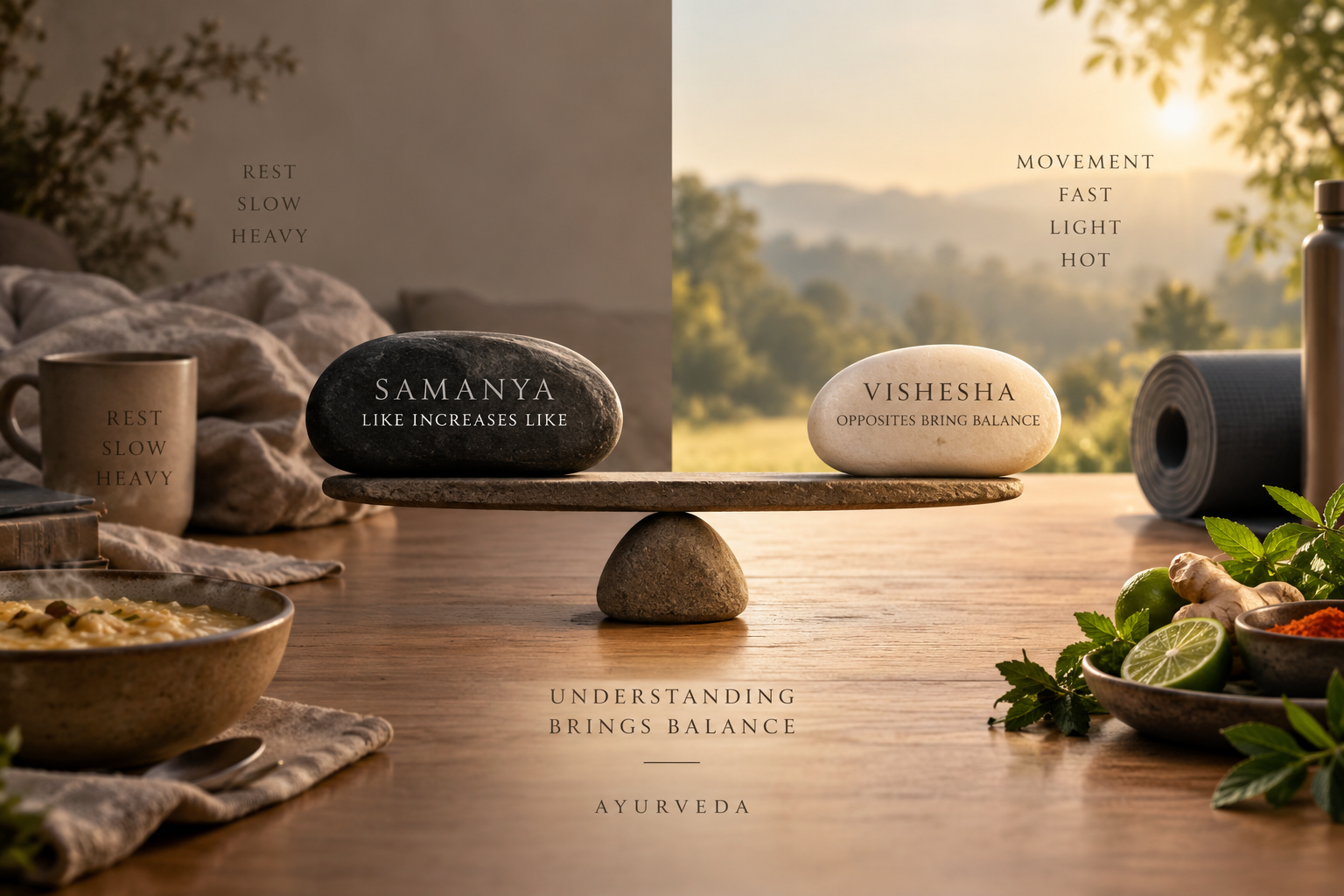
Think of this situation, you probably find it familiar.   You come home tired, and instead of hitting the gym or going for a walk, all you want to do is sleep. So, you lie down but when you get up instead of feeling refreshed, you feel even more tired.   There might also be days when you feel jittery and restless instead. So, you go for a walk or hit the gym hoping it will help. But rather than feeling energised, you end up feeling even more wired than when you started.   You must have noticed that nobody has really taught us this. We just vaguely assume that rest will fix our tiredness, or movement will fix our restlessness, without actually stopping to think about whether they really do.   Interestingly, Ayurveda has actually talked about this phenomenon. The Charaka Samhita has a verse that describes this very pattern.   सामान्यमेकत्वकरं, विशेषस्तु पृथक्त्वकृत् । तुल्यार्थता हि सामान्यं, विशेषस्तु विपर्ययः ॥   It can be roughly translated to Samanya brings things together, Vishesha pulls them apart. Samanya is sameness of quality; Vishesha is its opposite.   This verse introduces us to two words. One is samanya, which means sameness or similarity. The other is vishesha, which means difference or distinction.   And the principle the text is pointing towards is that things that are similar to each other tend to increase each other, while things that are opposite to each other tend to reduce each other.   It’s almost like fields, where one thing can either reinforce what is already there or counter it.   Rest is slow. So, if you are already feeling heavy and slow, more rest isn’t necessarily going to rebalance you. It only reinforces that feeling of heaviness and sluggishness.   On the other hand, restlessness is hot and fast. So, if you respond to that feeling with more movement, you might end up feeling even more hot and wired rather than actually calming the restlessness. You’re reinforcing the qualities that are already present.   Now that we think about it, it sounds obvious. But we rarely think about our own habits in these terms.   This principle can also be applied to the food we consume and our body’s internal balances, what Ayurveda calls the doshas.   It’s quite simple. Whatever quality is already present in excess, you don’t add more of it. You reach for its opposite instead.   On a cold day, for example, if you’re already feeling stiff, dry and cold you naturally want to add some warmth. Similarly, if you’re feeling sluggish or heavy after a meal, you probably don’t want to eat something even heavier, right? You want something lighter.   In fact, the very first chapter of the Charaka Samhita, called Dirghanjivitiya, which is about the desire for long life, talks about exactly which tastes can calm which imbalances.   It goes through all six rasas, or tastes, and explains their qualities and what can be used to pacify different states.   Take Vata, for example. Vata is dry and is associated with movement. So, it is calmed by substances with opposite qualities. If you’re feeling dry and cold, if you’re in a Vata state, you would reach for sweet, sour and salty tastes because these carry qualities of moisture, warmth and weight.   Or if you feel like your Pitta is rising, you’re overheated or you’re feeling short-tempered, bitter and sweet tastes can help cool things down.   And this is important: none of the six tastes are universally good or universally bad. It’s not that sweet is unhealthy and bitter is healthy. Each taste has its place whether it is helpful or unhelpful depends entirely on the state it is meeting.   There is no fixed list where cold foods are always bad or sweet foods are always bad. It depends entirely on the person, the place, the timing, and the state of the body, not just the substance itself.   This is one of the core ideas of Ayurveda. It is individualistic. The same food or medicine can be helpful for one person but not for another. If you must have also noticed, even for the same person, something that suits them one day may not suit them on another day.   It depends on what qualities they are already carrying in excess at that particular time.   Ayurveda says that even a well-known poison, used with the right knowledge, at the right dose, for the right person, can become the best possible medicine. And a substance that’s technically medicine, used without that understanding, can do as much damage as poison.   The substance alone is never the whole story.   You have to look at what you’re giving, who you’re giving it to, why you’re giving it, how much you’re giving, and under what circumstances.   And this brings us back to samanya and vishesha.   Because the real question isn’t simply, “Is this food good?”   Ayurveda’s answer is rarely just about the thing itself.   It is about the relationship between the thing and the person receiving it.   If this way of looking at Ayurveda interests you, you might enjoy our courses on the Charaka Samhita and Ashtanga Hridayam, where we go deeper into the texts and the ideas behind them. Sometimes, going back to the original texts can change the way you understand Ayurveda, and even the way you look at your own life.

Ayurveda Named the Reason We Keep Doing Things We Know Are Bad For Us

Have you ever eaten an extra serving despite being full?   Have you ever stayed up scrolling through your phone and lost track of time?   Have you ever decided to be a little lazy and skip your workout?   Admit it, we’ve all at least done any one of these once in our lives.   And here’s the thing, none of us do this because we don’t know better. We know exactly what we’re doing. We just do it anyway.   Ayurveda had a word for this, thousands of years before behavioural science made a whole field out of it. It’s called Pragyaparadha.   And according to Ayurveda, this one idea sits behind almost every disease we end up bringing on ourselves.   The word comes from two Sanskrit roots. Pragya, meaning wisdom or intellect. Aparadha, meaning offence or crime. Put the two together and Pragyaparadha literally means an offence against wisdom.   Not a lack of wisdom but an offence against it.   That difference matters a lot. Ayurveda wasn’t talking about ignorance here, it was talking about something far more familiar and honestly, a little harder to admit to. Knowing exactly what’s good for you, and choosing the opposite anyway.   Ayurvedic texts describe Pragyaparadha as actions of the body, mind or speech, done despite knowing better. Eating something you already know doesn’t suit you. Brushing off clear signs that you’re exhausted. Saying something in anger that you know you’ll regret the second it leaves your mouth. None of this needs ignorance. It just needs one moment where awareness loses to impulse.   Ayurveda believed that this pattern, repeated enough times, becomes one of the root causes of disease itself.   This is a very different starting point from how most of us think about getting sick.   When something goes wrong with our health, we usually look outward first. We look for the virus, the deficiency, the bad gene, the environmental trigger, the food we ate, or sometimes, simply, bad luck. And of course, these things matter.   Ayurveda never claimed that everything that happens to the body is a consequence of personal choices. But it also asked us to look somewhere else, somewhere most of us are much less comfortable looking: at the small, repeated choices we make against our own better judgement.   Because sometimes, we already know.   We know we are tired, but we stay up anyway. We know we are full, but we take another serving because it tastes good. We know that certain foods leave us feeling terrible, yet somehow, they keep finding their way back onto our plates. We know we need to move, rest, slow down, or stop stressing about something, and still find ourselves doing the exact opposite.   We think subconsciously that stayiny up one late night is not going to affect our health, one indulgent meal is not going to make us sick. But we forget that we keep repeating these things quietly, so much so that you’ll realise it stopped becoming a choice and started becoming a pattern.   The doshas getting disturbed again and again by the same habits. The body constantly having to compensate for the same disruptions. Small imbalances being ignored because they are still small enough to live with. Until, eventually, the body cannot keep correcting itself quite as easily as it once did, and disease gets the room it needs to take hold.   And honestly, this sounds a lot like something we are already talking about today.   There is an entire area of behavioural science concerned with the distance between what we know and what we actually do. It is often described as the knowledge-behaviour gap, and you do not need a psychology degree to recognise it in your own life.   We are not exactly short on information.   And yet, somehow, knowing all of this does not guarantee that we will act on it.   We can have all the information in the world and still find ourselves repeating the same habits we promised ourselves we were going to change.   And this is where I think the concept gets particularly interesting, because Pragyaparadha is not really about not knowing better. It is about knowing better and then, for whatever reason, choosing otherwise.   There is something almost painfully human about that.   And here is what I particularly like about the Ayurvedic approach to this. It does not seem interested in turning that observation into another reason for us to feel terrible about ourselves.   There is already enough guilt attached to health. Every day, we are given another reason to feel like we are failing at taking care of ourselves.   Pragyaparadha gives us a slightly different way of looking at the problem. Instead of asking, What is wrong with me that I keep doing this?, perhaps the more useful question is, Why did I act against what I already knew?   That question takes us somewhere much more interesting.   Ayurveda places importance on cultivating Sattva, a state associated with clarity, steadiness and a balanced mind. The answer, therefore, was not simply to keep collecting more knowledge. It was to develop the mental clarity required to actually live according to the knowledge you already have.   Because there is a huge difference between knowing something and being able to act on it.   And this is also why practices like Dinacharya, the Ayurvedic approach to daily routine, make more sense when viewed through this lens. They were not simply a collection of rituals designed to give you another checklist to complete every morning. At their best, routines create regularity, and regularity gives you the opportunity to notice yourself.   You start noticing when you are actually hungry instead of eating because the clock says it is lunchtime. You notice when your sleep is beginning to deteriorate. You notice when your digestion feels different, when your energy is lower than usual, when… Continue reading Ayurveda Named the Reason We Keep Doing Things We Know Are Bad For Us

Why Ayurveda Built an Entire Science Around Your Daily Routine

School kids daily schedule according to clock. Boy sleeping, taking bath, having breakfast or dinner, walking to school. Vector illustration for daily routine, everyday life concept

Most of us think of routine as something boring. It is often reduced to a mere schedule or a checklist to follow out of discipline, not health.   Daily routine or Dinacharya as we call it in Ayurveda, spoke of these things differently.   Thousands of years ago, Ayurveda proposed that the time of day you wake up, eat, work, rest and sleep is not aligned to your health but is the major force driving it.   Let me take you to understand more about Dinacharya, the Ayurvedic concept of daily routine.   Today, modern science is beginning to look at it far more seriously than before. To understand why, we first need to understand what Ayurveda was actually observing.   Ayurveda describes the body as a being governed by three functional principles, the Doshas, Vata, Pitta and Kapha. What is less commonly known is that these Doshas do not stay constant throughout the day.   According to Ayurveda, each Dosha dominates at particular hours. Kapha in the early morning and early evening. Pitta around midday and midnight. Vata in the late afternoon and the hours before dawn.   In other words, Ayurveda mapped the day into biological phases long before anyone had a word for biological clocks.   The current healthcare industry has a term for it now, it’s called circadian rhythm.   Modern chronobiology tells us that the human body runs on an internal 24-hour clock, coordinated by a region of the brain called the suprachiasmatic nucleus. This clock influences when we feel alert, when we digest food efficiently, when hormones rise and fall, and when the body is primed for rest.   Researchers have started asking the same question. Several recent reviews in Ayurvedic and integrative medicine journals have explored whether Dosha-based time cycles and circadian biology are describing the same underlying rhythm, just through different frameworks.   Both these frameworks, however, come to the same conclusion that the body is not meant to function the same way at every hour. It has natural windows, and working against them comes at a cost.   This is why I say Dinacharya is more than just a wellness ritual.   Dinacharya includes practices such as waking up before sunrise, tongue scraping, oil massage or Abhyanga, structured mealtimes, and a consistent sleep schedule.   On the surface, these can look like common habits unrelated to each other. But Ayurveda designed them as a single system, meant to keep the body’s internal rhythm stable rather than making it constantly disrupted.   And disruption, as it turns out, is exactly what modern lifestyle is capable of.   Late nights lit by screens, irregular meal timings, sleep that shifts by hours depending on the day of the week and constant mental stimulation with very little downtime built in.   Ayurveda would describe this as a body pulled away from its natural Kala, or time-based rhythm. Modern medicine describes it as circadian misalignment, and links it to poor sleep quality, disrupted metabolism, weakened immunity and long-term stress on the body.   Though different vocabulary, the meaning and warnings remain the same.   This is also why Ayurveda never treated sleep, digestion and mental health as separate categories. In its view, they are all expressions of the same rhythm. Disturb one, and the others eventually follow.   So why did something this systematic end up being reduced to a set of morning habits people casually borrow, an oil massage here, an early wake-up there, without the philosophy behind it?   Part of it is how wellness content is spreading today, individual practices travel faster than the reasoning behind them. It is easier to share a five-step morning routine than to explain why Ayurveda built time itself into its understanding of disease and health.   But the reasoning is where the real value lies.   Because Dinacharya was never meant to be a productivity hack or a set of disconnected habits. It was Ayurveda’s answer to a question modern medicine is only now returning to seriously.   Not just what should a person do to stay healthy, but when?   As more research continues to explore the overlap between Ayurvedic time-based concepts and circadian science, one thing becomes increasingly clear. Ayurveda was not simply describing a lifestyle preference all those centuries ago.   It was describing a clock built by your body.   But Dinacharya does not work alone. Ayurveda paired it with a wider concept called Ritucharya, or seasonal routine. If Dinacharya governs the 24-hour clock, Ritucharya governs the yearly one.   According to Ayurveda, the same Doshas that rise and fall through the day also rise and fall through the seasons. Kapha accumulates through the cold months. Pitta builds through the heat of summer. Vata increases as the season turns dry and windy.   Left unaddressed, these seasonal shifts were believed to be behind many recurring illnesses, the cold that returns every winter, the fatigue that shows up every monsoon.   This is Ayurveda applying the same logic at a different scale. The day has its rhythm then the year has its rhythm too. And a person who ignores both is, in Ayurvedic terms, working against nature twice over.   Modern medicine is only beginning to catch up here. Seasonal patterns in immunity, mood and metabolism are well documented, yet they are rarely built into everyday treatment plans the way Ayurveda built them into everyday living.   This is really where Ayurveda’s real strength lies, not in a single remedy, but in a framework. A framework that treats time as a variable in health itself.   And once you see that framework, Dinacharya stops looking like a checklist of habits and starts looking like what it always was, a daily practice built on centuries of observation about how the human body actually works.   If this made you curious about how deep Ayurveda’s foundational principles really go, our guided courses on Charaka Samhita and Ashtanga Hridayam walk through these concepts directly from the… Continue reading Why Ayurveda Built an Entire Science Around Your Daily Routine

Ayurveda Is An Alternative Medicine. Alternative To WHAT!?

Ayurveda is often called “alternative medicine”.   But alternative to what?   The word “alternative” suggests that Ayurveda came later, as another option after modern medicine. That is simply not true.   Ayurveda is one of the oldest systems of medicine in the world. It has been helping people understand health, disease, and the human body for thousands of years. It did not begin as an alternative. It existed long before modern medicine as we know it today.   What Ayurveda Actually Does   Ayu means life, and Veda means knowledge. Together, Ayurveda is commonly understood as “the science of life.”   Ayurveda is not just about treating disease.   At its core, Ayurveda looks at both the outer world and our inner world. It teaches us that good health comes from understanding ourselves and living in harmony with nature. It is about understanding how the body functions, what keeps it healthy, and what causes it to lose balance.   Instead of looking at one symptom on its own, Ayurveda looks at the whole person.   It asks simple questions.   Why did this problem develop?   What changed in the person’s lifestyle?   How can balance be restored naturally?   The goal is not only to help someone feel better today but also to support long-term health.   This is one of the biggest differences in the way Ayurveda approaches healthcare.   Rather than waiting for illness to develop, Ayurveda encourages us to recognize subtle changes in the body before they progress into larger problems. It teaches that health is something we care for every day, not something we think about only when we are sick.   That is why Ayurveda places so much importance on daily habits, food, sleep, movement, mental wellbeing, and living according to the seasons. These are not isolated aspects of health. They all influence one another.   When one area is out of balance, it often affects the others as well.   The Importance of Daily Living   One of the most beautiful ideas in Ayurveda is that health is created through our everyday choices.   The way we wake up.   The food we eat.   The time we sleep.   How we manage stress.   How we move our bodies.   These may seem like ordinary parts of life, but Ayurveda considers them the foundation of good health.   This is why Ayurveda places great importance on Dinacharya, or a healthy daily routine, and Ritucharya, living according to the changing seasons.   These are not complicated rules.   They are practical ways of helping the body function in harmony with nature.   Is Ayurveda Against Modern Medicine?   Not at all.   Modern medicine has transformed healthcare. It is essential for emergencies, surgeries, infections, and life-threatening conditions. It has saved countless lives, and it continues to save lives every single day.   Nobody serious about health denies this.   But Ayurveda was never trying to do that job. It was never built for emergency intervention. It was built to place particular emphasis on understanding why health declines in the first place, often before disease becomes advanced or requires emergency care.   Ayurveda was never intended to compete with modern medicine, nor was it meant to serve merely as a backup option.   It is one of the oldest and most complete systems for understanding the human body, built on the simple idea that health is something we build every single day, not something we only think about once it is already gone.   Perhaps it is time to stop asking whether Ayurveda is an alternative.   Instead, ask a different question.   What is Ayurveda trying to achieve?   Its purpose has always been clear.   To help us understand the body.   To maintain balance.   To support health through daily living.   To recognize imbalance early.   And to help people live healthier, more fulfilling lives.   The goals have remained the same for thousands of years.   The world around us has changed dramatically. The way we live, work, eat, and interact with our environment is very different from how our ancestors lived.   Medical science has advanced in extraordinary ways, and our understanding of disease continues to evolve. Yet the basic needs of the human body have remained remarkably consistent.   We still need nourishing food, regular sleep, movement, emotional balance, and a lifestyle that supports our physical and mental wellbeing. These are not modern discoveries.   This is why Ayurveda is often described as a way of life rather than simply a system of medicine. Its teachings extend beyond treating illness.   Ayurveda is far more than the labels often attached to it today.   If you want to understand Ayurveda as it was originally taught, explore our courses and learn directly from the timeless wisdom of the Charaka Samhita and Ashtanga Hridayam.

Why Ayurveda Needs Evidence, Not Excuses!

Some people believe asking Ayurveda for evidence is disrespectful.   I disagree.   Evidence does not weaken Ayurveda. It protects Ayurveda.   It separates real practice from misinformation. It helps the world understand what our teachers preserved for centuries.   The Question of Evidence   Like any other traditional system of medicine, Ayurveda has also faced this criticism and scrutiny over the question of evidence.   As modern healthcare has become increasingly evidence driven, Ayurveda has often been judged against standards developed for the biomedical framework.   This has led many people to dismiss it as unscientific, not because of a lack of knowledge, but because the knowledge has been traditionally generated, preserved, and communicated in a different way from the standards of modern medicine.   To understand this, we need to look at how Ayurvedic knowledge has evolved.   For centuries, Ayurveda was taught through the gurukula system, where learning was transferred from the guru to the disciple.   Students did not simply memorize texts. They observed patients alongside their teachers. Most of the knowledge was practical rather than purely theoretical, and knowledge was often refined through observation and experience.   Ayurveda therefore had its own framework for validating knowledge. It relied on its own set of parameters. What it did not develop was the kind of biomedical research framework that has formed the foundation of modern healthcare today, and this is important.   Ayurveda is one of the world’s most extensively documented traditional medical systems. Classical texts like the Charaka Samhita, Sushruta Samhita, and Ashtanga Hridayam have preserved its principles for centuries.   However, while the core philosophy and knowledge have been documented, clinical practice was never recorded in the systematic manner expected today. Individual case studies, long-term treatment outcomes, and standardized datasets are all part of modern clinical culture.   Where the Gap Actually Comes From   As a result, this historical gap explains why Ayurveda has entered the modern scientific era with a wealth of classical wisdom but comparatively limited research documentation. In recent decades, significant efforts have been made to bridge this gap. Institutions working under the AYUSH framework have invested in research on Ayurvedic formulations, therapies, and clinical practices.   This brings us to another challenge.   Much of this research has been expected to conform to the language and methodology of biomedical science, including its full set of protocols. These are valuable tools, but they were never part of the traditional system of Ayurveda.   Presenting Ayurveda through this different scientific language is not just a challenge; it can lead to gaps in both evidence and translation.   Hence, to address this gap, significant efforts are being made.   Addressing The Gap   In May 2025, the World Health Assembly adopted the WHO Global Traditional Medicine Strategy 2025 to 2034, a ten-year roadmap built specifically to strengthen the evidence base for traditional medicine systems including Ayurveda.   India’s Ministry of Ayush has signed a three-million-dollar agreement with WHO to bring Ayurveda into the International Classification of Health Interventions, the same global data framework biomedicine uses to track treatment outcomes worldwide.   WHO is also building a Traditional Medicine Global Library, already holding over 1.5 million records of evidence maps, clinical journals, and policy documents.   None of this happens for a system that has nothing to prove. It happens because global health authorities have recognized that Ayurveda’s outcomes are real and worth documenting properly.   The medicine was never the problem. The documentation was.   And documentation is not a threat to Ayurveda. It is its greatest opportunity.   Evidence does not exist to replace classical knowledge. It exists to preserve it, strengthen it, and make it accessible to a healthcare system that increasingly relies on measurable outcomes. If Ayurveda is to serve future generations across the world, its principles must be communicated in a language that researchers, physicians, policymakers, and patients can understand.   Authentic knowledge should never be afraid of scrutiny. If a treatment consistently produces positive outcomes, documenting those outcomes only strengthens confidence in that practice.   At the same time, we must also recognise that not every aspect of Ayurveda fits neatly into conventional biomedical research models.   Ayurveda is fundamentally personalised. Two patients with the same diagnosis may receive different treatment plans because their constitution, digestive capacity, lifestyle, stage of disease, and overall health are different. Standardised clinical trial designs often attempt to minimise variation between patients, whereas Ayurveda intentionally incorporates individual variation into treatment decisions.   This means Ayurveda deserves research methods that respect the complexity of whole-system, personalised care rather than forcing every principle into a framework originally designed for modern healthcare standards.   The goal should never be to make Ayurveda imitate modern medicine.   The goal should be to develop rigorous methods that can evaluate Ayurveda on its own principles while maintaining the scientific standards expected in global healthcare.   This is where the future lies.   After treating thousands of patients across the world, one thing has become clear to me. I do not see evidence and tradition as competitors. I see them as two generations of the same commitment: the commitment to helping the person in front of you and being honest about what works.   Our teachers built Ayurveda on direct observation of patients over centuries. Evidence based research is simply the modern language for continuing that same observation, at a scale and rigor our teachers never had access to.   The future of Ayurveda needs both. The wisdom of our ancient texts. And the language of modern validation. One without the other is incomplete.