
Your Gut, Brain, Blood and Breath Aren’t as Separate as You Think

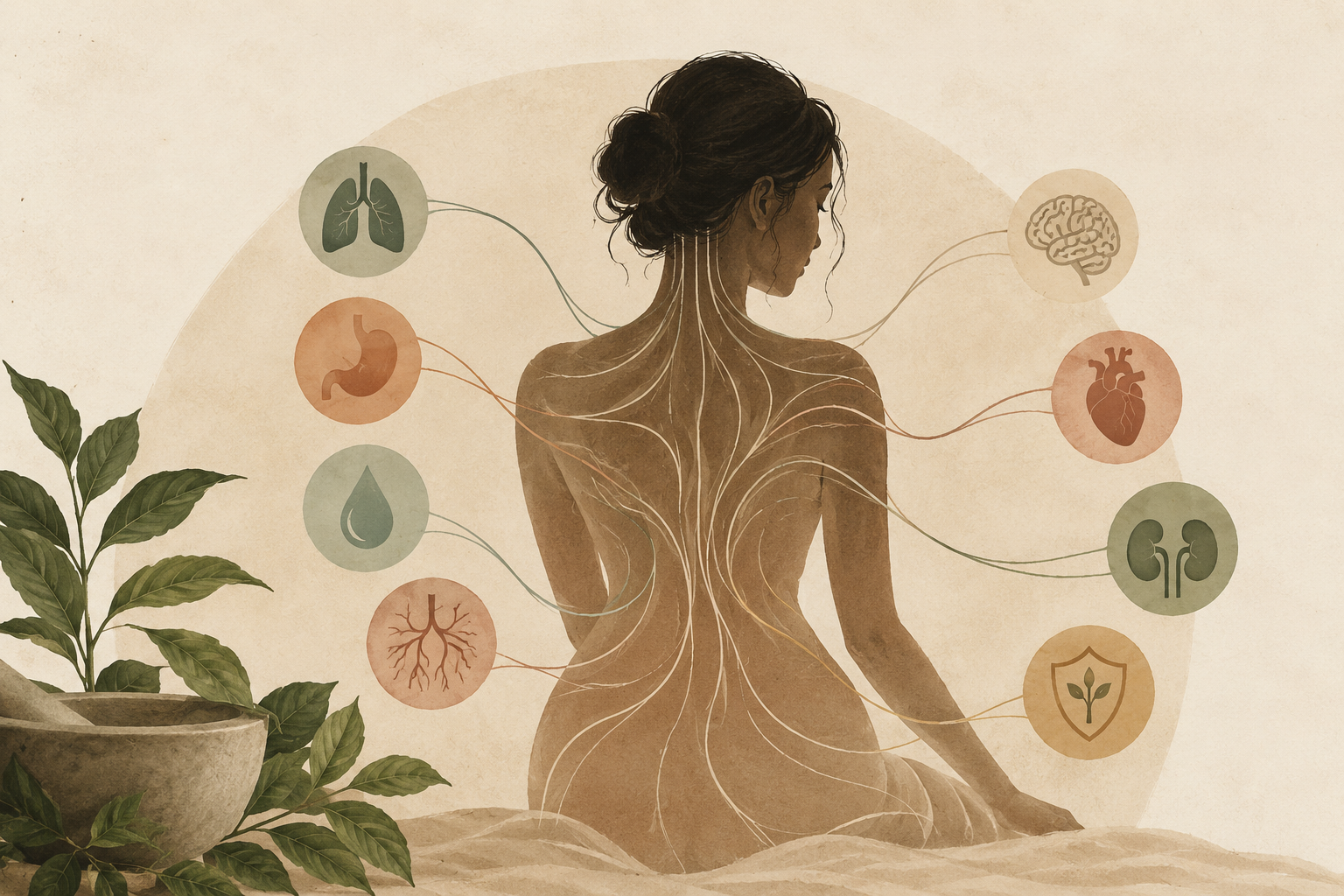
Think about everything your body has to move around all day.   Food, water, oxygen, nutrients, hormones, waste.   Nothing just sits there. Everything is constantly travelling somewhere, through something.   And when that movement gets disturbed, your body usually has a way of showing you. Bloating, sluggishness, poor digestion, congestion, changes in your skin, feeling unusually tired.   Ayurveda has a rather interesting way of explaining why this happens.   It’s called Srotas.   Srotas literally means channel, and the idea behind it is honestly pretty simple once you get it. Your body isn’t one solid block of tissue. It’s a network, an endless system of channels and pathways carrying stuff around, nutrients in and waste out.   And not just fluids, it also carries your thoughts, emotions and your immune responses.   Charaka mentioned that the human body is a pile of these channels, so many of them that you couldn’t hope to count them all. But he and Sushruta still tried to organise the important ones into thirteen main Srotas, each responsible for carrying something specific through the body.   Let me give you a sense of how detailed they are.   There’s Pranavaha Srotas, the channel for breath and oxygen, roughly matching what we’d now call the respiratory system. The Annavaha Srotas, carries food through digestion. Rasavaha and Raktavaha handle plasma and blood while Swedavaha Srotas for sweat, and Mutravaha for urine.   And then there’s the one I find most fascinating, Manovaha Srotas, the channel through which thoughts and emotions are believed to move.   Yes, your mind has its own channel too, right alongside your blood vessels and your gut.   Strotas aren’t just for moving things around, they also help us understand something we’ve all felt but never really questioned. Why does anxiety sit in your stomach? Why does a stressful week somehow show up as a breakout, or a headache, or a flare-up in your gut?   Ayurveda’s answer is that these channels aren’t separate systems running in isolation, they’re connected. A disturbance in one can easily spill into another.   Modern medicine, interestingly, is inching toward the same conclusion. There’s actual research now on the gut-brain axis, the idea that your digestive system and your nervous system are in constant conversation, influencing each other more than we ever gave them credit for.   Ayurveda was describing something remarkably similar centuries ago.   Here’s the part that really changes how you look at illness though.   Ayurveda believed most diseases begin the same way. Not with a sudden attack from nowhere, but with a Srotas getting disturbed. And it described this disturbance, called Srotodushti, in a few specific ways. A channel can get blocked, it can narrow. It can widen beyond what it should. It can even start carrying things in the wrong direction entirely.   I think this reframes a lot of things we brush off too quickly. That afternoon brain fog you get after a heavy meal? Ayurveda would say your Annavaha Srotas, the digestive channel, is overloaded, and that congestion is now affecting clarity elsewhere. Random skin flare-ups with no obvious trigger? Possibly a disturbance that finally found somewhere to surface.   None of this means Ayurveda had X-ray vision into the body, it didn’t have MRIs or blood panels. What it had was centuries of careful observation, watching how symptoms moved, repeated and connected across generations of patients. And through that, it built an entire model of the body based on flow, not fixed parts.   This is actually a pretty different way of thinking about health compared to how most of us were taught. We tend to think in terms of organs like the stomach handles digestion, the lungs handle breathing and the brain handles thinking, full stop. Ayurveda asked a slightly bigger question. Not just what does each part do, but how does everything stay connected, and what happens when that connection breaks down.   Keeping these channels clear was never treated as an afterthought in Ayurveda either. It’s actually one of the reasons practices like proper digestion, regular elimination, oil massage and even breathing exercises show up so often in Ayurvedic practices.  They were seen as basic maintenance for keeping the body’s channels open and functioning the way they’re meant to.   But once you actually understand Srotas, a lot of Ayurveda’s other ideas start clicking into place too. Why Dinacharya matters, why Ama, the toxin buildup we mentioned earlier, is taken so seriously, why treating one symptom in isolation was never really Ayurveda’s style to begin with.   Long before modern medicine started mapping out the gut-brain axis or the lymphatic system in real detail, Ayurveda had already sketched out its own map, one built entirely on the idea that nothing in the body works alone.   If ideas like this interest you, our guided courses on Charaka Samhita and Ashtanga Hridayam explore concepts like Srotas straight from the original texts.

Why Ayurveda Needs Evidence, Not Excuses!

Some people believe asking Ayurveda for evidence is disrespectful.   I disagree.   Evidence does not weaken Ayurveda. It protects Ayurveda.   It separates real practice from misinformation. It helps the world understand what our teachers preserved for centuries.   The Question of Evidence   Like any other traditional system of medicine, Ayurveda has also faced this criticism and scrutiny over the question of evidence.   As modern healthcare has become increasingly evidence driven, Ayurveda has often been judged against standards developed for the biomedical framework.   This has led many people to dismiss it as unscientific, not because of a lack of knowledge, but because the knowledge has been traditionally generated, preserved, and communicated in a different way from the standards of modern medicine.   To understand this, we need to look at how Ayurvedic knowledge has evolved.   For centuries, Ayurveda was taught through the gurukula system, where learning was transferred from the guru to the disciple.   Students did not simply memorize texts. They observed patients alongside their teachers. Most of the knowledge was practical rather than purely theoretical, and knowledge was often refined through observation and experience.   Ayurveda therefore had its own framework for validating knowledge. It relied on its own set of parameters. What it did not develop was the kind of biomedical research framework that has formed the foundation of modern healthcare today, and this is important.   Ayurveda is one of the world’s most extensively documented traditional medical systems. Classical texts like the Charaka Samhita, Sushruta Samhita, and Ashtanga Hridayam have preserved its principles for centuries.   However, while the core philosophy and knowledge have been documented, clinical practice was never recorded in the systematic manner expected today. Individual case studies, long-term treatment outcomes, and standardized datasets are all part of modern clinical culture.   Where the Gap Actually Comes From   As a result, this historical gap explains why Ayurveda has entered the modern scientific era with a wealth of classical wisdom but comparatively limited research documentation. In recent decades, significant efforts have been made to bridge this gap. Institutions working under the AYUSH framework have invested in research on Ayurvedic formulations, therapies, and clinical practices.   This brings us to another challenge.   Much of this research has been expected to conform to the language and methodology of biomedical science, including its full set of protocols. These are valuable tools, but they were never part of the traditional system of Ayurveda.   Presenting Ayurveda through this different scientific language is not just a challenge; it can lead to gaps in both evidence and translation.   Hence, to address this gap, significant efforts are being made.   Addressing The Gap   In May 2025, the World Health Assembly adopted the WHO Global Traditional Medicine Strategy 2025 to 2034, a ten-year roadmap built specifically to strengthen the evidence base for traditional medicine systems including Ayurveda.   India’s Ministry of Ayush has signed a three-million-dollar agreement with WHO to bring Ayurveda into the International Classification of Health Interventions, the same global data framework biomedicine uses to track treatment outcomes worldwide.   WHO is also building a Traditional Medicine Global Library, already holding over 1.5 million records of evidence maps, clinical journals, and policy documents.   None of this happens for a system that has nothing to prove. It happens because global health authorities have recognized that Ayurveda’s outcomes are real and worth documenting properly.   The medicine was never the problem. The documentation was.   And documentation is not a threat to Ayurveda. It is its greatest opportunity.   Evidence does not exist to replace classical knowledge. It exists to preserve it, strengthen it, and make it accessible to a healthcare system that increasingly relies on measurable outcomes. If Ayurveda is to serve future generations across the world, its principles must be communicated in a language that researchers, physicians, policymakers, and patients can understand.   Authentic knowledge should never be afraid of scrutiny. If a treatment consistently produces positive outcomes, documenting those outcomes only strengthens confidence in that practice.   At the same time, we must also recognise that not every aspect of Ayurveda fits neatly into conventional biomedical research models.   Ayurveda is fundamentally personalised. Two patients with the same diagnosis may receive different treatment plans because their constitution, digestive capacity, lifestyle, stage of disease, and overall health are different. Standardised clinical trial designs often attempt to minimise variation between patients, whereas Ayurveda intentionally incorporates individual variation into treatment decisions.   This means Ayurveda deserves research methods that respect the complexity of whole-system, personalised care rather than forcing every principle into a framework originally designed for modern healthcare standards.   The goal should never be to make Ayurveda imitate modern medicine.   The goal should be to develop rigorous methods that can evaluate Ayurveda on its own principles while maintaining the scientific standards expected in global healthcare.   This is where the future lies.   After treating thousands of patients across the world, one thing has become clear to me. I do not see evidence and tradition as competitors. I see them as two generations of the same commitment: the commitment to helping the person in front of you and being honest about what works.   Our teachers built Ayurveda on direct observation of patients over centuries. Evidence based research is simply the modern language for continuing that same observation, at a scale and rigor our teachers never had access to.   The future of Ayurveda needs both. The wisdom of our ancient texts. And the language of modern validation. One without the other is incomplete.