
Maybe It Is Not Just What You Eat, But How Much

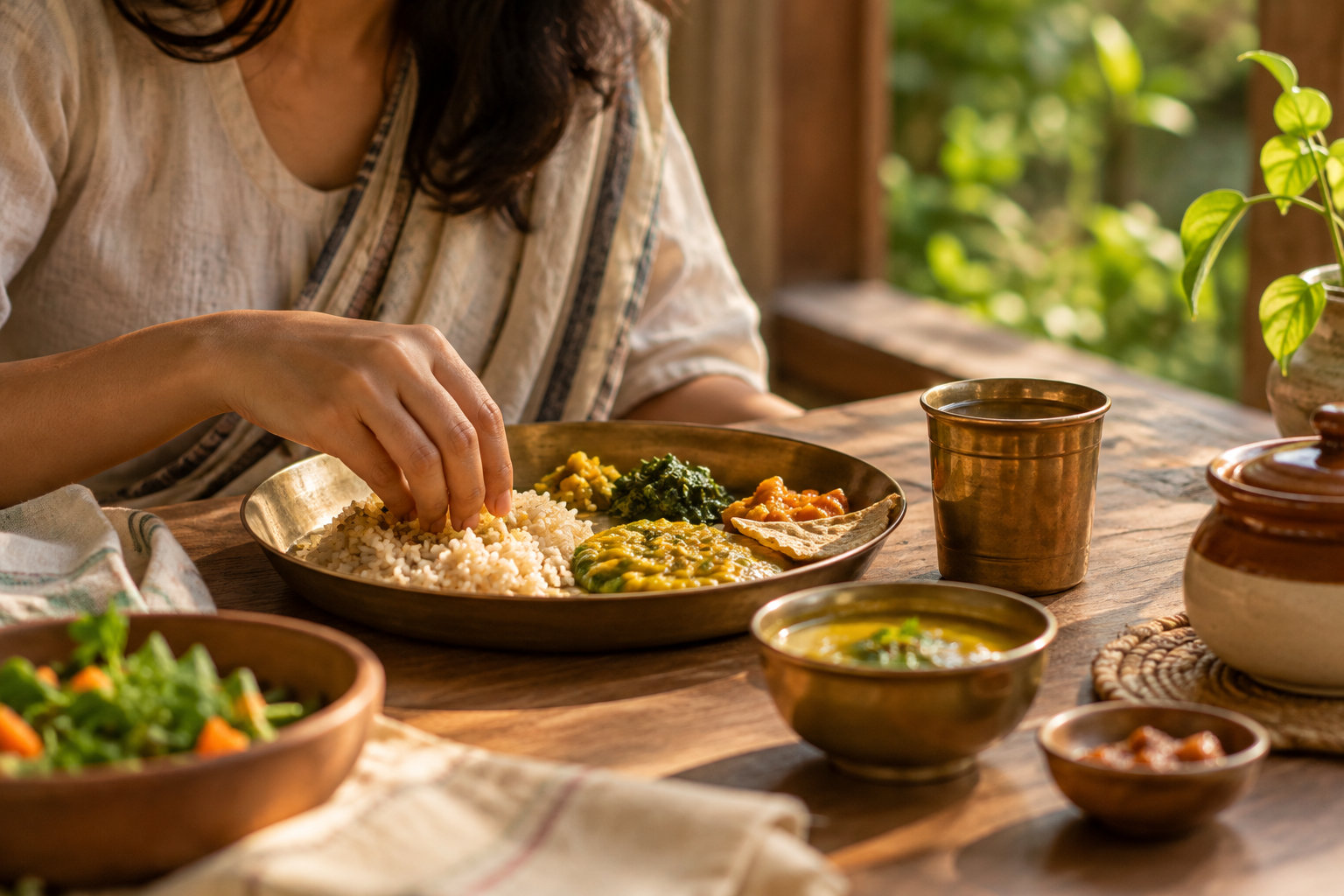
We have become very good at asking what we should eat.   What is the healthiest breakfast? Which oil should we use? Is rice better than roti? Should we have more protein? What should we eat for good digestion? There is always another food to add, remove, replace or worry about.   But there is one much simpler question that often gets lost: how much are you actually eating?   Ayurveda has been asking this question for a very long time. In the Matrashiteeya chapter of the Charaka Samhita, the discussion begins with something remarkably straightforward: matrashī syāt, essentially, one should eat in the right quantity.   And then comes the important part that quantity is not exactly the same for everyone. It depends on the strength of one’s digestion.   That immediately makes the conversation about food a little more interesting. Because we often speak about food as though the food itself is the whole story. We label something “light” or “heavy” and assume that its effect will be the same every time we eat it.   But even foods considered naturally light or heavy still depend on quantity. Something that is generally easy to digest can become difficult when eaten in excess, while a heavier food may be manageable in an appropriate amount depending on the person’s digestive capacity.   In other words, there is no point in asking only, “Is this food healthy?” without also asking, “Is this the right amount for me, at this time?”   Eat according to the proper measure; the proper measure of food depends on the strength of digestion. It sounds almost obvious when you hear it, but think about how rarely we actually apply this idea.   We eat because it is lunchtime even when we are not hungry. We continue eating because the food tastes good even after we are full. We finish everything on the plate because that is what we were taught to do.   We order more because we are out with friends. Sometimes we eat very little all day and then compensate with a huge dinner because we are exhausted and starving. The food may not necessarily be the problem. Sometimes it is simply the relationship we have with quantity.   The chapter makes another interesting distinction between foods that are naturally lighter and those that are naturally heavier. It mentions foods such as rice, green gram and certain meats among the lighter foods, while describing things such as preparations made from flour, sesame, black gram, milk and certain meats like fish as heavier.   But even here, food is not reduced to a simple good-food versus bad-food list. It repeatedly brings the discussion back to quantity and digestive strength. This is important because the idea is not to become afraid of foods that are described as heavy.   It is to understand that the same food can behave differently depending on how much of it you eat, how strong your digestion is and what else is happening in your body.   You do not have to create a permanent list of foods you are “allowed” to eat and foods you are not. You can instead become more attentive to what happens after you eat.   Do you feel comfortable? Does the meal digest without leaving you excessively heavy or sluggish? Are you hungry again at an appropriate time? Do you feel energised or do you feel like you need to lie down immediately? These observations are not meant to turn eating into another thing to obsess over. They are simply a way of becoming familiar with your own body.   The appropriate quantity of food often supports one’s strength, complexion, comfort and longevity. That is quite different from the way we often talk about food today, where every meal can start to feel like a calculation of calories, protein, carbohydrates, fats and restrictions.   Ayurveda’s concern here is much more functional: what does this food, in this amount, do to the person eating it?   And it does not just stop with food.   Health is maintained through small acts of care repeated regularly.   Take something as ordinary as brushing the teeth.   Your body is something you maintain, not something you only attend to when something goes wrong.   We have a strange relationship with self-care today. We can spend hundreds of rupees on a product marketed as a “self-care essential” and still forget the basics. We can have a complicated skincare routine but sleep four hours.   We can buy supplements while eating at completely irregular times. We can spend an hour researching the perfect shampoo and then ignore the fact that we are exhausted all week. Sometimes care becomes another form of consumption instead of something we actually practise.   The Matrashiteeya chapter offers a much quieter idea of care. Eat in the right quantity. Keep yourself clean. Take care of the senses. Pay attention to the body. Maintain routines. Do things regularly rather than waiting until a problem becomes severe. There is a sense of maintenance rather than constant correction.   And perhaps that is the part of this chapter that feels most relevant now.   Eating when we are actually hungry. Stopping before we have eaten far beyond what we need. Paying attention to how a meal makes us feel instead of blindly following a food trend. Keeping our bodies clean. Taking a few minutes to care for our skin, hair, feet and senses. Giving the body enough rest. Building routines that are sustainable rather than impressive for a week.   There is also something important in the way the chapter describes the body: almost as something that deserves regular attention and respect.   Maybe that is what we miss when we reduce healthy living to individual foods and isolated habits.   Because sometimes the most useful change is not finding a better food.   It is learning when enough is enough. Health does not always come from… Continue reading Maybe It Is Not Just What You Eat, But How Much


Dinacharya in Ayurveda: The Art of Living in Rhythm With Your Body

What comes to your mind when you hear the word Dinacharya?   You might think the words morning routine, right?   And what does your morning routine include?   Waking up early, brushing your teeth, scraping your tongue, drinking warm water, exercising, meditating, and perhaps some oil pulling. Then you begin your day feeling particularly disciplined.   Yes, some of these practices are indeed part of the Ayurvedic approach to daily living, but Dinacharya is much bigger than this list of things that we do.   It extends far beyond waking up and going to bed. Even the way we eat, the timing of our meals and the way food is prepared can influence how we experience our day-to-day health.   I recently spoke about some of these in my new YouTube video, “5 Ayurvedic Eating Habits I Wish Everyone Knew | Part 1.” If you want to understand how everyday eating habits can be approached, I go into this in much more detail there.   [Watch: 5 Ayurvedic Eating Habits I Wish Everyone Knew | Part 1]   Ashtanga Hridayam has an entire chapter dedicated to Dinacharya, and Vagbhata begins the chapter with a very simple instruction:   “Brahme muhurte uttishthēt.”   Wake up during Brahma Muhurta.   Now, what exactly is Brahma Muhurta?   A Muhurta is a traditional unit of time, approximately 48 minutes. Brahma Muhurta refers to the period before sunrise, traditionally beginning two Muhurtas, or approximately 96 minutes, before sunrise and lasting for about 48 minutes. So, depending on the time of sunrise, it generally falls somewhere around 1.5 hours before sunrise.   And there is a reason Ayurveda places such importance on this particular window.   This is considered a time dominated by Vata, the Dosha associated with movement, lightness and subtle activity. It is the transition between night and day. The environment is quieter, there is less sensory stimulation, and the mind is considered to be more receptive and clear.   The chapter then talks about Danta Dhavana, using twigs from specific trees like Arka, Nyagrodha, Khadira, and Karanja, chosen for tastes that are Kashaya (astringent), Katu (pungent), or Tikta (bitter). And it specifically mentions cleaning your teeth without hurting the gums, “dantamaamsaanyabaadhayan.”   It’s such a small detail, but it tells you something important about how nothing is too minor to matter. Even your mouth, the very first point of contact between you and your food, gets its own careful instruction.   The body is made up of all these small things, and the way you care for them every day eventually becomes part of your overall health.   From Danta Dhavana, the text moves into Anjana, or the care of the eyes. Vagbhata recommends Sauviranjana as a daily practice for the eyes and mentions Rasanjana at intervals for cleansing.   Again, what stands out to me is the attention to detail. The eyes are not treated as something separate from the rest of the body. They are another part of the body that needs regular care. And when you think about how much of our day today is spent looking at screens, this idea of simply paying attention to the condition of our eyes feels particularly relevant.   Then comes Nasya, Gandusha, and Dhoomapana, with the use of Tambula. These practices belong to a very different medical context, and they should not simply be copied into a morning routine without understanding who they are intended for and under what circumstances.   But what is interesting, and what I want to point out here, is how comprehensive the total idea of daily care was.   From the mouth, nose, eyes, skin, the head, and all the senses, everything had a place in Dinacharya. There was an understanding that health was made up of all these systems that need to be cared for continuously. It was not about waiting for something to go wrong and then addressing it.   And then we come to Abhyanga, which is one of the most recognisable practices today. Vagbhata says, “Abhyangam acharet nityam.” He recommended regular oiling of the body, emphasising particularly on the head, ears, and feet, and describing benefits related to the skin, vitality, strength and sleep.   I have also made a detailed video about Abhyanga, if you wish to understand the practice in more detail. [Watch the video here.]   Then finally comes Vyayama, or exercise.   Exercise that is appropriate can bring lightness to the body, improve our capacity for work, support digestion and help reduce excess fat. But we must understand that exercise is not the same for everybody, and it is certainly not meant to be excessive.   Vagbhata actually gives detailed instructions about who should exercise, how much they should exercise and when exercise should be avoided. He says that exercise should be done up to approximately half of one’s capacity, rather than pushing the body beyond what it can comfortably tolerate.   And I think this is an important distinction.   And Dinacharya doesn’t just stop with the physical body.   This is where I find the chapter particularly interesting, because Vagbhata gradually moves from taking care of your body to how you conduct yourself.   He speaks about using words that are truthful, measured and pleasant:   “Kāle hitam mitam brūyād avisaṃvādi peśalam.”   Speak at the right time. Speak what is beneficial, measured, truthful and pleasant.   He speaks about compassion, generosity, humility and how we should conduct ourselves even when dealing with people who may not treat us well in return.   And this tells us something important about what Ayurveda actually meant by health.   It was never only about physical health. The way you conduct yourself is also part of your well-being.   The way you speak, the way you behave, the conflicts that you create, the anger you hold on to, and the way you treat other people all become part of the environment in which your body and mind have… Continue reading Dinacharya in Ayurveda: The Art of Living in Rhythm With Your Body

Ama: When Digestion Is Incomplete

After you have had your meal, there might be times when you feel heavy. It is not exactly tiredness, but you do not feel nourished either. Your head feels foggy, there is a discomfort you cannot quite ignore, and yet it is not severe enough to feel like something is seriously wrong.   There may also be a feeling that you have not experienced complete satisfaction from the meal. It is almost as though something inside you is saying that the process is not finished, that the job has not been completed.   Today, we are going to talk about one of the widely spoken-about concepts in Ayurveda: Ama. When the accumulation of Ama is greater, it can give rise to a condition described as Amadosha.   To understand Ama, we have to go back to something we have spoken about before: Agni, our digestive fire.   What Is Ama?   Ashtanga Hridayam describes this state directly. When the digestive strength is low, the very first tissue formed from food, which remains undigested, becomes vitiated and gets lodged in the stomach as unprocessed matter. This is described as Ama.   When Agni is working the way it should, the food we consume gets properly digested, absorbed, and converted into Rasa Dhatu, the first and most essential tissue our body produces after digestion.   But when Agni is weak, this conversion does not happen cleanly. Your food is not entirely digested, but it is not entirely rejected either. Some of it remains half-processed, turning into something called Ama.   Ama is not exactly food. It is not waste either. It is something caught in between the two, the result of incomplete digestion and improper transformation.   What Causes Ama?   One of the causes is eating more than what your hunger can accommodate.   Ayurveda describes this as atimātrā āhāra, or consuming food in excessive quantity. When food is consumed in a quantity greater than what the digestive capacity can handle, it places a burden on Agni. This can lead to the aggravation of all three doshas and interfere with proper digestion.   But it is not exactly about quantity alone. The nature of the food also matters.   Food that is heavy, dry, or cold can contribute to the formation of ama, even when it is eaten in a reasonable amount.   And it is not just about food.   Your lifestyle, mental strain, and the mental state you carry throughout the day can also contribute. When your digestive capacity is compromised, even food that you consider light or harmless may not be processed properly.   When Agni is weak, food does not necessarily provide the nourishment your body requires. Instead, according to the Ayurvedic understanding of ama, incompletely processed material can behave like a slow-acting poison within the body.   What Happens When Ama Interacts With the Doshas?   As this undigested or improperly processed material interacts with the doshas, its effects can vary depending on how the body responds.   It may become trapped and cause a condition described in Ayurveda as Alasaka. Or it may be expelled violently from the body, which is described as Vishoochika.   Either way, the body is signalling that something has gone wrong in the process of digestion and assimilation.   The manifestation can also differ depending on which dosha is involved.   When Pitta is involved, you may see signs such as a burning sensation, excessive thirst, and disturbances in the mouth, reflecting more heat-related expressions.   When Kapha is involved, it can manifest differently, with congestion-type conditions, urinary disorders, and other Kapha-dominant patterns.   This is why Ayurveda does not look at digestion as simply a matter of what you eat. It considers the strength of Agni, the nature and quantity of food, the timing of meals, lifestyle, mental state, and the condition of the doshas together.   Ama, in this sense, is not simply about having eaten something unhealthy. It is about what happens when the body is unable to properly process what it has received.   What Are the General Properties of Ama?   Ayurveda describes Ama as having certain characteristic properties.   It is guru, meaning heavy and difficult to digest.   It is drava, meaning it has a liquid nature.   It is aneka-varṇa, meaning it can present in different colours.   And it is picchila, meaning slimy or sticky in nature.   The symptoms associated with ama are often the kind most of us have experienced at some point.   There may be a sense of blockage or obstruction, general exhaustion, heaviness in the head, dizziness, stiffness in the back and hips, unusual thirst, and that general feeling that whatever you eat is simply not sitting right.   Individually, none of these symptoms may seem particularly alarming.   But when several of them appear together, they can indicate that something is not functioning properly within the digestive system.   The answer is not always to simply eat less, eliminate one particular food, or ignore the discomfort and wait for it to disappear.   Ayurveda asks us to look deeper at Agni.   How strong is your digestion? Are you eating according to your hunger? Are you eating at regular times? Is the food appropriate for your digestive capacity? Is your lifestyle supporting digestion, or constantly working against it?   Because digestion is not merely about what happens to food after you swallow it. It is about how well the body is able to transform what it receives into nourishment.   If ideas like Ama and Agni interest you, our courses on Charaka Samhita and Ashtanga Hridayam go much deeper into understanding digestion, imbalance, and the way our body responds to what we eat, how we live, and how we care for ourselves.