
Why Your Body Isn’t Just “Tissues and Waste”

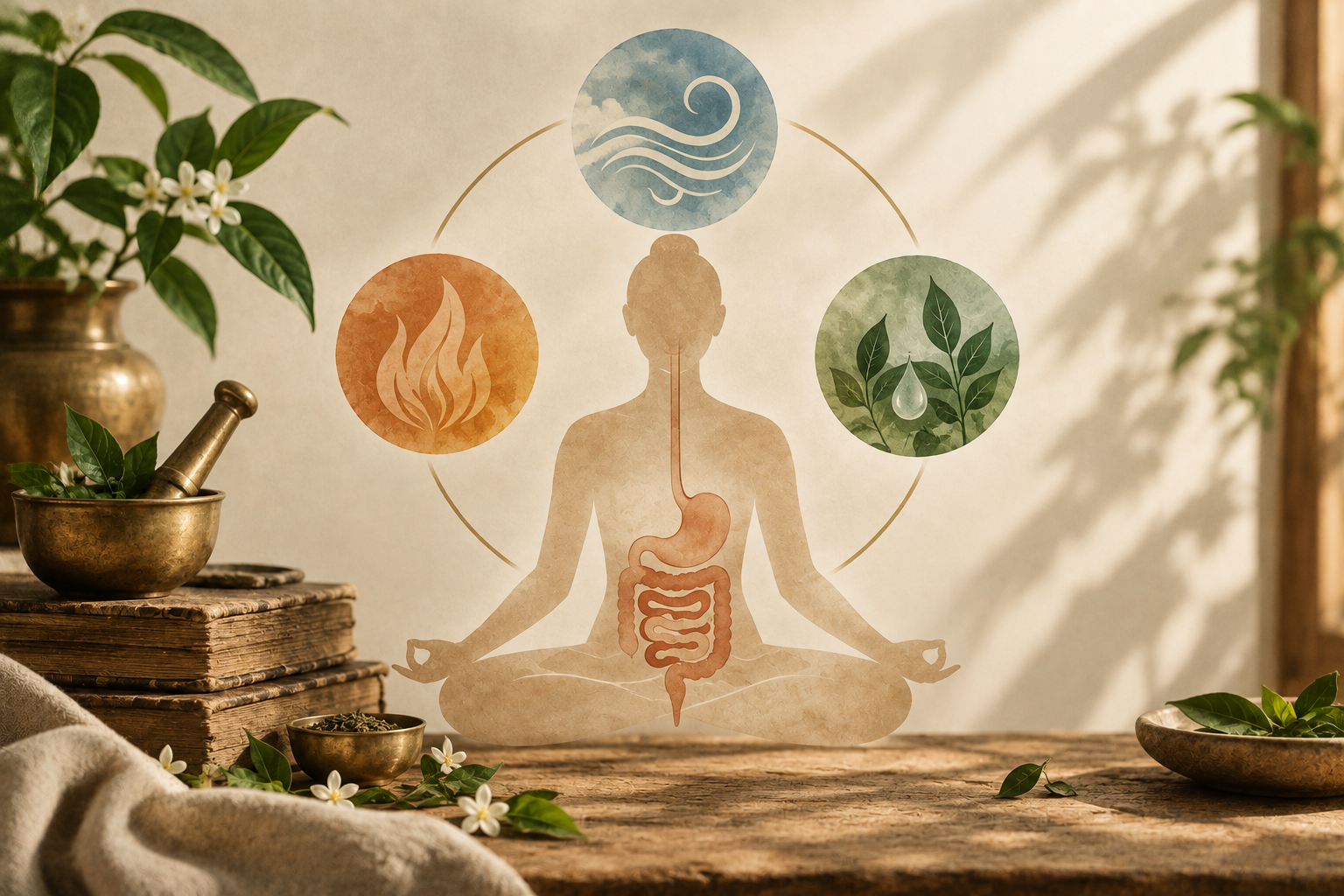
Most people, the moment they start reading about Ayurveda, land on this word, Dosha, almost immediately. Vata, Pitta, Kapha. And usually, the very first explanation they get is something like “Dosha means fault” or “Dosha means fluid,” and honestly, that explanation doesn’t help at all.   If anything, it makes the whole thing feel more confusing than before you started.   So let’s actually slow down and ask a more basic question first. What is the body even made of, according to Ayurveda?   Before we even get to Dosha, there are two other categories worth understanding, Dhatu and Mala, because once you see how these three relate to each other, Dosha suddenly makes a lot more sense.   Dhatu refers to everything in your body that’s meant to stay. Your blood, muscles, fat, bones, the fluid in your spinal cord, reproductive tissue, all of it.   These are structurally very different from each other, obviously, but they share one thing in common, none of them are meant to leave your body under normal circumstances.   When they do leave, by injury or bleeding or some other accident, your body doesn’t feel relieved. It feels depleted, anxious and weak. That’s the signature of a Dhatu, its presence sustains you, and its loss destabilizes you.   Mala is the exact opposite category. This is everything your body is meant to get rid of, stool, urine, sweat, and so on. And here’s the interesting part, getting rid of these isn’t a failure of the body, it’s actually a sign of it working properly.   Holding onto waste for too long doesn’t protect you, it burdens you. A Mala that overstays starts creating problems rather than preventing them.   So while Dhatu is defined by staying, Mala is defined by leaving, and both, in their own way, keep the body functioning.   Now here’s where it gets genuinely interesting, because Dosha doesn’t fit into either of these categories. It refuses to follow the rule.   Think about saliva for a second. It’s produced inside your body, moves through your salivary glands, briefly steps outside the boundary of your internal tissue system into your mouth, and then re-enters your body as you swallow it along with your food.   It doesn’t stay put like a Dhatu, and it doesn’t fully leave like a Mala either. It does something in between, and that “in between” behavior is exactly what defines a Dosha.   It moves out into contact with the world, and then brings something back in, and this back-and-forth movement is precisely what makes digestion, absorption, and basically your entire relationship with the outside environment possible.   This is such an important shift in how to think about Vata, Pitta, and Kapha. They’re not things that cause or lead up to a disease. They’re the functional bridges that let your body interact with everything you eat, breathe, and absorb from the world around you.   Vata handles movement, what you take in. Pitta governs transformation, converting of one thing into another. Kapha manages binding, lubrication, and the way things hold together and connect.   Without these three doing their job constantly, your Dhatus would never get built, and your Malas would never get properly separated out and removed.   And here’s something that genuinely surprised me the first time I really understood it, this dual-direction movement of the Doshas happens twice a day, in the gastrointestinal tract specifically.   If something you’re consuming regularly doesn’t actually suit your body, that excess starts getting expressed back out, sometimes as an unusually sour or pungent sensation, sometimes as a sweet, sticky feeling.   This isn’t randomness, it’s your body’s own feedback system, quietly telling you that whatever you keep feeding it in excess isn’t being absorbed the way you assume it is.   Most of us just don’t know how to read that signal.   This is also why identifying someone’s Prakriti, their natural constitutional dominance of one or two Doshas, matters so much in how Ayurveda actually treats a person. Two people can eat the exact same meal and metabolize it completely differently, purely because their underlying Dosha balance is different.   What nourishes one person can genuinely unsettle another. This is the entire logic behind why Ayurveda has never really believed in one-size-fits-all diet advice, it was never really about the food.   It was always about how well your Doshas are managing the exchange between what’s outside you and what needs to become a part of you.   So the next time someone tells you Dosha simply means “fault,” it’s worth remembering that it’s actually closer to the opposite. It’s not what goes wrong in the body. It’s the very mechanism that allows the body to keep working, keep exchanging, and keep staying alive in the first place.   If ideas like this interest you, our courses on Charaka Samhita and Ashtanga Hridayam go much deeper into how Dosha, Dhatu, and Mala work together as the foundation of the entire Ayurvedic system.  
Your Gut, Brain, Blood and Breath Aren’t as Separate as You Think

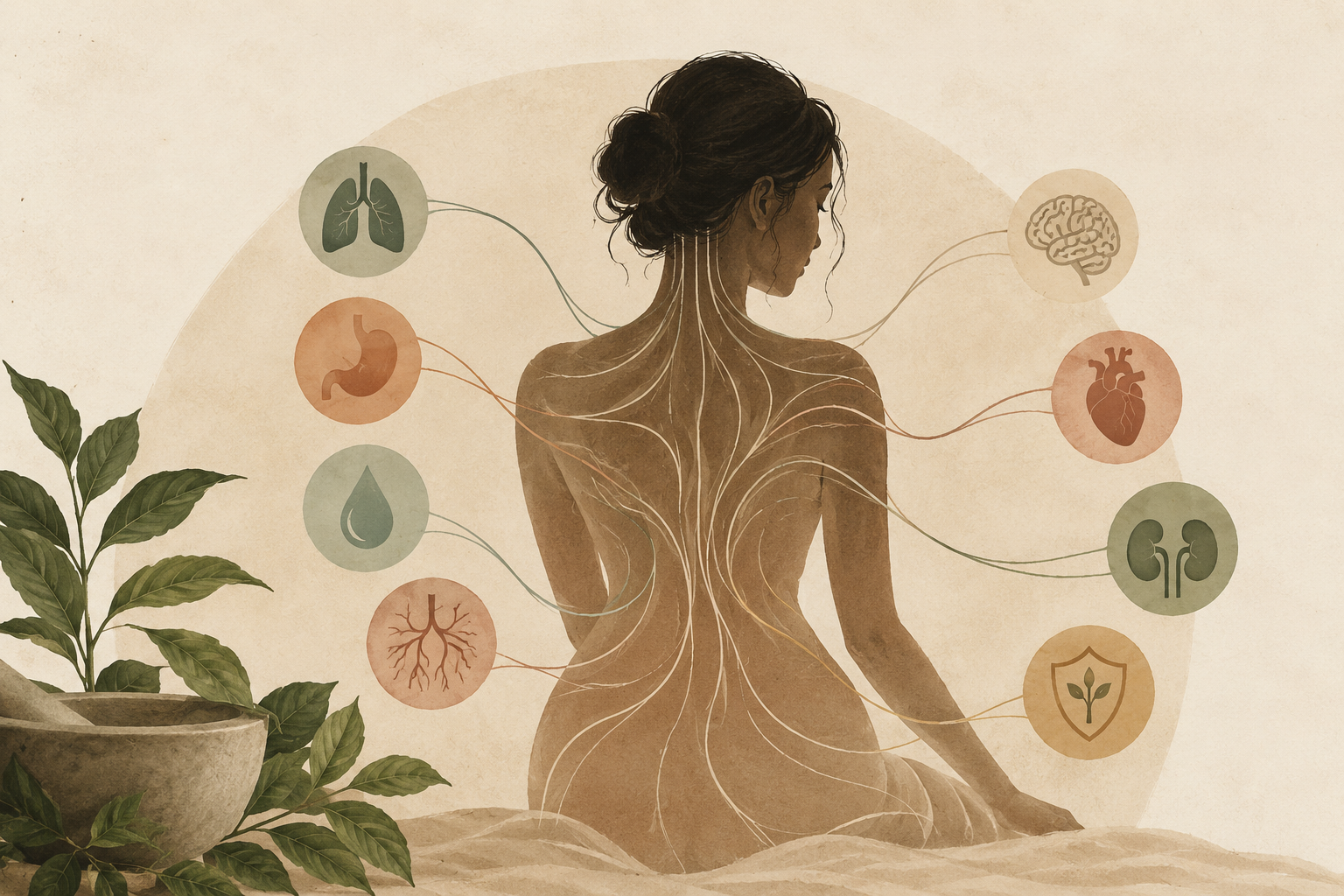
Think about everything your body has to move around all day.   Food, water, oxygen, nutrients, hormones, waste.   Nothing just sits there. Everything is constantly travelling somewhere, through something.   And when that movement gets disturbed, your body usually has a way of showing you. Bloating, sluggishness, poor digestion, congestion, changes in your skin, feeling unusually tired.   Ayurveda has a rather interesting way of explaining why this happens.   It’s called Srotas.   Srotas literally means channel, and the idea behind it is honestly pretty simple once you get it. Your body isn’t one solid block of tissue. It’s a network, an endless system of channels and pathways carrying stuff around, nutrients in and waste out.   And not just fluids, it also carries your thoughts, emotions and your immune responses.   Charaka mentioned that the human body is a pile of these channels, so many of them that you couldn’t hope to count them all. But he and Sushruta still tried to organise the important ones into thirteen main Srotas, each responsible for carrying something specific through the body.   Let me give you a sense of how detailed they are.   There’s Pranavaha Srotas, the channel for breath and oxygen, roughly matching what we’d now call the respiratory system. The Annavaha Srotas, carries food through digestion. Rasavaha and Raktavaha handle plasma and blood while Swedavaha Srotas for sweat, and Mutravaha for urine.   And then there’s the one I find most fascinating, Manovaha Srotas, the channel through which thoughts and emotions are believed to move.   Yes, your mind has its own channel too, right alongside your blood vessels and your gut.   Strotas aren’t just for moving things around, they also help us understand something we’ve all felt but never really questioned. Why does anxiety sit in your stomach? Why does a stressful week somehow show up as a breakout, or a headache, or a flare-up in your gut?   Ayurveda’s answer is that these channels aren’t separate systems running in isolation, they’re connected. A disturbance in one can easily spill into another.   Modern medicine, interestingly, is inching toward the same conclusion. There’s actual research now on the gut-brain axis, the idea that your digestive system and your nervous system are in constant conversation, influencing each other more than we ever gave them credit for.   Ayurveda was describing something remarkably similar centuries ago.   Here’s the part that really changes how you look at illness though.   Ayurveda believed most diseases begin the same way. Not with a sudden attack from nowhere, but with a Srotas getting disturbed. And it described this disturbance, called Srotodushti, in a few specific ways. A channel can get blocked, it can narrow. It can widen beyond what it should. It can even start carrying things in the wrong direction entirely.   I think this reframes a lot of things we brush off too quickly. That afternoon brain fog you get after a heavy meal? Ayurveda would say your Annavaha Srotas, the digestive channel, is overloaded, and that congestion is now affecting clarity elsewhere. Random skin flare-ups with no obvious trigger? Possibly a disturbance that finally found somewhere to surface.   None of this means Ayurveda had X-ray vision into the body, it didn’t have MRIs or blood panels. What it had was centuries of careful observation, watching how symptoms moved, repeated and connected across generations of patients. And through that, it built an entire model of the body based on flow, not fixed parts.   This is actually a pretty different way of thinking about health compared to how most of us were taught. We tend to think in terms of organs like the stomach handles digestion, the lungs handle breathing and the brain handles thinking, full stop. Ayurveda asked a slightly bigger question. Not just what does each part do, but how does everything stay connected, and what happens when that connection breaks down.   Keeping these channels clear was never treated as an afterthought in Ayurveda either. It’s actually one of the reasons practices like proper digestion, regular elimination, oil massage and even breathing exercises show up so often in Ayurvedic practices.  They were seen as basic maintenance for keeping the body’s channels open and functioning the way they’re meant to.   But once you actually understand Srotas, a lot of Ayurveda’s other ideas start clicking into place too. Why Dinacharya matters, why Ama, the toxin buildup we mentioned earlier, is taken so seriously, why treating one symptom in isolation was never really Ayurveda’s style to begin with.   Long before modern medicine started mapping out the gut-brain axis or the lymphatic system in real detail, Ayurveda had already sketched out its own map, one built entirely on the idea that nothing in the body works alone.   If ideas like this interest you, our guided courses on Charaka Samhita and Ashtanga Hridayam explore concepts like Srotas straight from the original texts.