
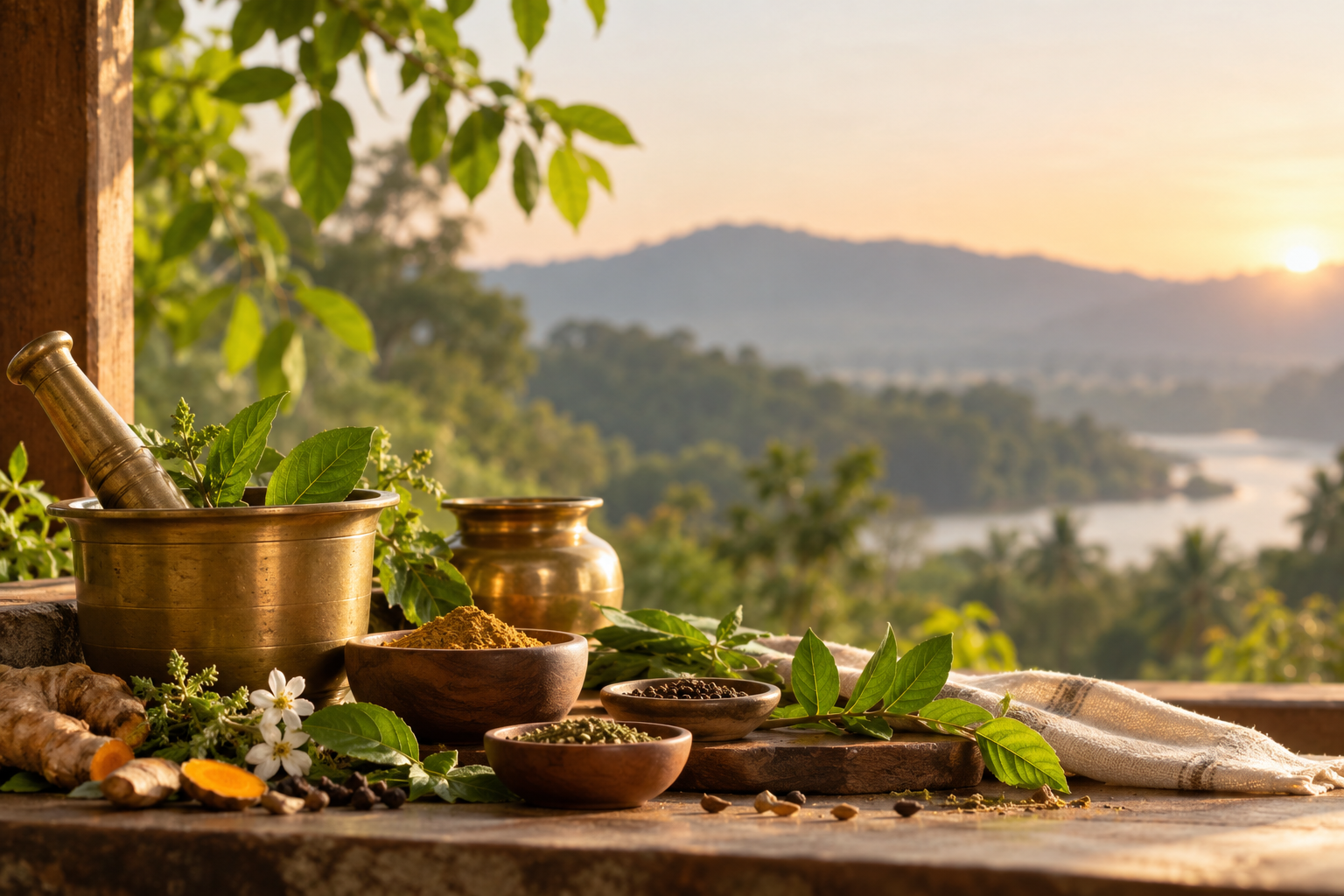
Ayurveda Is An Alternative Medicine. Alternative To WHAT!?

Ayurveda is often called “alternative medicine”.   But alternative to what?   The word “alternative” suggests that Ayurveda came later, as another option after modern medicine. That is simply not true.   Ayurveda is one of the oldest systems of medicine in the world. It has been helping people understand health, disease, and the human body for thousands of years. It did not begin as an alternative. It existed long before modern medicine as we know it today.   What Ayurveda Actually Does   Ayu means life, and Veda means knowledge. Together, Ayurveda is commonly understood as “the science of life.”   Ayurveda is not just about treating disease.   At its core, Ayurveda looks at both the outer world and our inner world. It teaches us that good health comes from understanding ourselves and living in harmony with nature. It is about understanding how the body functions, what keeps it healthy, and what causes it to lose balance.   Instead of looking at one symptom on its own, Ayurveda looks at the whole person.   It asks simple questions.   Why did this problem develop?   What changed in the person’s lifestyle?   How can balance be restored naturally?   The goal is not only to help someone feel better today but also to support long-term health.   This is one of the biggest differences in the way Ayurveda approaches healthcare.   Rather than waiting for illness to develop, Ayurveda encourages us to recognize subtle changes in the body before they progress into larger problems. It teaches that health is something we care for every day, not something we think about only when we are sick.   That is why Ayurveda places so much importance on daily habits, food, sleep, movement, mental wellbeing, and living according to the seasons. These are not isolated aspects of health. They all influence one another.   When one area is out of balance, it often affects the others as well.   The Importance of Daily Living   One of the most beautiful ideas in Ayurveda is that health is created through our everyday choices.   The way we wake up.   The food we eat.   The time we sleep.   How we manage stress.   How we move our bodies.   These may seem like ordinary parts of life, but Ayurveda considers them the foundation of good health.   This is why Ayurveda places great importance on Dinacharya, or a healthy daily routine, and Ritucharya, living according to the changing seasons.   These are not complicated rules.   They are practical ways of helping the body function in harmony with nature.   Is Ayurveda Against Modern Medicine?   Not at all.   Modern medicine has transformed healthcare. It is essential for emergencies, surgeries, infections, and life-threatening conditions. It has saved countless lives, and it continues to save lives every single day.   Nobody serious about health denies this.   But Ayurveda was never trying to do that job. It was never built for emergency intervention. It was built to place particular emphasis on understanding why health declines in the first place, often before disease becomes advanced or requires emergency care.   Ayurveda was never intended to compete with modern medicine, nor was it meant to serve merely as a backup option.   It is one of the oldest and most complete systems for understanding the human body, built on the simple idea that health is something we build every single day, not something we only think about once it is already gone.   Perhaps it is time to stop asking whether Ayurveda is an alternative.   Instead, ask a different question.   What is Ayurveda trying to achieve?   Its purpose has always been clear.   To help us understand the body.   To maintain balance.   To support health through daily living.   To recognize imbalance early.   And to help people live healthier, more fulfilling lives.   The goals have remained the same for thousands of years.   The world around us has changed dramatically. The way we live, work, eat, and interact with our environment is very different from how our ancestors lived.   Medical science has advanced in extraordinary ways, and our understanding of disease continues to evolve. Yet the basic needs of the human body have remained remarkably consistent.   We still need nourishing food, regular sleep, movement, emotional balance, and a lifestyle that supports our physical and mental wellbeing. These are not modern discoveries.   This is why Ayurveda is often described as a way of life rather than simply a system of medicine. Its teachings extend beyond treating illness.   Ayurveda is far more than the labels often attached to it today.   If you want to understand Ayurveda as it was originally taught, explore our courses and learn directly from the timeless wisdom of the Charaka Samhita and Ashtanga Hridayam.

Ayurveda Does Not Need Modernization. It Needs to Be Understood.

Biology concept with retro science cartoon icons set vector illustration

People often ask me if Ayurveda is finally catching up with modern science. I understand why they ask this. But the question itself is backwards.   Ayurveda was never behind. It has always offered its own framework for understanding health. What has changed is the way we explain those principles today.   What we are seeing now, across nutrition science, sleep research, and gut health, is not Ayurveda catching up to modern medicine. It is modern research increasingly exploring ideas that Ayurveda has emphasized for centuries.   Ayurveda has spent generations being misunderstood, explained badly, or not explained at all, which left people assuming it was outdated. And that is really the whole problem.   Before going into the specifics, we need to understand why this has happened. Modern medicine, especially over the last century, has often focused on identifying specific biological mechanisms and treating individual disease processes.   This approach has led to remarkable advances. But it can sometimes overlook the broader interactions between systems that shape overall health.   When research focuses on one mechanism at a time, it can sometimes miss the larger patterns connecting multiple systems.   Ayurveda approached the body from the opposite direction.   Instead of isolating single mechanisms, it observed the whole person, their digestion, their sleep, their energy, their mood, and looked for patterns across all of it. This is why Ayurveda often sounds broad or general when compared to the extensive tests and diagnosis of modern medicine.   It was never trying to explain one molecule. It was trying to explain a whole living person.   Let’s start with food, for example, because this is where the pattern is easiest to see.   Personalized Nutrition Is Not a New Idea   Right now, precision nutrition is one of the fastest growing fields in medical research. Scientists have found that two people can eat the exact same meal and have completely different reactions to it.   This has led to a shift away from generic diet advice and toward plans built around a person’s genetics, metabolism, and gut bacteria.   One of the most important principles of Ayurveda is built on this very idea, and it is called Prakriti.   Prakriti describes a person’s unique constitution, the combination of physical and mental characteristics that influences how they respond to food, environment, and disease. And this is not just a philosophical idea.   Researchers have also explored possible biological correlates of Prakriti including genes associated with metabolism and immune function.   Much of this research is still developing. But it does show that the idea behind Prakriti reflects something real in human biology.   Circadian Rhythm and the Ayurvedic Daily Routine   Another area getting a lot of attention in medicine today is circadian rhythm, the internal body clock that controls sleep, digestion, hormone release, and energy levels throughout the day. Researchers have found that eating late at night, sleeping at irregular hours, or ignoring the body’s natural rhythm can affect metabolism and long term health.   Though this field of study is fairly young in modern medicine, Ayurveda addressed this through Dinacharya, a daily routine built around the sun, the seasons, and the body’s natural rhythm.   I think this is one of the easiest ideas for people to test in their own lives.   Most people already know, from personal experience, that eating dinner very late at night leaves them feeling heavier and sleeping worse than eating dinner a few hours earlier.   You can also notice how waking up at a different time every day affects your energy levels. You feel more tired than waking up at a consistent time, even if the total hours of sleep are the same.   Ayurveda took these everyday observations seriously enough to build them into a structured daily practice, long before modern science had language like circadian rhythm or clock genes to describe what was happening.   The value here is not that Ayurveda predicted modern chronobiology in exact scientific terms. It did not. But it recognized that timing matters just as much as what you eat or how you move.   Gut Health and the Concept of Agni   Gut health has become one of the most talked about topics in wellness and medicine today. Scientists are studying how the trillions of bacteria living in our digestive system affect everything from immunity to mood.   There is a lot we do not yet understand about how food interacts with the body at this level.   Ayurveda approached digestion differently, through the concept of Agni, often translated as digestive fire. Agni refers to the body’s ability to break down food, absorb nutrients, and convert them into energy. When Agni is weak, Ayurveda considers it a root cause of many health problems, not just digestive ones. This idea predates any understanding of gut bacteria or the microbiome. It came from observing how people responded to food, and how digestion connected to their overall health.   Where the Real Gap Actually Is   None of this means Ayurveda has all the answers or that it should replace modern medicine. It has its own limits. But it needs better understanding.   Ayurveda has always encouraged us to observe ourselves. It asks us to pay attention to how we eat, how we sleep, how we respond to the seasons, and how our daily choices shape our health over time. These are not complicated ideas. They are practical ones.   Ayurveda does not need to become modern. It needs to be understood.

Beyond Remedies: Ayurveda & the Body’s Intelligence

Most of us treat health like a problem‑solution game. Dry skin? Apply something moisturizing. Low energy? Drink something strong. Upset digestion? Take a quick‑fix remedy.   But Ayurveda asks us to pause and ask a deeper question: What is the body trying to tell us through these experiences?   As you continue listening to more insights from Ayurveda, you’ll noticed something beautiful.   The body is constantly adapting, and our role is to support that intelligence instead of overriding it.   Let us explore how this works in everyday life.   Not Everything Natural Is the Same   In today’s wellness world, “natural” is almost a magic word. But Ayurveda digs a little deeper and asks: How natural? And more importantly, how suitable is it for you?   Take camphor, for example. At first glance, it might seem like any camphor will do. But Ayurveda differentiates between:   Natural camphor (Bhimseni camphor) Synthetic camphor   They look similar, but their qualities are different.   Natural camphor has an irregular, crystalline shape and dissolves slowly. Synthetic camphor is uniform, very rigid, and burns with a harsher, sharper flame.   Why does this matter? Because subtle qualities affect how a substance interacts with the body. A harsh, synthetic version can irritate rather than soothe.   Ayurveda teaches us not to trust only the label, but to observe the qualities—how something feels, smells, and behaves. That attention to detail can make a big difference in how your body responds.   The Forgotten Art of Preparation   Another often overlooked part of health is how we prepare what we eat and use.   Take dry ginger powder, for example.   Making it at home usually means fresher, purer ingredients. Store‑bought is okay too, but only if you are sure it is unadulterated and of good quality.   Even the way you consume it matters. A small amount of dry ginger boiled briefly and then reduced in water can become a gentle digestive tonic. But this is not one‑size‑fits‑all advice.   If someone already has a lot of internal heat (Pitta), even something considered helpful like dry ginger can increase burning, acidity, or discomfort. In that case, it needs to be used cautiously or avoided until the heat is under control.   This shows a simple yet powerful idea: The same ingredient can heal or harm depending on the internal environment of the person.   The Body Is Not One System—It’s Many Working Together   Ayurveda does not see the body only as organs and bones. It describes the body as several functional energies working together in harmony.   One of the most beautiful frameworks is the five types of Vayu, or subtypes of Vata:   Prana Vayu – governs breathing, perception, and mental clarity Udana Vayu – supports speech, expression, and confidence Samana Vayu – manages digestion and assimilation Vyana Vayu – handles circulation and movement Apana Vayu – oversees elimination and reproductive functions   When you look at the body this way, symptoms start to make more sense.   For example, someone who struggles to speak clearly or feels hesitant to express themselves may not be dealing only with an emotional issue. It can also involve Udana Vayu being disturbed.   Similarly, poor circulation and stiffness are not just physical problems. They may indicate that Vyana Vayu needs support.   This interconnected view reminds us: Nothing in the body truly operates in isolation.   When Substitutes Are Not Real Substitutes   Modern thinking often asks, “Can I use this instead of that?” But Ayurveda is cautious about substitutes because it focuses on energy, not just appearance.   Take sesame oil, for example. It is widely considered ideal for daily use in many Ayurvedic practices. If you cannot find or use it, alternatives exist, but they are not equal.   White sesame oil can be acceptable, though it may be slightly less potent. Coconut oil can work, but it suits some people better in heat‑dominated conditions. Other oils may be suitable only after individual assessment.   And some substitutes, like certain refined seed oils, are simply not appropriate at all, even though they look similar.   Why such precision? Because Ayurveda does not just replace one ingredient with another. It works with qualities like heat, heaviness, lightness, and penetration, and matches them to the person’s condition.   Similarity in appearance does not mean similarity in effect.   Skin, Sensitivity, and the Limits of Moisturizing   We often treat dry skin as a surface problem. We apply more oil, carry more creams, and buy richer lotions.   But Ayurveda sees dry skin as a reflection of deeper imbalance, especially of Vata. When common oils are not tolerated, something like Shatadhauta Ghritam can be helpful.   Shatadhauta Ghritam is ghee that is transformed through repeated washing with water. It becomes cooling, light, and deeply soothing, and can be used as an external application.   Interestingly, even people sensitive to dairy may tolerate it on the skin, because:   It is processed differently It is used externally, not ingested   Still, Ayurveda adds important nuances:   It is not suitable for infected or oily skin. Sensitive individuals should always patch test first.   This level of personalization shows an essential truth: Healing is not about finding the single best product. It is about finding the right match for your body and condition.   Simple Practices, Done Mindfully   Some of the most powerful Ayurvedic practices are also the simplest.   Take foot soaks, for example.   Warm water alone can relax muscles and improve circulation. Adding a little salt can enhance the effect. Herbal decoctions can be used when extra support is needed.   No complicated steps. No fancy equipment. Just a simple, grounded practice done with awareness.   Even something as basic as water temperature matters.   Lukewarm water is usually preferred. It gently stimulates the body without shocking it, which supports smoother digestion and circulation.   These small details may seem minor, but they… Continue reading Beyond Remedies: Ayurveda & the Body’s Intelligence

Understanding Seasonal Living Through Ayurveda

If we observe nature closely, it becomes clear that our body is not separate from the environment. Ayurveda explains that the movement of the sun, the change of seasons, and the shifting climate all influence our strength, digestion, and overall health.   By understanding this relationship, we can gently adjust our food, lifestyle, and daily habits so that we stay balanced throughout the year.   One important way Ayurveda explains this connection is through the movement of the sun across the year. The year is broadly divided into two halves called Uttarayana and Dakshinayana, and each of these phases affects both nature and the human body in a very specific way.   The Role of the Sun: Adana and Visarga   During Uttarayana, the sun appears to move northward and its intensity gradually increases. In Ayurveda, this phase is called Adana Kala, which means to take away or absorb.   In this period, the growing strength of the sun and wind slowly draws moisture, nourishment, and strength from the earth and living beings. The environment becomes more dry and sharp, and our physical strength tends to go down.   Dakshinayana is the opposite half of the year, when the sun appears to move southward. This phase is known as Visarga Kala, which means to release or nourish.   Here, the influence of the moon becomes more prominent, bringing coolness, moisture, and stability to the surroundings. The earth and all living beings receive nourishment, and strength gradually returns.   These are not just astronomical descriptions. They describe how solar movement changes qualities like heat, dryness, and moisture, and how these qualities affect our strength, nourishment, and the balance of the doshas in the body.   This is why Ayurvedic seasonal routines change so much from one part of the year to another.   Why Our Strength Changes with the Seasons   Summer falls within the Adana phase and is marked by intense heat. During this time, the sun and air become extremely hot, sharp, and dry. Because the sun is effectively taking away strength, human vitality reaches one of its lowest points in this period.   To support the body, Ayurveda recommends foods that are cooling, hydrating, and light during summer. At the same time, it advises avoiding foods that increase internal heat, especially salty, sour, and pungent tastes.   These tastes are naturally heating, and if we consume them in large amounts during very hot weather, they can increase internal heat, dehydrate the body further, and worsen fatigue.   Instead, summer foods are better when they are light, cooling, and somewhat liquid in nature. They help maintain hydration, soothe heat, and protect strength.   A good example is a traditional drink called Rasala, which is curd churned with sugar and a small amount of pepper. At first, pepper may seem like an odd choice for hot weather, but in this preparation it helps support weak digestive fire, while the sugar and churning make the drink light and cooling overall. The result is a gentle, nourishing drink that fits the needs of the season.   How Seasons Influence the Doshas   Each season affects the doshas in a different way, which is why the focus of seasonal routines keeps changing.   In spring, Kapha is the main dosha to watch. During the cold months, Kapha accumulates in the body. When the sun begins to warm the earth in spring, this stored Kapha starts to melt.   This can weaken digestion and lead to congestion or other Kapha-related issues if not managed well. So, seasonal guidance for spring focuses on reducing Kapha with light food, regular exercise, and cleansing practices.   In summer, the extreme heat reduces Kapha but begins to increase Vata. Dryness, overheating, and exhaustion slowly aggravate Vata. By the time the rainy season arrives, Vata reaches its peak. The cool winds, clouds, dampness, and unstable weather further disturb Vata and make the body more vulnerable to illness.   These patterns show why Ayurveda gives so much importance to seasonal routines. The idea is not to wait until disease appears but to anticipate these natural shifts and support the body before imbalance sets in.   Winter: A Season of Strong Digestive Fire   Winter holds a special place in Ayurvedic understanding of the body. Even though the environment is very cold, the internal digestive fire, known as Agni, actually becomes stronger.   The reason is that the cold outside blocks the sweat channels of the body and prevents heat from escaping. This trapped heat builds up inside and increases digestive power so the body can stay warm and stable.   However, this strong digestive fire also has a risk. If it does not receive enough proper nourishment, it may begin to use the body’s own tissues as fuel, which can lead to depletion and Vata-type problems.   To prevent this, winter diets emphasize nourishing foods rich in sweet, sour, and salty tastes. These tastes are heavier and more strengthening, and they provide the fuel needed to support the powerful digestive fire and protect body tissues from being used up. This is why many traditional winter foods are richer, heavier, and more satisfying than foods we typically eat in other seasons.   The Six Tastes and Their Effects   Ayurveda describes six main tastes, or rasas, and each one has a specific effect on the body. Sweet, bitter, and astringent tastes generally have a cooling potency, while sour, salty, and pungent tastes tend to be heating.   These tastes also influence strength. Sweet, sour, and salty tastes usually increase strength, nourishment, and stability when used in the right way. Pungent, bitter, and astringent tastes can reduce strength if overused, as they are more drying and clearing in nature.   Ayurveda does not ask us to completely avoid any taste. Instead, it encourages moderation and context. Even a food that can aggravate a particular dosha may be perfectly safe or even beneficial when taken in the right amount, at the right… Continue reading Understanding Seasonal Living Through Ayurveda