
Atman in Ayurveda: Understanding the Self, Mind, and Consciousness

Today, let’s talk about a concept in Ayurveda that is present in everything the system talks about, but not everyone gets into it or knows about it because the whole concept itself is too abstract on the surface.   I am talking about Atman, which translates to the self, the soul, or simply the knower.   Now, before jumping into what Atman really means, let’s start with something which we are more familiar with in terms of Ayurveda, which is the Manas, the mind.   So, mind is essentially the part of you that reacts. It takes in the stimulus and turns it into a response. It distinguishes between likes and dislikes. For example, if something you eat tastes good, you want to eat more of it, and if you experience pain, you pull away. You don’t want to experience it again.   This is what the Manas does.   However, Atman is something else entirely. It is a part of you that is aware that all of this is happening. It’s not the reaction itself, but it’s the one noticing the reaction.   While Manas distinguishes experiences into pain and pleasure, Atman is simply aware of the inside and outside, it is the very awareness of this experience.   Here’s a simple way of how I think about it.   When you’re feeling unwell, usually the food that you eat every time, or the food that you like, you don’t want to have it and it might even taste unpleasant to you.   But nothing about the food has changed. What changed is how it is being received by your body.   This shift, the change between you and your mind, is the job of Atman. It is adjusting your experiences based on what is happening inside you.   Now, Atman cannot itself be described the way we describe everything else in the body, because it has no color, no shape, no texture. Its presence is not known entirely or directly.   But even if you don’t see Atman, you infer it. How differently a person can respond to the same thing, and how something within them prompts them to respond in that particular way.   The whole Atman can also be understood through this perspective, from the whole idea of possession, how it naturally comes to us when we talk about our things.   When we say, “I am tired,” there is still this strange distinction between the one who is experiencing tiredness and the tiredness itself.   This distance implied between someone who possesses and something that is being possessed, is where the idea of Atman comes from.   All the parts of your body are what is possessed by you, the person. So, despite any changes or aging or anything, the one that is staying constant is me, my. The idea of the owner is what is Atma.   And this whole distinction isn’t just philosophical. There’s a real practical framework of diagnosis around it too.   In Ayurveda, illness comes in three severities. One is ordinary, one serious, and one that is heading to a very fatal outcome.   And the way you tell these apart isn’t just purely because of external signs, but how clearly the person can experience their own feeling.   How clearly can they experience things like their preference, discomfort, desire, how they feel, and if all of this is intact in a coherent way.   Because once illness starts to get serious, all of this starts to blur. The person struggles to clearly experience. Memory becomes hazy, and the coordination too falters.   And in most serious cases, the patients may not be able to experience anything at all. They might feel numb. They can’t tell you how they feel because the whole response, the whole connection between your Atma, Manas, and the senses has weakened and there’s only basic signs of life that’s left.   This is such a different way of thinking about diagnosis compared to how we actually imagine ancient medicine, which is reduced to something that is purely external, physical observation.   In Ayurveda, the presence of your mind and the clarity of your awareness itself is one of the most important ways to diagnose what is wrong inside you, and it is sometimes arguably more important than any physical sign.   Now, the takeaway from all of this is very simple, despite how abstract Atman sounds.   And before even Ayurveda gets into the details of the body, bones, tissues, or organs, it is first establishing that awareness that is present inside every one of us, and everything else is built on top of that basic confirmation.   Health is never only about visible, measurable parts of the body. It is always, at its core, something that is changing inside you.   And I think this is where Atman becomes much less abstract than it initially sounds.   Because when we hear words like soul or self, it can immediately feel like we’re entering a completely philosophical conversation, something very distant from the body and from medicine. But Ayurveda doesn’t really separate these things in the way that we might expect. The person who is experiencing the illness is not just the body that is carrying the illness.   There is the body, there are the senses, there is the mind, and there is this awareness that experiences all of it.   If ideas like this interest you, you can check out our courses on Charaka Samhita and Ashtanga Hridayam which talk in depth about how Ayurveda understands the self, the mind, and the body as one connected system and much more.

Why Your Body Isn’t Just “Tissues and Waste”

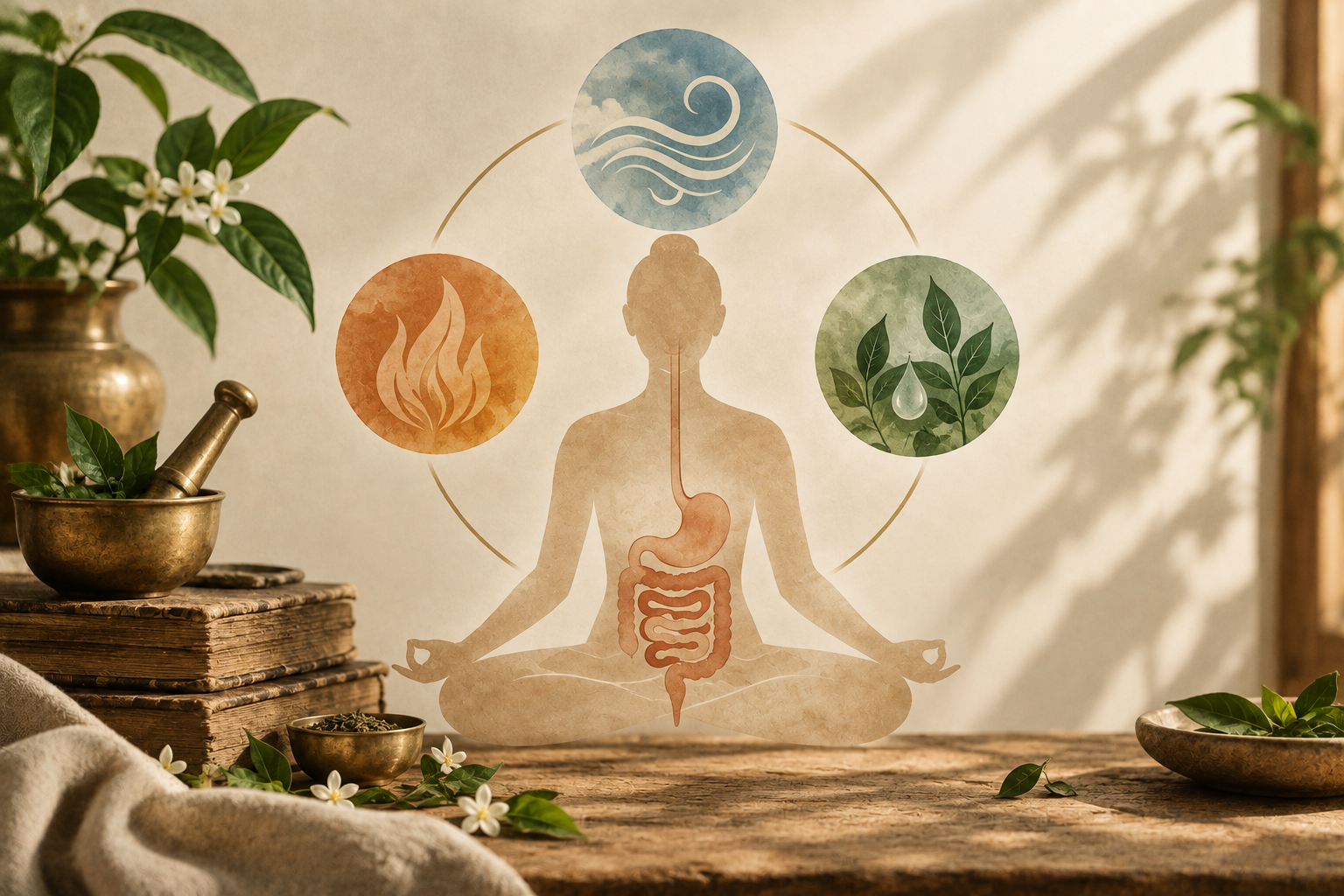
Most people, the moment they start reading about Ayurveda, land on this word, Dosha, almost immediately. Vata, Pitta, Kapha. And usually, the very first explanation they get is something like “Dosha means fault” or “Dosha means fluid,” and honestly, that explanation doesn’t help at all.   If anything, it makes the whole thing feel more confusing than before you started.   So let’s actually slow down and ask a more basic question first. What is the body even made of, according to Ayurveda?   Before we even get to Dosha, there are two other categories worth understanding, Dhatu and Mala, because once you see how these three relate to each other, Dosha suddenly makes a lot more sense.   Dhatu refers to everything in your body that’s meant to stay. Your blood, muscles, fat, bones, the fluid in your spinal cord, reproductive tissue, all of it.   These are structurally very different from each other, obviously, but they share one thing in common, none of them are meant to leave your body under normal circumstances.   When they do leave, by injury or bleeding or some other accident, your body doesn’t feel relieved. It feels depleted, anxious and weak. That’s the signature of a Dhatu, its presence sustains you, and its loss destabilizes you.   Mala is the exact opposite category. This is everything your body is meant to get rid of, stool, urine, sweat, and so on. And here’s the interesting part, getting rid of these isn’t a failure of the body, it’s actually a sign of it working properly.   Holding onto waste for too long doesn’t protect you, it burdens you. A Mala that overstays starts creating problems rather than preventing them.   So while Dhatu is defined by staying, Mala is defined by leaving, and both, in their own way, keep the body functioning.   Now here’s where it gets genuinely interesting, because Dosha doesn’t fit into either of these categories. It refuses to follow the rule.   Think about saliva for a second. It’s produced inside your body, moves through your salivary glands, briefly steps outside the boundary of your internal tissue system into your mouth, and then re-enters your body as you swallow it along with your food.   It doesn’t stay put like a Dhatu, and it doesn’t fully leave like a Mala either. It does something in between, and that “in between” behavior is exactly what defines a Dosha.   It moves out into contact with the world, and then brings something back in, and this back-and-forth movement is precisely what makes digestion, absorption, and basically your entire relationship with the outside environment possible.   This is such an important shift in how to think about Vata, Pitta, and Kapha. They’re not things that cause or lead up to a disease. They’re the functional bridges that let your body interact with everything you eat, breathe, and absorb from the world around you.   Vata handles movement, what you take in. Pitta governs transformation, converting of one thing into another. Kapha manages binding, lubrication, and the way things hold together and connect.   Without these three doing their job constantly, your Dhatus would never get built, and your Malas would never get properly separated out and removed.   And here’s something that genuinely surprised me the first time I really understood it, this dual-direction movement of the Doshas happens twice a day, in the gastrointestinal tract specifically.   If something you’re consuming regularly doesn’t actually suit your body, that excess starts getting expressed back out, sometimes as an unusually sour or pungent sensation, sometimes as a sweet, sticky feeling.   This isn’t randomness, it’s your body’s own feedback system, quietly telling you that whatever you keep feeding it in excess isn’t being absorbed the way you assume it is.   Most of us just don’t know how to read that signal.   This is also why identifying someone’s Prakriti, their natural constitutional dominance of one or two Doshas, matters so much in how Ayurveda actually treats a person. Two people can eat the exact same meal and metabolize it completely differently, purely because their underlying Dosha balance is different.   What nourishes one person can genuinely unsettle another. This is the entire logic behind why Ayurveda has never really believed in one-size-fits-all diet advice, it was never really about the food.   It was always about how well your Doshas are managing the exchange between what’s outside you and what needs to become a part of you.   So the next time someone tells you Dosha simply means “fault,” it’s worth remembering that it’s actually closer to the opposite. It’s not what goes wrong in the body. It’s the very mechanism that allows the body to keep working, keep exchanging, and keep staying alive in the first place.   If ideas like this interest you, our courses on Charaka Samhita and Ashtanga Hridayam go much deeper into how Dosha, Dhatu, and Mala work together as the foundation of the entire Ayurvedic system.  

Satva, Rajas and Tamas: The Three Forces Behind How We Think and Act

When we look at something that already exists, we tend to focus on what we can see. To us, in our mind, a book is a book, a building is a building and a person is a person.   But let us go a little deeper, what made that thing come into existence in the first place? What happened before we could see the finished form? What allowed an idea to become reality?   According to the Ayurvedic understanding of nature, three fundamental qualities are involved in this process: Satva, Rajas and Tamas.   These are not substances in the ordinary physical sense. They are the principles that influence how things are conceived, developed, organised and eventually brought into a definite form.   They also influence how we think, respond to situations and behave.   From an idea to something real   Think about something as simple as a printed page.   Before the page existed, someone first had an idea. They imagined that information could be communicated through a page.   Then came the practical process where the paper had to be selected, its size had to be decided, the text had to be organized and the printing process had to be worked out.   Only then could the page actually be produced.   This can be understood through the three qualities.   Satva is associated with clarity, awareness and the emergence of an idea.   Rajas is associated with activity, movement and the effort required to bring that idea into action.   Tamas provides stability, limitation and resistance to further alternatives. It allows something to settle into a definite form.   All three have a role.   An idea without action remains an idea while an action without direction becomes scattered and without some form of limitation or stability, nothing is ever finalised.   This principle can be observed everywhere, from something as simple as making a page to something as complex as the development of a living being.   Satva, Rajas and Tamas in the mind   Ayurveda extends this idea beyond the physical world and applies it to Manas, or the mind.   Every person has Satva, Rajas and Tamas in relative dominance.   This explains us why two people can experience exactly the same situation but respond to it completely differently.   This is where understanding the predominance of Satva, Rajas and Tamas becomes important.   The Satva-dominant mind   A person in whom Satva is more prominent tends to be curious, observant and interested in understanding things.   They want to know why something happened.   If they fall ill, they may want to understand the cause, the relationship between their habits and their symptoms, and what they can do to improve their situation.   They may also be better able to remain composed during difficult circumstances. Instead of immediately reacting, they tend to step back, understand what is happening and work towards a solution.   This does not mean that a Satva-dominant person does not experience pain, fear or distress. Rather, their ability to understand and process the situation can influence how they respond to it.   The Rajas-dominant mind   Rajas is associated with movement, activity and constant engagement.   A Rajas-dominant person may be more expressive about both pleasure and discomfort. They may actively seek experiences, stimulation and reassurance.   If something happens to them, they may not necessarily be interested in understanding the deeper cause immediately. What they often need first is clear guidance and reassurance.   Once they feel confident about the course of action, they may be able to move forward.   Their mind is active and constantly responding to what is happening around them.   The Tamas-dominant mind   Tamas is associated with resistance, confusion and difficulty in moving forward.   A Tamas-dominant person may struggle to understand or accept what is happening around them. When they are facing a difficult situation, fear and apprehension may become stronger.   They may repeatedly question advice, seek opinions from several people and still find it difficult to make a decision.   Even with the outcome seeming clear, they may find it difficult to take a first step.   This is also why the same advice might not help every person, as they might not react to it in a similar way.   Why this matters in Ayurveda   For Ayurveda, treating a person is not limited to identifying physical symptoms.   The way a person perceives, expresses and responds to those symptoms also matters.   Let us take an example, someone may experience severe pain but barely express it while there is another person who may express relatively mild pain very dramatically. Someone else may not even understand that their symptoms require attention.   Now, the individual’s mental state might affect the way they communicate or show signs to understand about their condition.   If a practitioner judges the severity of a condition only by outward expression, there is a possibility of misunderstanding the situation.   Ayurveda’s understanding of Satva, Rajas and Tamas also highlights something that is often overlooked in modern conversations about health.   Two people can have similar physical circumstances but very different experiences of illness. Our perception, emotional response, understanding and behaviour can influence how we deal with what is happening to us.   This does not mean that mental qualities magically determine whether someone will recover. Nor does it mean that a person’s illness is simply a result of their mindset.   Rather, the Ayurvedic framework recognises that the mind is part of the individual’s overall experience and therefore deserves attention during care.   Three qualities, one constantly changing mind   Satva, Rajas and Tamas should not be understood as three permanent personality categories.   They are present in everyone, in different proportions, and can change depending on circumstances.   A person may be calm and thoughtful in one situation, highly restless in another and completely withdrawn in a third.   The important… Continue reading Satva, Rajas and Tamas: The Three Forces Behind How We Think and Act

Your Gut, Brain, Blood and Breath Aren’t as Separate as You Think

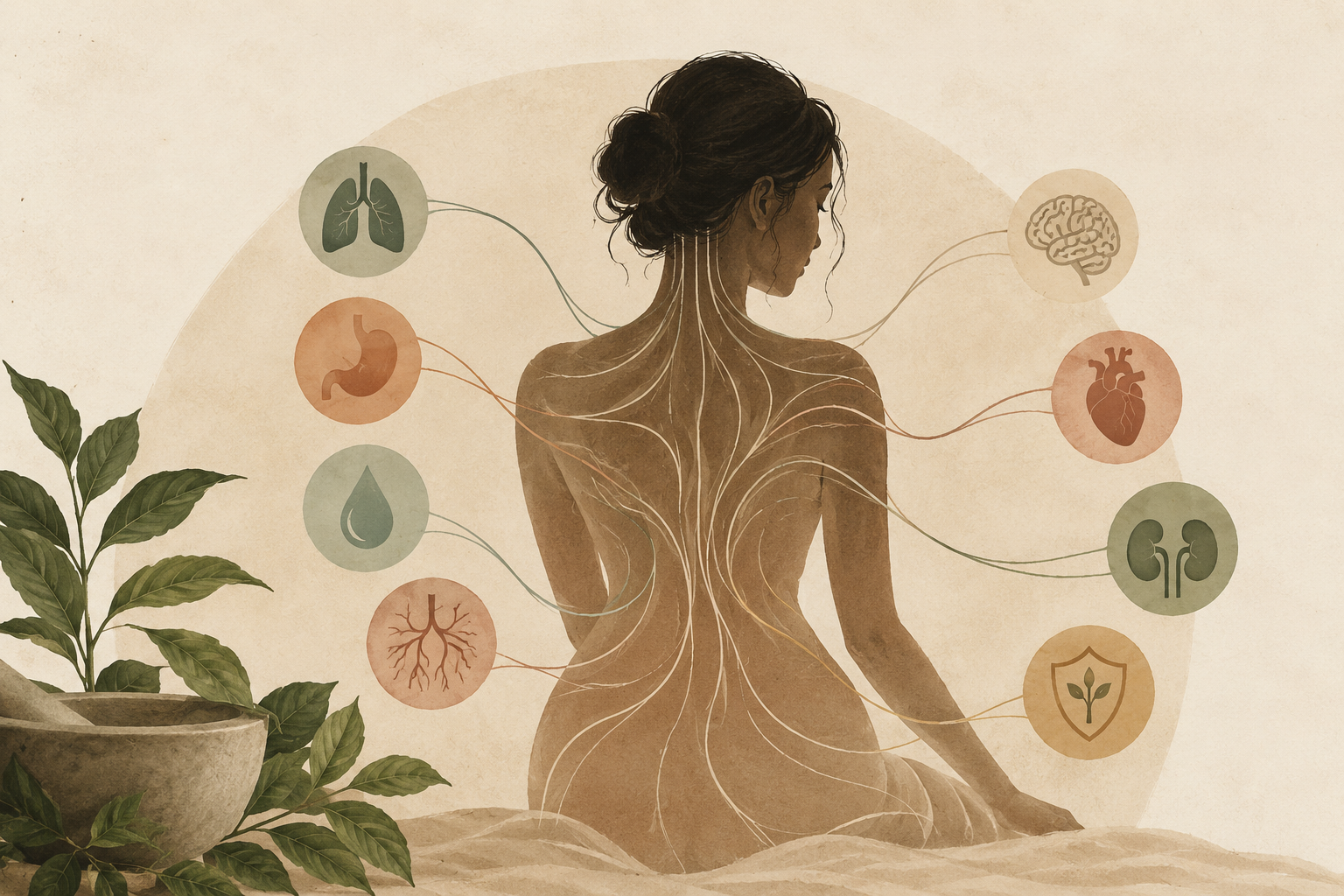
Think about everything your body has to move around all day.   Food, water, oxygen, nutrients, hormones, waste.   Nothing just sits there. Everything is constantly travelling somewhere, through something.   And when that movement gets disturbed, your body usually has a way of showing you. Bloating, sluggishness, poor digestion, congestion, changes in your skin, feeling unusually tired.   Ayurveda has a rather interesting way of explaining why this happens.   It’s called Srotas.   Srotas literally means channel, and the idea behind it is honestly pretty simple once you get it. Your body isn’t one solid block of tissue. It’s a network, an endless system of channels and pathways carrying stuff around, nutrients in and waste out.   And not just fluids, it also carries your thoughts, emotions and your immune responses.   Charaka mentioned that the human body is a pile of these channels, so many of them that you couldn’t hope to count them all. But he and Sushruta still tried to organise the important ones into thirteen main Srotas, each responsible for carrying something specific through the body.   Let me give you a sense of how detailed they are.   There’s Pranavaha Srotas, the channel for breath and oxygen, roughly matching what we’d now call the respiratory system. The Annavaha Srotas, carries food through digestion. Rasavaha and Raktavaha handle plasma and blood while Swedavaha Srotas for sweat, and Mutravaha for urine.   And then there’s the one I find most fascinating, Manovaha Srotas, the channel through which thoughts and emotions are believed to move.   Yes, your mind has its own channel too, right alongside your blood vessels and your gut.   Strotas aren’t just for moving things around, they also help us understand something we’ve all felt but never really questioned. Why does anxiety sit in your stomach? Why does a stressful week somehow show up as a breakout, or a headache, or a flare-up in your gut?   Ayurveda’s answer is that these channels aren’t separate systems running in isolation, they’re connected. A disturbance in one can easily spill into another.   Modern medicine, interestingly, is inching toward the same conclusion. There’s actual research now on the gut-brain axis, the idea that your digestive system and your nervous system are in constant conversation, influencing each other more than we ever gave them credit for.   Ayurveda was describing something remarkably similar centuries ago.   Here’s the part that really changes how you look at illness though.   Ayurveda believed most diseases begin the same way. Not with a sudden attack from nowhere, but with a Srotas getting disturbed. And it described this disturbance, called Srotodushti, in a few specific ways. A channel can get blocked, it can narrow. It can widen beyond what it should. It can even start carrying things in the wrong direction entirely.   I think this reframes a lot of things we brush off too quickly. That afternoon brain fog you get after a heavy meal? Ayurveda would say your Annavaha Srotas, the digestive channel, is overloaded, and that congestion is now affecting clarity elsewhere. Random skin flare-ups with no obvious trigger? Possibly a disturbance that finally found somewhere to surface.   None of this means Ayurveda had X-ray vision into the body, it didn’t have MRIs or blood panels. What it had was centuries of careful observation, watching how symptoms moved, repeated and connected across generations of patients. And through that, it built an entire model of the body based on flow, not fixed parts.   This is actually a pretty different way of thinking about health compared to how most of us were taught. We tend to think in terms of organs like the stomach handles digestion, the lungs handle breathing and the brain handles thinking, full stop. Ayurveda asked a slightly bigger question. Not just what does each part do, but how does everything stay connected, and what happens when that connection breaks down.   Keeping these channels clear was never treated as an afterthought in Ayurveda either. It’s actually one of the reasons practices like proper digestion, regular elimination, oil massage and even breathing exercises show up so often in Ayurvedic practices.  They were seen as basic maintenance for keeping the body’s channels open and functioning the way they’re meant to.   But once you actually understand Srotas, a lot of Ayurveda’s other ideas start clicking into place too. Why Dinacharya matters, why Ama, the toxin buildup we mentioned earlier, is taken so seriously, why treating one symptom in isolation was never really Ayurveda’s style to begin with.   Long before modern medicine started mapping out the gut-brain axis or the lymphatic system in real detail, Ayurveda had already sketched out its own map, one built entirely on the idea that nothing in the body works alone.   If ideas like this interest you, our guided courses on Charaka Samhita and Ashtanga Hridayam explore concepts like Srotas straight from the original texts.

What makes Ayurveda different?

When we talk about Ayurveda, we think about Yoga, Satwik, spiritual science and many more. But the truth is they are not the same.   Ayurveda is different. Yoga and Satwik and spiritual sciences are associated with lifestyle practices for leading a harmonious and healthy life. Meanwhile, Ayurveda is a traditional system of medicine that helps people heal from their health conditions physically, emotionally and spiritually.    This blog will dig deeper into these concepts and give a brief outcome of Ayurveda.   Yoga   Yogic refers to practices and principles related to Yoga. In Sanskrit, the term “yoga” originates from the word “yoke” or “union.” Yogic refers to a discipline that unites an individual’s physical, mental, and spiritual aspects with a universal consciousness.   Yoga is a discipline that aims to create harmony between the mind and body. It derives from a spiritual practice and a nuanced area of study. Maintaining a healthy lifestyle requires both creativity and knowledge.   Yoga, as described in Yogic scriptures, aids in aligning our thoughts with those of others, illustrating the harmony of our mind and body with the world. Contemporary scientists call quantum particles the basic elements that form everything in the universe. A person who feels a deep connection to everything is known as a yogi. They have achieved a state of liberation known as Mukti, Nirvana or Moksha.   Yoga is intended to assist individuals in gaining insight into themselves and overcoming their pain, ultimately achieving a state of liberation known as Moksha or Kaivalya. Yoga is focused on living a life of freedom and achieving overall health and balance. It provides a method for individuals to reconnect with themselves and assert authority over their lives. It has existed for an extended period and supports individuals in their growth and improvement, both in practical and spiritual aspects—the principles of yoga center around embodying virtuous behavior.   Satwik   Satwik life refers to following lifestyle practices with the intent of being pure, positive, clean, responsible and honest. This is achieved by following the best practices for a Satwik life.  Following them influence our bodies’ health and our minds’ state and help us lead a balanced life.    Sattvic diet emphasizes the consumption of foods with Sattva (pure) quality. It  consists of natural and healthy foods that benefit the body and mind. Foods that are included are natural, unadulterated and packed with energy. It also abides by causing no harm to other living creatures. This is one explanation for why yogis frequently opt for a vegetable-based diet.   Sattvic diet includes fresh, natural foods such as fruits, vegetables, nuts, seeds and whole grains. It also comprises proteins from sources other than meat. Good dairy products are the result of cows being fed and milked correctly.   Spiritual Science   The concept of spiritual science combines elements of spirituality, moral beliefs and empirical knowledge. According to spiritual science, the world consists of tangible and visible elements and spiritual components. Spiritual science provides an alternative approach to understanding the world that diverges from traditional scientific and religious views. It demonstrates an alternative world perspective, distinct from science and religion. According to spiritual science, self-awareness is crucial, and our spiritual understanding can enhance scientific progress. It is an approach to understanding the world based on spiritual concepts rather than materialistic ones.   It is presented as an alternative to conventional science. Both spirituality and science aim to comprehend the fundamental aspects of the universe and our place within it. Science attempts to address this question through observation and experimentation, while spirituality examines it through introspection and personal experience. Spirituality involves contemplating and understanding concepts such as love, kindness, selflessness, afterlife, wisdom and truth.   Ayurveda   Ayurveda, on the other hand, is a traditional system of medicine that has been in existence for over 3,000 years. The tern “Ayurveda” is a combination of two words – Ayu meaning life and Veda meaning science or knowledge. Ayurveda, therefore, means science of life.    This traditional system of medicine emphasizes on the importance of maintaining a well-rounded balance between the mind, body, spirit, and environment for overall health. It strives to maintain people’s wellness, prevent them from becoming ill and address their ailments.     Ayurveda focuses on the entirety of the body, including the mind and spirit. According to Ayurveda, Doshas are the biophysical energies that represent the distinctive traits of individuals and influence their mental and physical health. There are three Doshas – Vata, Pitta and Kapha.   Every living thing in this universe consists of 5 “panchamahabhutas,” or five elements.  Now, you might be working on what this term is. Panchamahabhutas are the five vital elements in Ayurveda, including Earth, Air, Water, Fire and Ether. The human body composes all these five elements, but in different proportions.   Depending on the proportions of these elements, Doshas are categorized into Vata, Pitta and Kapha, and the best way to understand them is by observing their qualities.   Vata   Vata has more of the air element. The air has the property of moving and instability; similarly, Vata people show the same characteristics. They are always active and continuous to move, as they never sit idle. Anybody symptoms related to dryness are closely related to Vata Dosha. Whenever you feel lightness in your body, it means Vata is affecting your body.    Pitta   Pitta means fire. Fire denotes aggression, passion, etc., and therefore, Pitta people have more fire in them, depicting an aggressive and tenacious nature. Whenever you feel a rise in body temperature like fever, you should understand that Pitta in your body is increasing. One can conceptualize pitta as burning liquid fuel.   Kapha   Kapha is predominantly the Earth element, and people with Kapha are sluggish, slow, lazy and lethargic. Whenever you feel heaviness in your body, it depicts that Kapha is influencing your body. Kapha is predominantly present in heavy-weight or overweight people. The stiffness and rigidity in the body related… Continue reading What makes Ayurveda different?