
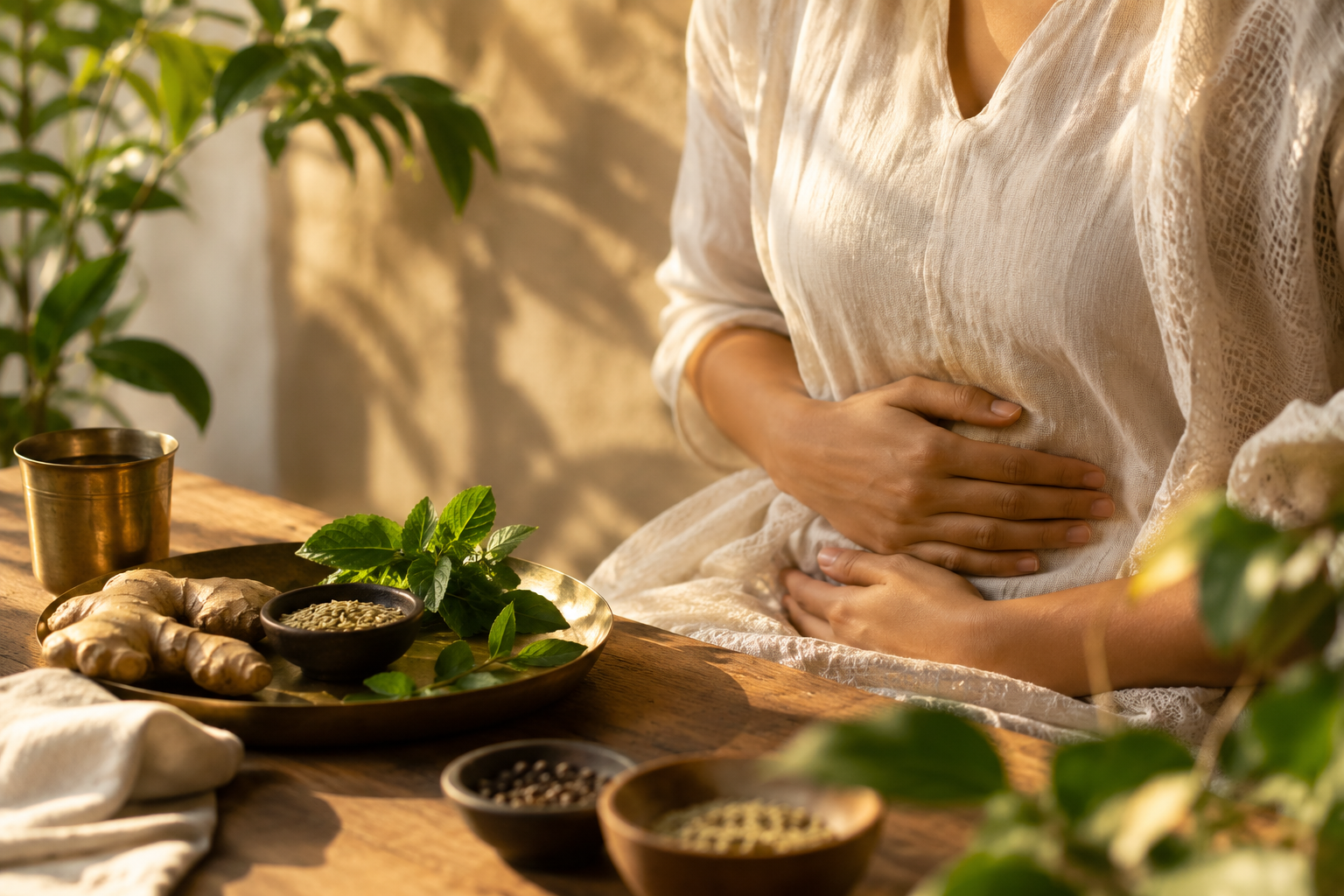
Agnimandya: What Ayurveda Says About Weak Digestion

Have you ever noticed how two people can eat the exact same meal, and one feels perfectly fine while the other feels bloated, sluggish, or gassy an hour later? We usually attribute this to our different bodies but Ayurveda has a much more specific explanation for this, and once you understand it, a lot of your own digestive patterns start making sense.   It’s called Agnimandya, and the word itself tells you exactly what it means. Agni is digestive fire, Mandya means a lowered or weakened state. Put together, Agnimandya literally translates to lowered digestive capacity.   But before we get into what goes wrong, it’s worth understanding what Agni actually is, because I think this is where most people get it slightly wrong. Agni isn’t just “stomach acid” or metabolism. In Ayurveda, it’s considered one of the Panchamahabhuta, and its function mirrors that of Agni Mahabhuta in the universe at large, it’s the factor responsible for any transformation in matter.   It’s the same force behind a mango ripening on a tree, as it is behind the food in your stomach being broken down into something your body can actually use. Specifically, the Agni that governs digestion is called Jatharagni, because it resides in the Jathara, the stomach.   Whenever the term Agni comes up in this context, it’s really Jatharagni being referred to, not Dhatvagni, which operates at the level of individual tissues.   And here’s the part most people fail to understand. Jatharagni’s real job isn’t just to “digest food.” It’s to convert the properties of food into the properties of your tissues.   Wheat, for instance, carries a heavy, stable quality, what Ayurveda calls Guru and Sthira. Once Jatharagni processes it properly, those same qualities get transferred into your Dhatus, your tissues, in a usable, assimilable form.   When this transformation happens cleanly, your tissues stay balanced. When it doesn’t, that imbalance shows up directly in your Dhatus, and eventually, as disease.   This is really the whole premise behind why Agni is treated with so much seriousness in Ayurveda. It’s not just about comfort after a meal, it’s about whether your body is actually building itself correctly from what you feed it.   Now, Ayurveda doesn’t describe Agni as one fixed, uniform thing. It actually breaks it down into four distinct states, based on how consistently and effectively it digests, and this classification alone tells you a lot about how this system really is.   The first is Sama Agni, balanced digestive capacity. This is the ideal state, where food taken in the right quantity, what’s called Sama Matra, enough to satisfy hunger, not more and not less, gets digested smoothly, without discomfort, without excess, without deficiency.   Ashtanga Sangraha even gives this a rough timeframe, food digesting within about four Yamas, roughly twelve hours. Sama Agni stays balanced as long as your conduct around food stays proper, and it’s our own poor habits that typically disturb it.   This single idea alone reframes a lot of digestive complaints, because it suggests that for most people, balanced digestion isn’t a fixed trait you either have or don’t, it’s a state that holds as long as you don’t actively work against it.   The second is Manda Agni, low digestive capacity, dominated by Kapha. This is the state where even a small meal feels heavy and takes far longer than it should to digest. What’s interesting is how intolerant this type is. Manda Agni can’t handle any deviation in eating habits, even minor missteps show up quickly as Aadhmana, bloating, Aasya Shosha, dryness in the mouth, Aatopa, abdominal distension, and Aantra Koojana, that gurgling sound in the intestines many of us have felt after a heavy meal we clearly shouldn’t have eaten.   If you’ve ever felt like your body “punishes” you disproportionately for one slightly indulgent meal, there’s a decent chance Manda Agni is part of that story.   Then there’s Teekshna Agni, sharp or excessive digestive capacity, dominated by Pitta. This is almost the opposite problem. Food gets digested fast, sometimes too fast, even when eaten in excess. It sounds like an advantage until you realize what happens when this type of Agni isn’t fed enough, it starts consuming the body’s own tissues instead, leading to Dhatu depletion over time.   Taken to an extreme, this becomes a condition called Bhasmaka, a state of such intense digestive capacity that a person feels perpetually hungry, no matter how much they eat, almost as if the fire is burning through fuel faster than it can be supplied.   What I find notable here is that Teekshna Agni can tolerate improper conduct around food far better than Manda Agni can, it just has a different kind of cost attached to that tolerance.   And finally, Vishama Agni, irregular digestive capacity, dominated by Vata. This is the most unpredictable of the four. Some days digestion is fine, other days the exact same meal sits like a stone.   Charaka specifically describes this as the direct opposite of Sama Agni, unstable, inconsistent, and a major contributor to Dhatu imbalance over time.   Interestingly, Vishama Agni can behave in two completely opposite ways depending on the amount eaten, food consumed beyond actual hunger may digest surprisingly fast, while food eaten in a reasonable, hunger-appropriate amount might digest very slowly instead.   This unpredictability is exactly what makes it so hard for people with this pattern to pin down what’s actually “wrong” with their digestion, because the pattern itself keeps shifting.   Out of all four, only Sama Agni is considered the healthy baseline, responsible for Dhatu Saamya, true balance across all seven tissues. The other three are classified as Vikrita, disturbed states, and this is really where Agnimandya comes in specifically.   Technically, Agnimandya refers to Manda and Vishama Agni, the Kapha-dominant and Vata-dominant disturbances, both of which share that core feature of reduced or inconsistent digestive strength, as opposed to Teekshna Agni, which is excessive rather than diminished.… Continue reading Agnimandya: What Ayurveda Says About Weak Digestion

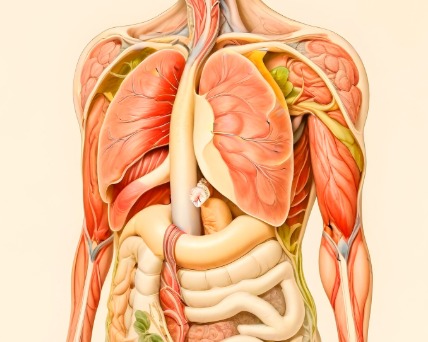
Prakriti and Dosha Balance: The Key to Health in Ayurveda

Ayurveda teaches that true health starts with understanding who you are at a constitutional level. When you know your Prakriti, or inherent body–mind type, you can care for yourself in a way that supports balance, resilience and long term wellbeing.   Many people try to follow general wellness advice and feel confused when it does not work for them. From an Ayurvedic perspective, this happens because the advice does not match their Prakriti, or natural constitution. When you first understand your Prakriti and the way Vata, Pitta and Kapha behave in your system, your choices start making sense. Diet, sleep, exercise and even the way you handle stress can then align with who you truly are rather than forcing you into a one size fits all model.   What Prakriti Really Means   Prakriti is your unique constitution; it is the “nature” you are born with. It reflects the combined state of Vata, Pitta and Kapha present at that exact moment, influenced by parental constitution, health, diet, lifestyle, climate and even emotional states.   In simple terms, Vata governs movement and communication, Pitta governs transformation and metabolism, and Kapha governs structure and stability.   All three must be present for life to exist, and nobody can function if even one dosha is completely absent. What changes from person to person is which dosha dominates and how these three interact to create your physical traits, mental tendencies and disease patterns.   Although Prakriti is fixed at conception, its outer expression becomes clearer only after growth and hormonal changes settle. Before around eighteen to twenty years of age, strong Kapha influence of childhood can mask or exaggerate certain features, which is why identifying exact Prakriti in very young people can be difficult and only becomes more reliable once development stabilizes.   How Ayurveda Organizes Knowledge: Prakaranas   Ayurvedic texts carry vast amounts of information, so teachers arrange them into Prakaranas, or thematic sections. These are meaningful categories that help students and practitioners study specific topics such as constitution, disease, diet or treatment in a structured way, rather than getting lost in scattered details.   Types of Prakriti: Single, Dual and Sama   Ayurveda describes different constitutional patterns based on the relative predominance of Vata, Pitta and Kapha. Single dosha Prakriti means one dosha is overwhelmingly dominant across body, physiology, psychology and disease tendency, while the other two express minimally.   This kind of pure Vata, Pitta or Kapha type exists in theory and appears occasionally, but in real life it is rare because genetics are mixed, parents rarely share identical dominance and modern diet, stress and lifestyle modify expression from birth.   Most people show dual dosha dominance, known as Dwidoshaja, for example Vata Pitta, Pitta Kapha or Vata Kapha. In such constitutions one dosha leads and the second supports, while the third remains present at a subordinate level, just enough to sustain essential functions but not enough to display strong traits.   Sama dosha Prakriti, where Vata, Pitta and Kapha exist in near equal proportions, is considered the most ideal state. Here none of the doshas dominate and each contributes roughly one third of the total constitutional makeup, creating a high potential for balance, stability and good health.   Sama, Uttama, Nindya and Hina: Quality of Constitutions   Classical texts use qualitative terms to describe the relative strength and stability of different Prakriti. Sama dosha Prakriti is called the absolute best because an equal presence of Vata, Pitta and Kapha gives the greatest harmony and adaptability.   Kapha Prakriti is described as having good quality, especially in terms of strength, stability and longevity. Kapha relates to creation, structure, lubrication and immunity, so individuals with Kapha dominance often have better natural reserves and resilience, even though Vata and Pitta are also present in lower proportions.   Vata Prakriti is referred to as lower quality, not because Vata is unimportant but because it is the most unstable of the doshas. It has qualities of dryness, coldness and constant movement, and while it is the hero of movement and change, it also drives depletion and destruction when not contained.   Dwidoshaja constitutions are termed less desirable compared to pure or Sama types. This does not mean any dosha is missing. It reflects the complexity of having two strongly dominant forces that can easily conflict and disturb each other, making balance more challenging to maintain over time.   Do We Ever Have Only Two Doshas?   Every person always has all three doshas present. Even in a Vata Pitta constitution, Kapha does not disappear. It simply remains in the background, present only to the degree required for basic survival and structural stability.   That background Kapha can still become imbalanced if diet, lifestyle or environment repeatedly promote Kapha qualities such as heaviness, coldness and stagnation.   The same logic applies to all combinations. Vata Pitta people can still develop Kapha disorders, and Kapha types still have Vata and Pitta operating in their systems. Constitution talks about dominance, not exclusivity.   Why Sama Prakriti Is Rare Today   Sama dosha constitutions are most often described in individuals born in regions where climate, land and lifestyle remain naturally balanced without a marked dominance of any single dosha. Parents with relatively balanced constitutions further support the chance of such offspring.   In the modern world, most regions and lifestyles lean toward one or two doshas. Irregular routines, processed food, chronic stress and disturbed sleep aggravate doshas and disturb nutrition from early life. These factors make perfectly balanced Sama Prakriti very uncommon today.   Can Parents Create the Best Prakriti through Rituals?   Traditional Ayurvedic culture includes various preparatory rituals for conception. These do not change the fundamental rule that Prakriti forms at the specific moment of union and cannot be chosen or redesigned through will alone.   However such practices play an important supportive role. They help parents purify, stabilize and balance their own doshas at the time of conception, which prevents extreme dominance and supports the… Continue reading Prakriti and Dosha Balance: The Key to Health in Ayurveda

7 Dhatus in Ayurveda: Meaning, Functions & How They Support Your Health

Ayurveda views human body in a different way compared to modern science and biology. Instead of focusing mainly on organs and cells, Ayurveda talks about tissues, called Dhatus that form the very foundations of our physical body.   The Sanskrit word “Dhatu” means one that holds, supports and sustains. There are seven main tissues in our body, Saptha Dhatus that make our whole physical being.   Before we jump into what each Dhatu does, let’s talk about how they are formed.   In simple terms, they start with the food you eat, your digestive fire breaks it down into the purest, most refined nutrients and become the first tissue, Rasa Dhatu.   Each Dhatu has its own job and gets built and nourished from the one before it.   So basically, your body is made from the food you eat, being transformed step by step into all the tissues that keep you alive.   Missing nutrients or poor digestion directly can affect the tissues. That’s why Ayurveda says good digestion is the backbone of good health.     The 7 Dhatus:     Rasa Dhatu   Rasa Dhatu is the first tissue formed after digestion of food. It represents the nourishing fluid in the body, similar to plasma and lymph. Its main role is to carry nutrients, hydration, and energy to every part of the body. Simply put, Rasa is the foundation that feeds all other tissues. This Dhatu is closely linked with Kapha Dosha, so when Kapha increases, Rasa tissue tends to increase too, and when Kapha decreases, Rasa also diminishes. Healthy Rasa Dhatu keeps you nourished, warm, and well-hydrated, while a weak Rasa may lead to fatigue, dryness, or feeling undernourished.     Rakta Dhatu   Rakta Dhatu is the blood tissue that develops from Rasa. It gives life, warmth, and vitality to the body. Rakta carries oxygen and nutrients to organs and tissues and helps remove waste. It supports good energy levels, clear skin and proper circulation. Rakta is directly related to Pitta Dosha, which gives it its red color and heat quality. But when blood tissue is compromised, such as in deficiency, symptoms like pale complexion, weakness, dryness, or skin problems can appear.     Mamsa Dhatu   Mamsa Dhatu refers to the muscle tissue of the body. It provides strength, shape, stability, and protection to internal organs. Strong muscles help with movement, posture, and daily physical activity. Mamsa is what gives the body its power and structure. Kapha Dosha influences Mamsa Dhatu, so changes in Kapha affect muscle strength and size. If it becomes weak or depleted, one might experience muscle wasting, weakness, or difficulty with movement and posture.     Meda Dhatu   Meda Dhatu is the fat tissue that stores energy and lubricates the body. In Ayurveda, Meda plays several important roles: it stores energy, protects organs, insulates the body against heat loss, and lubricates joints and tissues. Meda is also connected with sweat as a waste product (Mala). Healthy Meda supports endurance, flexibility, and proper metabolism. Meda acts like the body’s natural energy reserve. Too much Meda can lead to weight gain and metabolic imbalance, while too little can cause dryness, aggravated Vata symptoms.     Asthi Dhatu   Asthi Dhatu is the bone tissue. All the bones, cartilages, and hard structures that form your body’s framework. It gets its nourishment from the Meda Dhatu. Its main function is support and structure, giving the body its shape, protecting inner organs, and enabling strength for movement through joints and limbs. Asthi also produces nails and hair as the waste products of its formation, linking bone health with external features. Strong Asthi Dhatu means sturdy skeleton, good posture, and resilience, while weakness can show up as brittle bones, joint discomfort, weak nails or other concerns.     Majja Dhatu   Majja Dhatu refers to bone marrow and the tissues that fill the spaces within bones, including support for the nervous system. It is nourished by Asthi Dhatu and plays a key role in nervous system function and mental clarity. In Ayurveda, Majja fills up the bone cavities, supports nerve channels, and contributes to overall body strength. When Majja Dhatu is balanced, you tend to have good memory, clear thinking, stable nerves, and healthy marrow function. If Majja becomes depleted, it can lead to symptoms like dizziness, weakness, joint pains, or neurological discomforts.     Shukra Dhatu   Shukra Dhatu is the reproductive tissue and the most refined of all the Dhatus. It represents vitality, immunity, creativity, and reproductive strength. It supports fertility, stamina, glowing health, and emotional balance. When Shukra is depleted, low energy, reduced immunity, and reproductive challenges may occur. Shukra is often described as the essence of life and long-term strength.       What makes the concept of the seven Dhatus so powerful is the way they are all connected. Each tissue depends on the one before it for nourishment. If Rasa is weak due to poor digestion or unhealthy food choices, Rakta will not receive enough nutrition, and this imbalance can slowly affect all the other tissues down the line.   In the same way, when the earlier tissues are strong and balanced, the later tissues naturally become healthier and more stable. This chain effect teaches us that health is not about fixing just one problem, but about supporting the entire system.   Simple daily habits like eating fresh and wholesome food, chewing properly, drinking enough water, maintaining regular meal times, getting good sleep, and moving the body can go a long way in keeping these tissues healthy. Managing stress, spending time outdoors, and listening to the body’s natural rhythms also support tissues like Majja and Shukra.   Understanding the seven Dhatus helps us see our body with more awareness and respect. Instead of only reacting when illness appears, we begin to notice early signs of imbalance and take small steps to correct them. When digestion is strong and lifestyle choices are balanced, the body naturally builds healthy tissues and… Continue reading 7 Dhatus in Ayurveda: Meaning, Functions & How They Support Your Health