Why Your Body Isn’t Just “Tissues and Waste”

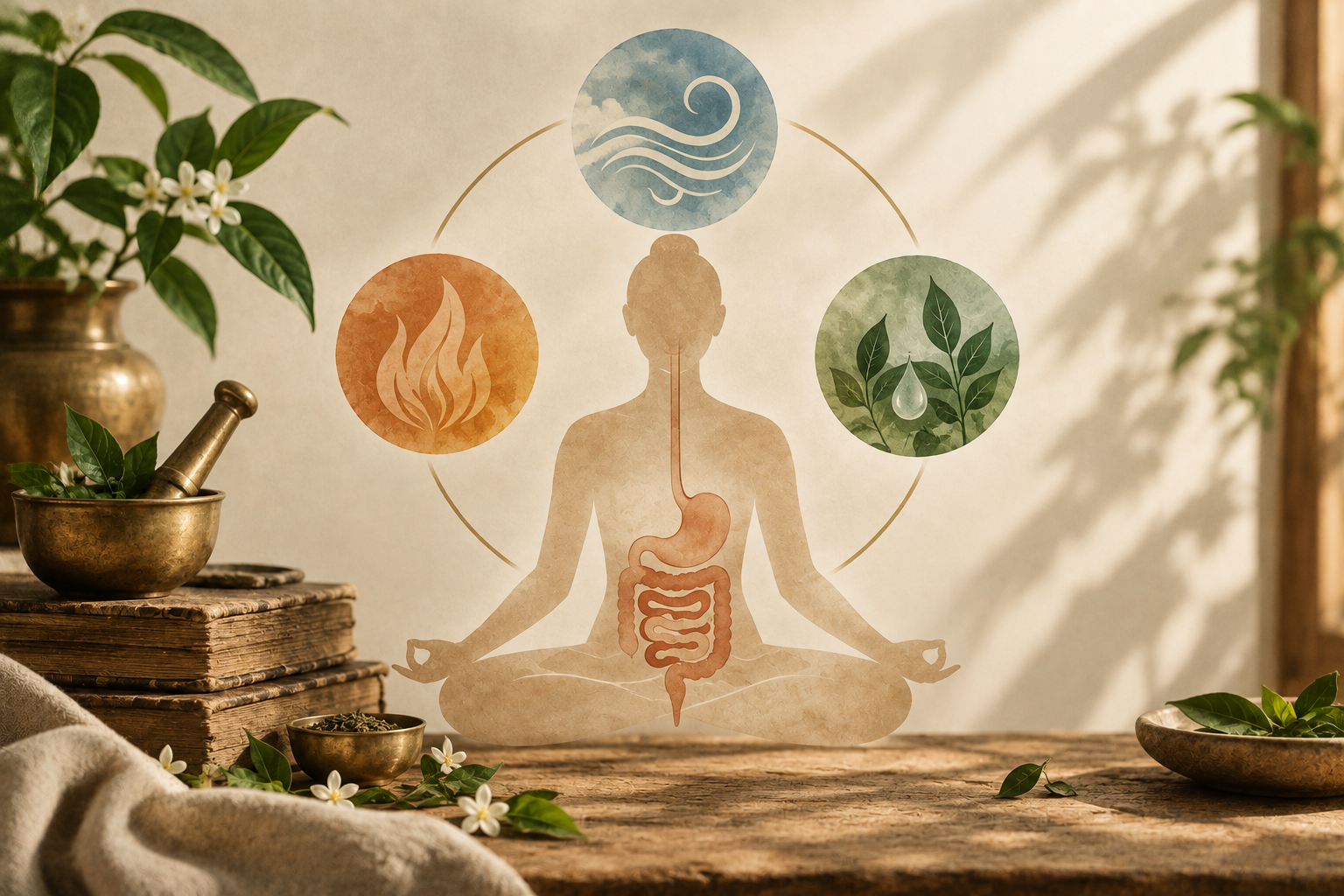
Most people, the moment they start reading about Ayurveda, land on this word, Dosha, almost immediately. Vata, Pitta, Kapha. And usually, the very first explanation they get is something like “Dosha means fault” or “Dosha means fluid,” and honestly, that explanation doesn’t help at all.   If anything, it makes the whole thing feel more confusing than before you started.   So let’s actually slow down and ask a more basic question first. What is the body even made of, according to Ayurveda?   Before we even get to Dosha, there are two other categories worth understanding, Dhatu and Mala, because once you see how these three relate to each other, Dosha suddenly makes a lot more sense.   Dhatu refers to everything in your body that’s meant to stay. Your blood, muscles, fat, bones, the fluid in your spinal cord, reproductive tissue, all of it.   These are structurally very different from each other, obviously, but they share one thing in common, none of them are meant to leave your body under normal circumstances.   When they do leave, by injury or bleeding or some other accident, your body doesn’t feel relieved. It feels depleted, anxious and weak. That’s the signature of a Dhatu, its presence sustains you, and its loss destabilizes you.   Mala is the exact opposite category. This is everything your body is meant to get rid of, stool, urine, sweat, and so on. And here’s the interesting part, getting rid of these isn’t a failure of the body, it’s actually a sign of it working properly.   Holding onto waste for too long doesn’t protect you, it burdens you. A Mala that overstays starts creating problems rather than preventing them.   So while Dhatu is defined by staying, Mala is defined by leaving, and both, in their own way, keep the body functioning.   Now here’s where it gets genuinely interesting, because Dosha doesn’t fit into either of these categories. It refuses to follow the rule.   Think about saliva for a second. It’s produced inside your body, moves through your salivary glands, briefly steps outside the boundary of your internal tissue system into your mouth, and then re-enters your body as you swallow it along with your food.   It doesn’t stay put like a Dhatu, and it doesn’t fully leave like a Mala either. It does something in between, and that “in between” behavior is exactly what defines a Dosha.   It moves out into contact with the world, and then brings something back in, and this back-and-forth movement is precisely what makes digestion, absorption, and basically your entire relationship with the outside environment possible.   This is such an important shift in how to think about Vata, Pitta, and Kapha. They’re not things that cause or lead up to a disease. They’re the functional bridges that let your body interact with everything you eat, breathe, and absorb from the world around you.   Vata handles movement, what you take in. Pitta governs transformation, converting of one thing into another. Kapha manages binding, lubrication, and the way things hold together and connect.   Without these three doing their job constantly, your Dhatus would never get built, and your Malas would never get properly separated out and removed.   And here’s something that genuinely surprised me the first time I really understood it, this dual-direction movement of the Doshas happens twice a day, in the gastrointestinal tract specifically.   If something you’re consuming regularly doesn’t actually suit your body, that excess starts getting expressed back out, sometimes as an unusually sour or pungent sensation, sometimes as a sweet, sticky feeling.   This isn’t randomness, it’s your body’s own feedback system, quietly telling you that whatever you keep feeding it in excess isn’t being absorbed the way you assume it is.   Most of us just don’t know how to read that signal.   This is also why identifying someone’s Prakriti, their natural constitutional dominance of one or two Doshas, matters so much in how Ayurveda actually treats a person. Two people can eat the exact same meal and metabolize it completely differently, purely because their underlying Dosha balance is different.   What nourishes one person can genuinely unsettle another. This is the entire logic behind why Ayurveda has never really believed in one-size-fits-all diet advice, it was never really about the food.   It was always about how well your Doshas are managing the exchange between what’s outside you and what needs to become a part of you.   So the next time someone tells you Dosha simply means “fault,” it’s worth remembering that it’s actually closer to the opposite. It’s not what goes wrong in the body. It’s the very mechanism that allows the body to keep working, keep exchanging, and keep staying alive in the first place.   If ideas like this interest you, our courses on Charaka Samhita and Ashtanga Hridayam go much deeper into how Dosha, Dhatu, and Mala work together as the foundation of the entire Ayurvedic system.  

Prakriti and Dosha Balance: The Key to Health in Ayurveda

Ayurveda teaches that true health starts with understanding who you are at a constitutional level. When you know your Prakriti, or inherent body–mind type, you can care for yourself in a way that supports balance, resilience and long term wellbeing.   Many people try to follow general wellness advice and feel confused when it does not work for them. From an Ayurvedic perspective, this happens because the advice does not match their Prakriti, or natural constitution. When you first understand your Prakriti and the way Vata, Pitta and Kapha behave in your system, your choices start making sense. Diet, sleep, exercise and even the way you handle stress can then align with who you truly are rather than forcing you into a one size fits all model.   What Prakriti Really Means   Prakriti is your unique constitution; it is the “nature” you are born with. It reflects the combined state of Vata, Pitta and Kapha present at that exact moment, influenced by parental constitution, health, diet, lifestyle, climate and even emotional states.   In simple terms, Vata governs movement and communication, Pitta governs transformation and metabolism, and Kapha governs structure and stability.   All three must be present for life to exist, and nobody can function if even one dosha is completely absent. What changes from person to person is which dosha dominates and how these three interact to create your physical traits, mental tendencies and disease patterns.   Although Prakriti is fixed at conception, its outer expression becomes clearer only after growth and hormonal changes settle. Before around eighteen to twenty years of age, strong Kapha influence of childhood can mask or exaggerate certain features, which is why identifying exact Prakriti in very young people can be difficult and only becomes more reliable once development stabilizes.   How Ayurveda Organizes Knowledge: Prakaranas   Ayurvedic texts carry vast amounts of information, so teachers arrange them into Prakaranas, or thematic sections. These are meaningful categories that help students and practitioners study specific topics such as constitution, disease, diet or treatment in a structured way, rather than getting lost in scattered details.   Types of Prakriti: Single, Dual and Sama   Ayurveda describes different constitutional patterns based on the relative predominance of Vata, Pitta and Kapha. Single dosha Prakriti means one dosha is overwhelmingly dominant across body, physiology, psychology and disease tendency, while the other two express minimally.   This kind of pure Vata, Pitta or Kapha type exists in theory and appears occasionally, but in real life it is rare because genetics are mixed, parents rarely share identical dominance and modern diet, stress and lifestyle modify expression from birth.   Most people show dual dosha dominance, known as Dwidoshaja, for example Vata Pitta, Pitta Kapha or Vata Kapha. In such constitutions one dosha leads and the second supports, while the third remains present at a subordinate level, just enough to sustain essential functions but not enough to display strong traits.   Sama dosha Prakriti, where Vata, Pitta and Kapha exist in near equal proportions, is considered the most ideal state. Here none of the doshas dominate and each contributes roughly one third of the total constitutional makeup, creating a high potential for balance, stability and good health.   Sama, Uttama, Nindya and Hina: Quality of Constitutions   Classical texts use qualitative terms to describe the relative strength and stability of different Prakriti. Sama dosha Prakriti is called the absolute best because an equal presence of Vata, Pitta and Kapha gives the greatest harmony and adaptability.   Kapha Prakriti is described as having good quality, especially in terms of strength, stability and longevity. Kapha relates to creation, structure, lubrication and immunity, so individuals with Kapha dominance often have better natural reserves and resilience, even though Vata and Pitta are also present in lower proportions.   Vata Prakriti is referred to as lower quality, not because Vata is unimportant but because it is the most unstable of the doshas. It has qualities of dryness, coldness and constant movement, and while it is the hero of movement and change, it also drives depletion and destruction when not contained.   Dwidoshaja constitutions are termed less desirable compared to pure or Sama types. This does not mean any dosha is missing. It reflects the complexity of having two strongly dominant forces that can easily conflict and disturb each other, making balance more challenging to maintain over time.   Do We Ever Have Only Two Doshas?   Every person always has all three doshas present. Even in a Vata Pitta constitution, Kapha does not disappear. It simply remains in the background, present only to the degree required for basic survival and structural stability.   That background Kapha can still become imbalanced if diet, lifestyle or environment repeatedly promote Kapha qualities such as heaviness, coldness and stagnation.   The same logic applies to all combinations. Vata Pitta people can still develop Kapha disorders, and Kapha types still have Vata and Pitta operating in their systems. Constitution talks about dominance, not exclusivity.   Why Sama Prakriti Is Rare Today   Sama dosha constitutions are most often described in individuals born in regions where climate, land and lifestyle remain naturally balanced without a marked dominance of any single dosha. Parents with relatively balanced constitutions further support the chance of such offspring.   In the modern world, most regions and lifestyles lean toward one or two doshas. Irregular routines, processed food, chronic stress and disturbed sleep aggravate doshas and disturb nutrition from early life. These factors make perfectly balanced Sama Prakriti very uncommon today.   Can Parents Create the Best Prakriti through Rituals?   Traditional Ayurvedic culture includes various preparatory rituals for conception. These do not change the fundamental rule that Prakriti forms at the specific moment of union and cannot be chosen or redesigned through will alone.   However such practices play an important supportive role. They help parents purify, stabilize and balance their own doshas at the time of conception, which prevents extreme dominance and supports the… Continue reading Prakriti and Dosha Balance: The Key to Health in Ayurveda