
Samanya and Vishesha: The Ayurvedic Principle of Balance

Think of this situation, you probably find it familiar.   You come home tired, and instead of hitting the gym or going for a walk, all you want to do is sleep. So, you lie down but when you get up instead of feeling refreshed, you feel even more tired.   There might also be days when you feel jittery and restless instead. So, you go for a walk or hit the gym hoping it will help. But rather than feeling energised, you end up feeling even more wired than when you started.   You must have noticed that nobody has really taught us this. We just vaguely assume that rest will fix our tiredness, or movement will fix our restlessness, without actually stopping to think about whether they really do.   Interestingly, Ayurveda has actually talked about this phenomenon. The Charaka Samhita has a verse that describes this very pattern.   सामान्यमेकत्वकरं, विशेषस्तु पृथक्त्वकृत् । तुल्यार्थता हि सामान्यं, विशेषस्तु विपर्ययः ॥   It can be roughly translated to Samanya brings things together, Vishesha pulls them apart. Samanya is sameness of quality; Vishesha is its opposite.   This verse introduces us to two words. One is samanya, which means sameness or similarity. The other is vishesha, which means difference or distinction.   And the principle the text is pointing towards is that things that are similar to each other tend to increase each other, while things that are opposite to each other tend to reduce each other.   It’s almost like fields, where one thing can either reinforce what is already there or counter it.   Rest is slow. So, if you are already feeling heavy and slow, more rest isn’t necessarily going to rebalance you. It only reinforces that feeling of heaviness and sluggishness.   On the other hand, restlessness is hot and fast. So, if you respond to that feeling with more movement, you might end up feeling even more hot and wired rather than actually calming the restlessness. You’re reinforcing the qualities that are already present.   Now that we think about it, it sounds obvious. But we rarely think about our own habits in these terms.   This principle can also be applied to the food we consume and our body’s internal balances, what Ayurveda calls the doshas.   It’s quite simple. Whatever quality is already present in excess, you don’t add more of it. You reach for its opposite instead.   On a cold day, for example, if you’re already feeling stiff, dry and cold you naturally want to add some warmth. Similarly, if you’re feeling sluggish or heavy after a meal, you probably don’t want to eat something even heavier, right? You want something lighter.   In fact, the very first chapter of the Charaka Samhita, called Dirghanjivitiya, which is about the desire for long life, talks about exactly which tastes can calm which imbalances.   It goes through all six rasas, or tastes, and explains their qualities and what can be used to pacify different states.   Take Vata, for example. Vata is dry and is associated with movement. So, it is calmed by substances with opposite qualities. If you’re feeling dry and cold, if you’re in a Vata state, you would reach for sweet, sour and salty tastes because these carry qualities of moisture, warmth and weight.   Or if you feel like your Pitta is rising, you’re overheated or you’re feeling short-tempered, bitter and sweet tastes can help cool things down.   And this is important: none of the six tastes are universally good or universally bad. It’s not that sweet is unhealthy and bitter is healthy. Each taste has its place whether it is helpful or unhelpful depends entirely on the state it is meeting.   There is no fixed list where cold foods are always bad or sweet foods are always bad. It depends entirely on the person, the place, the timing, and the state of the body, not just the substance itself.   This is one of the core ideas of Ayurveda. It is individualistic. The same food or medicine can be helpful for one person but not for another. If you must have also noticed, even for the same person, something that suits them one day may not suit them on another day.   It depends on what qualities they are already carrying in excess at that particular time.   Ayurveda says that even a well-known poison, used with the right knowledge, at the right dose, for the right person, can become the best possible medicine. And a substance that’s technically medicine, used without that understanding, can do as much damage as poison.   The substance alone is never the whole story.   You have to look at what you’re giving, who you’re giving it to, why you’re giving it, how much you’re giving, and under what circumstances.   And this brings us back to samanya and vishesha.   Because the real question isn’t simply, “Is this food good?”   Ayurveda’s answer is rarely just about the thing itself.   It is about the relationship between the thing and the person receiving it.   If this way of looking at Ayurveda interests you, you might enjoy our courses on the Charaka Samhita and Ashtanga Hridayam, where we go deeper into the texts and the ideas behind them. Sometimes, going back to the original texts can change the way you understand Ayurveda, and even the way you look at your own life.


Your Moods Have a Pattern Too, Here’s What Ayurveda Says

Ever had one of those days where you feel completely calm and clear-headed, like nothing can shake you?   And then there are days where you feel restless, edgy, almost itching to argue with someone over nothing?   And then, of course, there are the days where you don’t want to do anything at all. Not work, not talk, not even get off the couch.   If you’ve felt all three of these at different points in your life, you already understand the Trigunas, even if you’ve never heard the word before.   We talk a lot about Doshas when it comes to Ayurveda, Vata, Pitta, Kapha. But those three govern the body. What most people don’t know is that Ayurveda had a separate set of three for the mind. These are called the Trigunas: Sattva, Rajas and Tamas.   And honestly, I think this is one of the more underrated ideas in the whole system.   Let’s break it down simply.   Sattva is that calm, clear state of mind. Sharp focus, a settled heart, the kind of headspace where good decisions just come naturally.   Rajas is the restless one, driven, ambitious, a little impatient, always chasing the next thing.   Tamas is the heavy one, sluggish, foggy, the mental version of hitting snooze five times in a row.   Here’s the part I find genuinely interesting. Ayurveda didn’t treat these as personality types you’re stuck with. Unlike your Dosha, which is largely fixed from birth, your Guna shifts, sometimes within the same day.   You could wake up Sattvic, turn Rajasic by 3pm after back-to-back meetings, and end the night fully Tamasic on the couch, scrolling your phone with zero motivation to move. Same person, three different mental states, all in twelve hours.   That alone tells you something important. Ayurveda wasn’t describing who you are, it was describing where your mind happens to be, right now.   And that’s a much more useful way to think about your own moods, isn’t it?   We tend to label ourselves. “I’m just a lazy person.” “I’m always anxious.” “I’m just wired this way.”   Ayurveda would gently push back on that. It would say, you’re not permanently anything.   This is honestly a bit of a relief when you sit with it.   Ayurveda also didn’t leave you to just observe your Guna. It gave you actual levers to pull.   Food, for one.   Ever notice how a heavy, greasy meal makes you want to do absolutely nothing afterward? That’s Tamas showing up through your plate.   Ayurveda classified food the same way it classified minds: Sattvic, Rajasic and Tamasic, and it genuinely believed what you eat nudges your mental state, not just your waistline.   Sleep, company, the media you consume, even the pace of your day. Ayurveda considered all of it capable of tilting you toward one Guna or another.   This is where it gets a little uncomfortable, in a good way.   Because it means your 2am doom-scrolling isn’t just a habit. It’s actively feeding a Tamasic state.   And that overpacked schedule you’re proud of might be keeping you stuck in Rajas far more than you realise, wired, busy, but never actually at peace.   Ayurveda wasn’t saying Rajas or Tamas are bad, by the way.   You need Rajas to get out of bed and get things done. You need a bit of Tamas to actually rest. The goal was never to eliminate them. It was to notice which one you’re leaning on too heavily, and gently steer yourself back toward Sattva, the state Ayurveda considered closest to genuine wellbeing.   So why doesn’t this concept come up as often as Doshas do?   I think it’s because Doshas feel more “medical.” They explain digestion, body type, physical symptoms, things that are easy to point to.   Gunas are quieter. They live in your mood, your focus, your patience, things we’re used to blaming on stress or personality instead of actually examining.   But if you ask me, understanding your Guna day to day might be more useful than knowing your Dosha.   Because most of us aren’t struggling with our body type. We’re struggling with why we feel foggy, restless or completely unmotivated, and not knowing there was ever a name for it, or a way back to balance.   If ideas like this interest you, our guided courses on Charaka Samhita and Ashtanga Hridayam explore concepts like the Trigunas straight from the original texts.

Ayurveda Named the Reason We Keep Doing Things We Know Are Bad For Us

Have you ever eaten an extra serving despite being full?   Have you ever stayed up scrolling through your phone and lost track of time?   Have you ever decided to be a little lazy and skip your workout?   Admit it, we’ve all at least done any one of these once in our lives.   And here’s the thing, none of us do this because we don’t know better. We know exactly what we’re doing. We just do it anyway.   Ayurveda had a word for this, thousands of years before behavioural science made a whole field out of it. It’s called Pragyaparadha.   And according to Ayurveda, this one idea sits behind almost every disease we end up bringing on ourselves.   The word comes from two Sanskrit roots. Pragya, meaning wisdom or intellect. Aparadha, meaning offence or crime. Put the two together and Pragyaparadha literally means an offence against wisdom.   Not a lack of wisdom but an offence against it.   That difference matters a lot. Ayurveda wasn’t talking about ignorance here, it was talking about something far more familiar and honestly, a little harder to admit to. Knowing exactly what’s good for you, and choosing the opposite anyway.   Ayurvedic texts describe Pragyaparadha as actions of the body, mind or speech, done despite knowing better. Eating something you already know doesn’t suit you. Brushing off clear signs that you’re exhausted. Saying something in anger that you know you’ll regret the second it leaves your mouth. None of this needs ignorance. It just needs one moment where awareness loses to impulse.   Ayurveda believed that this pattern, repeated enough times, becomes one of the root causes of disease itself.   This is a very different starting point from how most of us think about getting sick.   When something goes wrong with our health, we usually look outward first. We look for the virus, the deficiency, the bad gene, the environmental trigger, the food we ate, or sometimes, simply, bad luck. And of course, these things matter.   Ayurveda never claimed that everything that happens to the body is a consequence of personal choices. But it also asked us to look somewhere else, somewhere most of us are much less comfortable looking: at the small, repeated choices we make against our own better judgement.   Because sometimes, we already know.   We know we are tired, but we stay up anyway. We know we are full, but we take another serving because it tastes good. We know that certain foods leave us feeling terrible, yet somehow, they keep finding their way back onto our plates. We know we need to move, rest, slow down, or stop stressing about something, and still find ourselves doing the exact opposite.   We think subconsciously that stayiny up one late night is not going to affect our health, one indulgent meal is not going to make us sick. But we forget that we keep repeating these things quietly, so much so that you’ll realise it stopped becoming a choice and started becoming a pattern.   The doshas getting disturbed again and again by the same habits. The body constantly having to compensate for the same disruptions. Small imbalances being ignored because they are still small enough to live with. Until, eventually, the body cannot keep correcting itself quite as easily as it once did, and disease gets the room it needs to take hold.   And honestly, this sounds a lot like something we are already talking about today.   There is an entire area of behavioural science concerned with the distance between what we know and what we actually do. It is often described as the knowledge-behaviour gap, and you do not need a psychology degree to recognise it in your own life.   We are not exactly short on information.   And yet, somehow, knowing all of this does not guarantee that we will act on it.   We can have all the information in the world and still find ourselves repeating the same habits we promised ourselves we were going to change.   And this is where I think the concept gets particularly interesting, because Pragyaparadha is not really about not knowing better. It is about knowing better and then, for whatever reason, choosing otherwise.   There is something almost painfully human about that.   And here is what I particularly like about the Ayurvedic approach to this. It does not seem interested in turning that observation into another reason for us to feel terrible about ourselves.   There is already enough guilt attached to health. Every day, we are given another reason to feel like we are failing at taking care of ourselves.   Pragyaparadha gives us a slightly different way of looking at the problem. Instead of asking, What is wrong with me that I keep doing this?, perhaps the more useful question is, Why did I act against what I already knew?   That question takes us somewhere much more interesting.   Ayurveda places importance on cultivating Sattva, a state associated with clarity, steadiness and a balanced mind. The answer, therefore, was not simply to keep collecting more knowledge. It was to develop the mental clarity required to actually live according to the knowledge you already have.   Because there is a huge difference between knowing something and being able to act on it.   And this is also why practices like Dinacharya, the Ayurvedic approach to daily routine, make more sense when viewed through this lens. They were not simply a collection of rituals designed to give you another checklist to complete every morning. At their best, routines create regularity, and regularity gives you the opportunity to notice yourself.   You start noticing when you are actually hungry instead of eating because the clock says it is lunchtime. You notice when your sleep is beginning to deteriorate. You notice when your digestion feels different, when your energy is lower than usual, when… Continue reading Ayurveda Named the Reason We Keep Doing Things We Know Are Bad For Us

Medicinal Plants in Ayurveda for Balancing Kapha Dosha

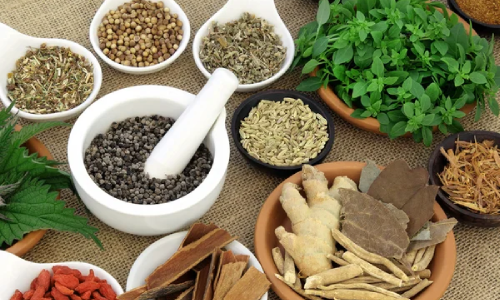
Kapha Dosha is responsible for giving structure and lubrication to the body. When balanced, Kapha gives us strength, protects against diseases and keeps us calm. But if it’s out of balance, it can cause weight gain, congestion and tiredness. My treatment for Dosha imbalances majorly involves dietary and lifestyle correction. And if necessary, It includes medicines in the treatment that aligns with the patients’ Prakriti (body type), Dosha imbalances and health conditions. The medicines are made in my unit using Ayurvedic medicinal Plants through traditional methods as mentioned in ancient Ayurvedic texts or Samhitas.    The Ayurvedic texts have mentions of an array of medicinal plants that help balance your Doshas. In this blog, let us discuss the top herbs that help balance Kapha Dosha.      5 Potent Medicinal Plants to Balance Kapha Dosha     These are some of the top medicinal plants that can help balance your Kapha Dosha:   Turmeric     Turmeric or Haridra is a bright yellow spice that comes from the dried rhizome of a plant in the ginger family. It’s a superstar in Ayurveda, known for its many healing properties. The herb is particularly effective in balancing Kapha Dosha. Its warming, dry and light qualities counteract Kapha’s heavy and moist nature.   Benefits   Anti-inflammatory Properties: One of the most amazing things about turmeric is its curcumin content. This compound helps reduce inflammation, which is great for managing Kapha.    Digestion: Turmeric supports the digestive fire or Agni, aiding digestion and metabolism. This is especially helpful for people with Kapha body types, who often struggle with slow digestion.    Detoxification: Another fantastic benefit of turmeric is its ability to support liver function and eliminate toxins (Ama) from the body. I often feel lighter and more energized when I regularly include turmeric in my diet.   How to Use   Turmeric is a staple ingredient in almost all Indian dishes. So, I would say it is the best way to incorporate turmeric into your routine.   You can add it as an ingredient to curries and soups or use its powder to make tea. Also, you can combine it with warm milk to make turmeric milk, which is great for coughs and colds, getting a good sleep and alleviating period cramps.   If you prefer, you can take turmeric supplements, but it’s always a good idea to consult with an Ayurvedic doctor first.    Ginger     Ginger, known as Shunti in Sanskrit, is a versatile herbal option to balance your Kapha Dosha. It has warming and stimulating properties that help in energizing the body and fighting off problems associated with Kapha, such as feeling “sluggish” or “congested.”   Benefits   Digestive Health: Works as a good appetizer and helps to improve digestion by enhancing the Agni. This reduces the accumulation of Ama as well as ensures that the food gets digested properly.   Respiratory Health: Works as an expectorant and helps remove mucus from the respiratory tract. This not only helps in relieving congestion but also makes breathing easier.   Weight Control: The herbs are able to enhance metabolism and help in weight reduction. It can prove to be especially effective if there is a Kapha vitiation in the individual’s body.   How to Use   Ginger can be used as an ingredient in cooking. You can also add it to teas, juices, smoothies, or can even be used as a spice in cooking. Ginger supplements are another option. But it is safe to consult an Ayurvedic doctor before trying them out.   Trikatu       Trikatu is a blend of three powerful spices: black pepper, long pepper (Pippali) and dry ginger. The strong heating and stimulating properties of this combination is great for balancing Kapha Dosha.   Benefits   Metabolic Booster: Trikatu helps enhance your metabolism and boosts your Agni, which helps your body process food more efficiently.   Detoxification: It helps your body get rid of Ama, reducing the risk of Kapha-related issues.   Respiratory Health: Trikatu is also good for clearing respiratory congestion and improving lung function.   How to Use   You can take Trikatu powder with honey or warm water. It’s also available in tablet form. As always, it’s best to consult with an Ayurvedic doctor before starting any new supplement.   Tulsi     Tulsi or Holy Basil is an important herb used in Ayurveda due to its numerous health benefits. It has the added advantage of helping to decrease Kapha Dosha due to its light, dry, and warm nature.   Benefits   Respiratory Support: Tulsi has a good effect on the respiratory passage and thins the mucus therefore; it is of great value in the case of Kapha respiratory disorders.   Stress Relief: It is an adaptogenic agent since it can help the body deal with stress to the point of sharpening your mind.   Immune Support: Tulsi also helps to strengthen the body’s defense and increases the body’s capability to fight diseases and infections.   How to Use   Tulsi can be consumed raw or the leaves may be boiled to prepare a tea or it can be used as a seasoning while preparing a particular dish. Tulsi capsules/tinctures are also available for those who do not want to consume leaves or Tulsi powder.   Also Read: Health Benefits of Tulsi   Cinnamon     Cinnamon or Twak in Sanskrit is a warm spice that helps in moderating Kapha Dosha. Due to its Pungent and hot like qualities, it can be used to balance excess Kapha Dosha.   Benefits   Blood Sugar Regulation: Cinnamon has a healing effect on blood sugar. Since blood sugar level is a major determinant of metabolism and weight, cinnamon is of great help.   Improved Circulation: It stimulates blood flow which combats Kapha’s tendency to cause lethargy.   Digestive Aid: Cinnamon helps in digestion and aids in getting rid of digestive problems like bloating and indigestion.   How to Use   Cinnamon is best added to teas,… Continue reading Medicinal Plants in Ayurveda for Balancing Kapha Dosha