6 Signs Your Agni Is Weak: What Ayurveda Says About Your Digestive Fire

In Ayurveda there is a saying,“Roga Sarvepi Mandagnau” it means, all diseases begin with a weakened digestive fire.   A strong Agni helps your body break down food efficiently, absorb nutrients properly, eliminate waste effectively, and maintain a healthy balance of the three Doshas: Vata, Pitta, and Kapha.   When Agni becomes weak, digestion slows down. Food is not processed efficiently, toxins begin to accumulate, and over time this can affect different systems in the body. This is why Ayurveda considers digestion to be the foundation of health.   So how do you know if your Agni needs attention? Here are 6 common signs of weak digestive fire according to Ayurveda.   Frequent Bloating and Gas   One of the most common signs of weak digestion is excessive gas and bloating.   Now, according to Ayurveda, gas and bloating are mainly associated with an imbalance of Vata in the body. And one of the biggest reasons for this is not eating at the right time.   Let me give you a simple example. Every day, you have your lunch at 12 o’clock. Your body gets used to this routine. It knows that food is going to arrive at that time, so your digestive system starts preparing itself. Your digestive juices, hydrochloric acid, and digestive enzymes are all ready and waiting.   But, instead of eating at 12, you have your lunch at 2 o’clock.   What happens then?   Your digestive system is already prepared for the meal, but the food never arrives. These digestive secretions continue to build up, creating discomfort in the stomach. Over time, this can show up as gas, bloating, heartburn, and acid reflux.   So, don’t just look at what you are eating. Also look at when you are eating. Sometimes, correcting your meal timings can make a huge difference to your digestive health.   Metallic taste in your mouth   I tell you, one of the easiest ways to find if your gut is in good shape is to wake up in the morning, go in front of the mirror, and smile. What do you see? Your teeth.   Your teeth can tell you a lot of things. Is your teeth yellow? Is it cracking? Sometimes you may feel that it is turning translucent and not really opaque, and you may have bad breath, and in the mouth, you may have a metallic taste. And when you open your mouth, you may feel that there is tendency for cavities. Your molars, teeth which is behind, they are getting affected slowly. They are not looking good.   And, and to be honest, all of this are actually huge signs your body is giving you about your gut, that you are having acid reflux, and your pitta in the body is really high.   Constipation or Irregular Bowel Movements   Our stool constitutes waste, not just from our food but also from the physiological processes in our body. If you are not defecating every day, a part of these get reabsorbed which causes toxin buildup.   Even a single day of not passing bowel movements is not advised for gut health.   There are a few simple Ayurvedic remedies that can help support regular bowel movements, which I’ve covered in detail here.   Your Skin Is Breaking Out   Your skin is often a reflection of what is happening inside your gut.   Another thing I look at is your diet. Are you eating foods that suit your body type, or Prakriti? Are you consuming a lot of processed and packaged foods?   Consuming foods that do not suit your body type or eating unhealthy processed foods can disrupt your body’s equilibrium and aggravate Dosha imbalances. Over time, this may contribute to skin problems such as acne, eczema, psoriasis, or unexplained breakouts.   So, if you are struggling with skin issues, don’t just look at your skin. Look at your gut as well. Sometimes the root cause is not on the outside, but inside your digestive system.   You Feel Heavy After Every Meal   Food is supposed to give you energy. It is not supposed to make you feel sleepy or sluggish.   People have become so used to feeling heavy after meals that they think it is normal. It is not.   If your meal leaves you feeling sluggish, uncomfortable, or ready to lie down, it may be a sign that your digestive fire is weak. Instead of efficiently digesting food and converting it into energy, your body is struggling to process what you eat.   A healthy Agni should leave you feeling satisfied and energized, not exhausted.   You Don’t Feel Hungry at Regular Times   One of the clearest signs of a healthy digestive fire is a healthy appetite.   Your body should naturally tell you when it is time to eat. If you frequently skip meals because you are not hungry, or if your appetite changes dramatically from one day to the next, it may indicate that your Agni is weak.   A healthy digestive system works like a well-maintained clock. It knows when to digest food and when to ask for more.   When those hunger signals become irregular, it is often one of the earliest signs that your digestive fire needs support.   Small Changes That Can Make a Big Difference   The good news is that Ayurveda offers simple ways to support your digestive fire.   One of the most important things you can do is maintain a routine. Try to eat your meals at roughly the same time every day. When your body knows when food is coming, digestion tends to work more efficiently.   Avoid skipping meals, overeating, or eating late at night. Give your body enough time to digest one meal before moving on to the next.   Pay attention to how different foods make you feel. Foods that suit one person may not suit another. Ayurveda always emphasizes eating according to your individual… Continue reading 6 Signs Your Agni Is Weak: What Ayurveda Says About Your Digestive Fire

5 Natural Supplements You Should Add To Your Diet Every Single Day

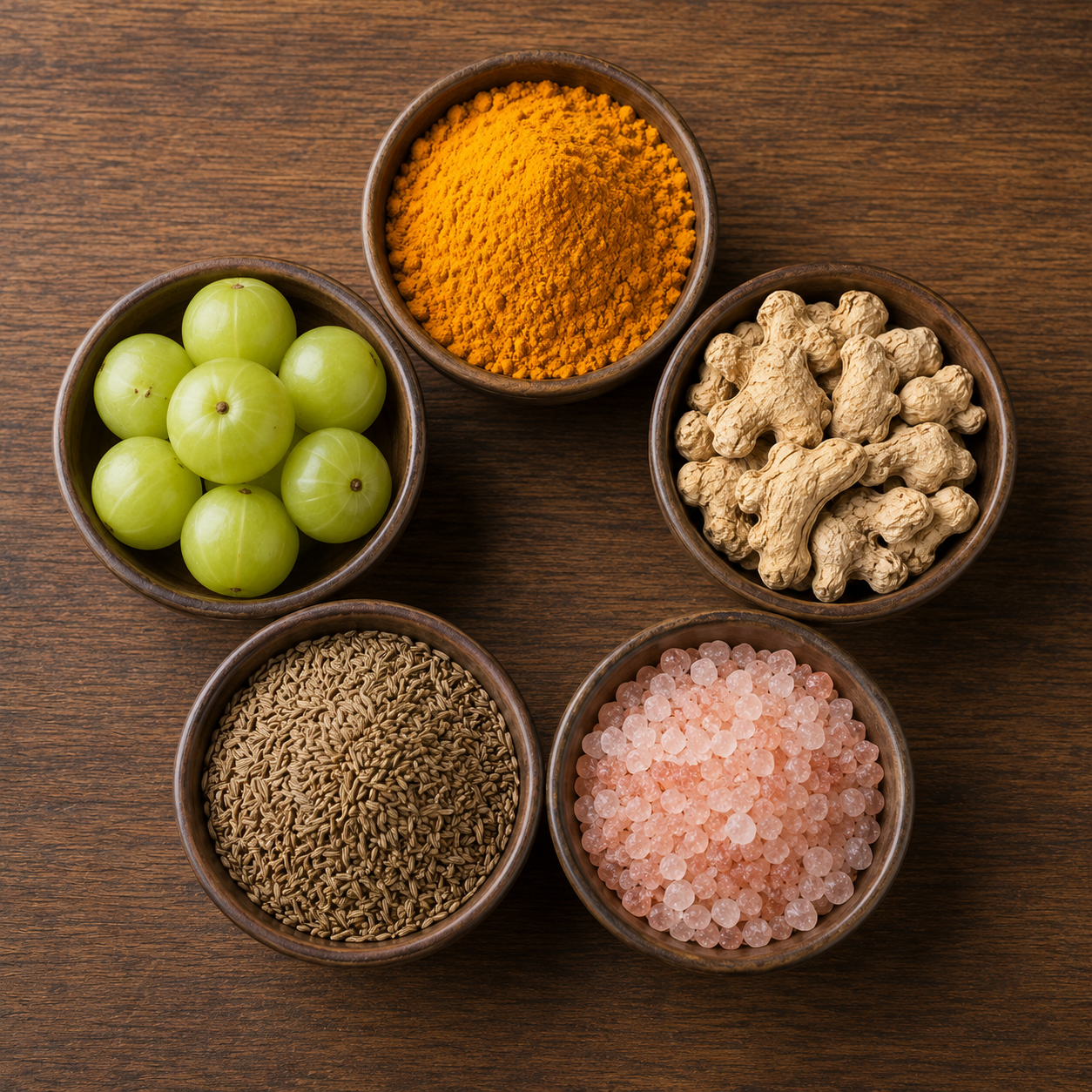
1. Turmeric   The number one supplement that you need in your life is nothing but turmeric.     You may have heard people saying, especially people in the west, talking about having turmeric in the form of teas, in the form of turmeric lattes, or sometimes even in the form of supplements.   You don’t need all of these pills and supplements to get your adequate amount of turmeric to help with all the benefits that it is going to give us.   Our traditional Indian way of cooking where we add the good fats and the spices, along with that we add turmeric, that is the most bioavailable form of turmeric and that helps with better digestion, better absorption, and better assimilation of all the good things that turmeric has to give us.   Now let us understand what turmeric does in our body. For this we have to understand what the properties of turmeric are as per Ayurveda.   Ayurveda says every food has certain properties, like there is a specific taste to a particular food item, a particular post-digestive taste.   Ayurveda also talks about a property called Prabhava or special characteristic.   One special characteristic or Prabhava of turmeric is that it is antimicrobial and anti-inflammatory.   For example, somebody is having a viral condition like chickenpox, we ask our patients to take shower with water boiled with turmeric because it is antimicrobial.   When it comes to food poisoning, if you consume more of turmeric paste throughout the day, you are helping your body to reduce inflammation.   Even if you have acne, you can use turmeric boiled water to wash your face because of its antimicrobial properties, you don’t need any antibacterial face washes.   All bitter tasting herbs are good for your liver. So, if you want to detoxify your liver, don’t go for supplements and medicines that detoxify your liver. Instead, just add a little bit more turmeric to your diet.   Adding turmeric to your dishes can help you improve your digestive fire, reduce gas, and bloating.   If you have children at home who constantly get bronchitis, cough, cold, fever, etc., turmeric helps you to improve their immunity. Make sure that you add turmeric to your cooking every day.   Even in traditional Indian cooking, we have so many dishes like haldi chawal, haldi doodh, haldi ka achar, turmeric lettuce soup. All of these are very good for improving your digestive system.     2. Dry Ginger     Number two is dry ginger.     I am talking about dry ginger and not wet ginger. Wet ginger is extremely heating, extremely pitta increasing. Dry ginger is also warm; it is much less heating compared to wet ginger.   When you buy ginger, make sure that you leave it outside and don’t keep it in the fridge so that it gets a little dry and then you can use it for cooking.   Just like how we said turmeric was anti-microbial and anti-inflammatory because of its prabhava, ginger also has a prabhava.   And what is that?   Dry ginger is anti-emetic. That means if somebody feels like vomiting, dry ginger is what we give.   It’s also good for improving digestion, absorption, and assimilation of food. It helps in reducing gas and bloating. It helps in subsiding Vata gently.   Just like how I told you about turmeric, don’t take dry ginger as a pill or a supplement. Instead, make sure that you have dry ginger in a cooked form along with other spices and good fats.   I personally add dry ginger every day to my cooking. However, one special indulgence that I really love doing is to have dry ginger wali masala chai.   After heavy meals, if for example, you had a biryani and you’re now feeling very heavy, very bloated, or you have this guilt feeling that you shouldn’t have had it because you can’t even think of the digestive problems that may come, then have dry ginger powder mixed with a little bit of rock salt, add a little bit of water and consume it.   That will help you subside the gas and bloating. It will also help you improve the digestion.   And if you’re somebody who feels constipation, you can have a glass of dry ginger water in the morning.   Make sure that you add two glasses of water, add one piece of dry ginger and reduce to one glass to get the maximum essence of dry ginger. And drink this water. This can ease your bowel movements.     3. Amla   This one is my favorite.     If you don’t want to have any supplement at all in this world, then one supplement that you need in your life is amla or amla powder.   This is something that you must include in your life.   Whether it is in the form of amla powder, amla juice, as amla murabba, amla candy, whatever it is, amla has to go into your system every single day.   Every house should have some form of amla ready to be served every day because amla helps in a lot of ways beyond what you can imagine.   There is a particular practice in Ayurveda. We call it as Kuti Pravishika. It is for people who want to reverse aging. It is a complete process. And the one thing that is given to people who wants to reverse their aging is Amla.   Amla has rejuvenating or anti-aging properties which can actually reverse your aging.   It is amazing for your skin, amazing for your heart, amazing for your hair, amazing for your digestive system, your liver, your intestine, and it’s good for your eyes.   So, if you want to take that one supplement every day, take Amla.   How can you consume Amla?   You can have Amla juice. Again, Amla juice, don’t have it as a… Continue reading 5 Natural Supplements You Should Add To Your Diet Every Single Day

Understanding Seasonal Living Through Ayurveda

If we observe nature closely, it becomes clear that our body is not separate from the environment. Ayurveda explains that the movement of the sun, the change of seasons, and the shifting climate all influence our strength, digestion, and overall health.   By understanding this relationship, we can gently adjust our food, lifestyle, and daily habits so that we stay balanced throughout the year.   One important way Ayurveda explains this connection is through the movement of the sun across the year. The year is broadly divided into two halves called Uttarayana and Dakshinayana, and each of these phases affects both nature and the human body in a very specific way.   The Role of the Sun: Adana and Visarga   During Uttarayana, the sun appears to move northward and its intensity gradually increases. In Ayurveda, this phase is called Adana Kala, which means to take away or absorb.   In this period, the growing strength of the sun and wind slowly draws moisture, nourishment, and strength from the earth and living beings. The environment becomes more dry and sharp, and our physical strength tends to go down.   Dakshinayana is the opposite half of the year, when the sun appears to move southward. This phase is known as Visarga Kala, which means to release or nourish.   Here, the influence of the moon becomes more prominent, bringing coolness, moisture, and stability to the surroundings. The earth and all living beings receive nourishment, and strength gradually returns.   These are not just astronomical descriptions. They describe how solar movement changes qualities like heat, dryness, and moisture, and how these qualities affect our strength, nourishment, and the balance of the doshas in the body.   This is why Ayurvedic seasonal routines change so much from one part of the year to another.   Why Our Strength Changes with the Seasons   Summer falls within the Adana phase and is marked by intense heat. During this time, the sun and air become extremely hot, sharp, and dry. Because the sun is effectively taking away strength, human vitality reaches one of its lowest points in this period.   To support the body, Ayurveda recommends foods that are cooling, hydrating, and light during summer. At the same time, it advises avoiding foods that increase internal heat, especially salty, sour, and pungent tastes.   These tastes are naturally heating, and if we consume them in large amounts during very hot weather, they can increase internal heat, dehydrate the body further, and worsen fatigue.   Instead, summer foods are better when they are light, cooling, and somewhat liquid in nature. They help maintain hydration, soothe heat, and protect strength.   A good example is a traditional drink called Rasala, which is curd churned with sugar and a small amount of pepper. At first, pepper may seem like an odd choice for hot weather, but in this preparation it helps support weak digestive fire, while the sugar and churning make the drink light and cooling overall. The result is a gentle, nourishing drink that fits the needs of the season.   How Seasons Influence the Doshas   Each season affects the doshas in a different way, which is why the focus of seasonal routines keeps changing.   In spring, Kapha is the main dosha to watch. During the cold months, Kapha accumulates in the body. When the sun begins to warm the earth in spring, this stored Kapha starts to melt.   This can weaken digestion and lead to congestion or other Kapha-related issues if not managed well. So, seasonal guidance for spring focuses on reducing Kapha with light food, regular exercise, and cleansing practices.   In summer, the extreme heat reduces Kapha but begins to increase Vata. Dryness, overheating, and exhaustion slowly aggravate Vata. By the time the rainy season arrives, Vata reaches its peak. The cool winds, clouds, dampness, and unstable weather further disturb Vata and make the body more vulnerable to illness.   These patterns show why Ayurveda gives so much importance to seasonal routines. The idea is not to wait until disease appears but to anticipate these natural shifts and support the body before imbalance sets in.   Winter: A Season of Strong Digestive Fire   Winter holds a special place in Ayurvedic understanding of the body. Even though the environment is very cold, the internal digestive fire, known as Agni, actually becomes stronger.   The reason is that the cold outside blocks the sweat channels of the body and prevents heat from escaping. This trapped heat builds up inside and increases digestive power so the body can stay warm and stable.   However, this strong digestive fire also has a risk. If it does not receive enough proper nourishment, it may begin to use the body’s own tissues as fuel, which can lead to depletion and Vata-type problems.   To prevent this, winter diets emphasize nourishing foods rich in sweet, sour, and salty tastes. These tastes are heavier and more strengthening, and they provide the fuel needed to support the powerful digestive fire and protect body tissues from being used up. This is why many traditional winter foods are richer, heavier, and more satisfying than foods we typically eat in other seasons.   The Six Tastes and Their Effects   Ayurveda describes six main tastes, or rasas, and each one has a specific effect on the body. Sweet, bitter, and astringent tastes generally have a cooling potency, while sour, salty, and pungent tastes tend to be heating.   These tastes also influence strength. Sweet, sour, and salty tastes usually increase strength, nourishment, and stability when used in the right way. Pungent, bitter, and astringent tastes can reduce strength if overused, as they are more drying and clearing in nature.   Ayurveda does not ask us to completely avoid any taste. Instead, it encourages moderation and context. Even a food that can aggravate a particular dosha may be perfectly safe or even beneficial when taken in the right amount, at the right… Continue reading Understanding Seasonal Living Through Ayurveda

Pathya and Apathya in Ayurveda: The 8 Rules of Eating from Charaka Samhita

Ever wonder why the same food can heal you one day and throw your digestion off the next?   That is where the ideas of Pathya and Apathya in Ayurveda come in.   A food is not automatically good or bad forever. The same food can become healing or harmful depending on many factors.   It’s not just about what you eat, but how, when, where, and who you are when you eat it.   Charaka Samhita, one of the oldest texts of Ayurveda, gives us the eight rules of eating, Ahara Vidhi, to help us make wiser choices. These principles, though ancient, are still practical and very relevant to modern life.   What Does Pathya and Apathya Really Mean?     Pathya means something that supports balance, digestion, clarity, and strength. Apathya means something that disturbs digestion, creates toxins, or aggravates imbalance.   But Ayurveda never looks at the food being consumed alone. It looks at the whole picture:   How much you eat? When you eat? How the food is prepared? Where you live? Your body type and current imbalance. Your habits and adaptability.   For example, A cup of warm spiced milk at bedtime may be soothing and comforting. The same milk at 3:00 in the morning can feel heavy, sticky, and disturbing to digestion.     Key Factors That Decide Whether Food Becomes Pathya or Apathya   Matra: Quantity   Even good food becomes harmful when eaten in excess. Heavy foods like cheese, fried food, or sweets should be eaten in smaller amounts. Light foods can be eaten a little more freely.   Overeating weakens Agni (digestive fire), creates heaviness, and leads to toxin formation. Undereating can weaken the body and nervous system. Balance is everything.   Kala: Time   Time means time of day, season, and even life stage. Digestion is strongest around midday, that is why lunch should ideally be your main meal. Late-night heavy meals disturb sleep and digestion.   Season also matters. In hot summer, heavy oily food can aggravate heat while in cold dry weather, more nourishing and oily foods may be helpful.   Food that suits winter may not suit summer. Ayurveda constantly reminds us to stay in rhythm with nature.   Kriya or Samskara: How Food Is Prepared   The way you prepare food changes its effect on the body. For example: Raw food is generally heavier to digest. Cooked food becomes lighter and easier for Agni. Dry roasting wheat makes it more digestible than eating it plain or poorly cooked. Rice becomes more wholesome when aged, soaked, washed, and cooked properly. The excess starch is removed, making it lighter and less clogging. Milk combined incorrectly can become harmful. Fish and milk together are considered incompatible. Fruit and milk can also disturb digestion.   Even herbs change their qualities based on preparation, these are the five basic dosage forms as per Ayurveda: Svarasa is fresh juice, very potent and heavy. Kalka is paste, useful externally or for specific effects. Kadha is a reduced decoction and becomes light and penetrating. Phanta is like herbal tea made with hot water. Hima is a cold infusion, often used to cool Pitta. Coriander soaked overnight and drunk the next day is a classic example for acidity and heat.   Even the container can change the effect. Triphala paste kept in an iron vessel becomes beneficial for eye health due to the interaction with iron.   So, food is not just what you eat, it is also how it is transformed.   Desha or Bhumi: Place and Environment   Where you live strongly influences what your body needs.   Dry, windy, high-altitude places increase dryness and nervous system activity. People living there often need more oils, warmth, and grounding foods. Wet, cold places increase heaviness and congestion. Desserts and heavy dairy consumption may worsen imbalance there.   Local food also matters. Vegetables, grains, and even animals carry the qualities of the land. Climate influences your Doshas whether you realize it or not.   Travel can disturb the nervous system, movement increases Vata and restlessness. Many people notice mood shifts or digestive upset after flights.   Dosha and Current Imbalance   Your Prakriti (constitution) and Vikriti (current imbalance) influence what suits you. When Doshas are aggravated, even small mistakes can trigger symptoms. Food choices become more sensitive during illness or stress.   Vega Avastha: Stage of Disease or Imbalance   When imbalance is severe, even small triggers can create flare-ups. At those times, discipline around food becomes especially important.   Satmya: Adaptability and Habituation   This is a powerful and subtle concept. The body adapts to what it is repeatedly exposed to.   Some people tolerate spicy food well because of cultural habits and ancestry. Others feel burned by the same food.   There is Sharira Satmya, adaptability to healthy things. There is Oka Satmya, adaptability to unhealthy things.   The body can adapt even to abuse, someone may tolerate junk food without immediate symptoms, but deeper imbalance may slowly build. Interestingly, a person who reacts quickly to wrong food may actually be healthier than someone who feels nothing.   Ayurveda recommends slow, gentle changes rather than extreme detox or cold-turkey approaches. Sudden drastic change can disturb the nervous system and create instability.   In the end, Pathya and Apathya help us to build a more conscious and compassionate relationship with our bodies.   Instead of chasing trends, superfoods, or rigid dietary rules, we learn to observe, feel, and respond. The body is always giving feedback through digestion, energy, sleep, emotions, and clarity of mind. When we honour that feedback, food becomes a tool for stability rather than struggle.   Even simple shifts such as eating at regular times, choosing freshly prepared meals, avoiding incompatible combinations, and adjusting to seasons can quietly transform health over time. There is no need for perfection, Ayurveda values consistency, patience and gradual refinement.   The body adapts slowly and forcing change often creates more imbalance than healing. When… Continue reading Pathya and Apathya in Ayurveda: The 8 Rules of Eating from Charaka Samhita

Ayurvedic Diet and the Art of Mindful Eating

An Ayurvedic diet is a major part of my treatment plan for my patients for all health conditions. According to Ayurveda, food is medicine. It not only provides you energy to sustain, but it also heals you. I am someone who gives importance to diet.  80% of my treatment involves food and the rest 20% involves medicines.    If you know me, you might have seen me talking about gut health all the time. Poor gut health is the root cause of all diseases. So, the best way to have a balanced gut health is to have foods that are suitable for you.    Ayurveda believes that each person is unique. That’s why each of my patients is given a personalized diet plan tailored to suit their body type (Prakriti), Dosha imbalances and health conditions.   In this blog, let us explore more about the power of the Ayurvedic diet.   Understanding Ayurvedic Nutrition   Ayurveda defines good health (as mentioned in Sushruta Samhita) as follows:   “Sama Dosha Sama Agnischa Sama Dhatu Mala Kriyaaha Prasanna Atma  Indriya Manaha Swastha Iti Abhidheeyate”    A person is in good health when their Doshas, Agni, Dhatus (body tissues) and Mala (waste products) are in balance. Also, the Mana (mind), Indriyas (sense organs) and Atma (soul) of the person must be in a pleasant state.    And for all these to be in balance, food plays an important role. Food, when not digested, turns into Ama (toxins). The accumulation of Ama in the body, therefore, causes imbalances in your Agni and Doshas; as a result, this can lead to diseases.  That’s why it is important to have light, digestible foods that suit you.   Furthermore, Ayurveda emphasizes the significance of consuming locally sourced and seasonal foods. It’s crucial to adjust your diet to accommodate changes in weather and seasons. This helps keep your dominant Doshas in check and boost your immunity according to the season.    Foods based on your Doshas   Each person has a unique constitution of the three Doshas, out of which one or two may be predominant. So, it is important to eat foods that help balance out your predominant Doshas. You can consult an Ayurvedic doctor to figure out your Prakrit as well as Dosha imbalances and to guide you regarding your diet.   Vata Dosha   Vata Dosha is associated with the characteristics of air and space; moreover, it embodies qualities such as lightness and mobility. This Dosha governs movement, creativity and communication. Vata people are full of energy, possess great creativity and have quick-thinking abilities. Imbalanced Vata can result in feelings of anxiety, fidgetiness and difficulties with digestion.   Foods to balance Vata: Hot and prepared foods, such as soups, thick stews and vegetables cooked by steaming. Healthy fats, like ghee, avocado and sesame oil. Basic spices, such as cumin, ginger and cinnamon.   Pitta Dosha   Pitta Dosha is, indeed, the combination of fire and water in the body. Furthermore, it regulates the body’s energy usage and, consequently, the process of breaking down food for energy. Pitta people tend to be passionate, committed, and able to maintain their focus on objectives. However, an imbalance in Pitta may manifest as irritability, inflammation, and digestive issues.   Foods to balance Pitta: Cooling foods like Cucumber, mint, and coconut. Foods with robust and intense tastes, such as pungent leafy greens and fenugreek.   Avoid overindulging in extremely spicy, sour or fried foods.   Kapha Dosha   Kapha Dosha, resembling the elements of earth and water, provides the body with solidity, power and hydration. Individuals who possess a robust Kapha constitution typically exhibit composure, compassion and willingness to assist others. Excessive Kapha can result in feelings of fatigue, weight gain and congestion.   Foods to balance Kapha: Warm and spicy foods, such as red peppers, garlic, and ginger are great.  Leafy greens, beans and quinoa are examples of foods that are not heavy and do not leave you feeling overly satiated.   Limit your consumption of dairy and high-fat foods.   Foods that promote healing   Ayurveda categorizes foods based on their taste (Rasa), potency Virya), and post-digestive effect (Vipaka). Incorporating the six tastes – sweet (Madhura), sour (Amla), salty (Lavana), bitter (Tikta), pungent (Katu) and astringent (Kashaya) – ensures a well-rounded diet that satisfies the body’s needs and promotes healing.   Many everyday ingredients possess remarkable healing properties, according to Ayurveda. Turmeric, for instance, is revered for its anti-inflammatory and antioxidant properties, making it a staple in Ayurvedic cuisine. Other examples include ginger, cilantro, and cumin, each offering unique health benefits. To reset gut health, emphasis is placed on easily digestible foods such as cooked vegetables, whole grains like basmati rice, and nourishing soups.  Ayurvedic nutrition extends beyond physical health to encompass mental and spiritual well-being. Therefore, have foods like almonds, saffron, and ghee that help nourish the mind and enhance spiritual awareness.   Foods based on seasons   According to Ayurveda, there are 7 seasons (Ritu) – Vasanta Ritu (spring), Greeshma Ritu (summer), Varsha Ritu (monsoon), Sharad Ritu (autumn), Hemanta Ritu (late autumn or pre-winter) and Shishira Ritu (winter).   Seasonal changes, consequently, affect your body and, as a result, bring about imbalances in your Doshas and Agni. So, it is important to eat accordingly.   During Vasanta Ritu, consume dry (Ruksa) and cold (Sheeta) foods. You can have foods with Madhura (sweet) taste during Greeshma Ritu. Foods with Lavana Rasa are the best for Varsha Ritu.  During Sharad Ritu, have dry and cold foods with Madhura, Tikta and Kashaya Rasas.  Snigdha (unctuous) and Ushna (hot) foods are, therefore, best suited for Hemanta and Shishira Ritu.   Ayurvedic principles of eating   Here are the 10 principles of eating (Ahara vidhi vidhana) recommended by Ayurveda: Ushnamashneeyat: Eat warm food. Snigdhamashneeyat: Eat unctuous food (not dry). Matravadashneeyat: Eat the right quantity. Jeerneashneeyat: Eat food only after the previous meal gets digested. Viryaavairudhamashneeyat: Eat compatible foods. Ishtadeshe ishtasarvopakaramashneeyat: Eat food in a good place and also, ensure you… Continue reading Ayurvedic Diet and the Art of Mindful Eating