
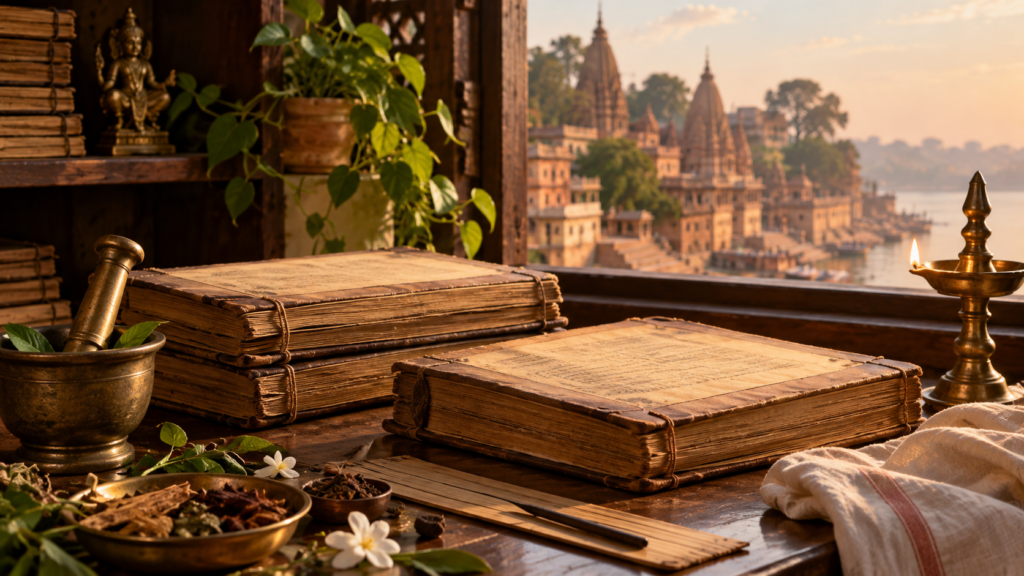
I always talk about principles mentioned in Charaka Samhita or Ashtanga Hridayam, in my videos, in my blogs, quoting a verse or referencing a concept but I’ve actually never spoken about these texts themselves.
So today, let’s talk about them.
Ayurveda, as a whole, is built upon three foundational texts. Together, they’re literally called the Brihatrayi, which means “the great three.” These are Charaka Samhita, Sushruta Samhita, and Ashtanga Hridayam.
And honestly, once you understand how different these three actually are from each other, in purpose and what they were even trying to accomplish, a lot of Ayurveda starts making more sense.
Let’s start with Charaka Samhita.
The Charaka Samhita was originally attributed to Agnivesha, the sage who is said to have written this work, then called Agnivesha Tantra, under the guidance of his teacher Punarvasu Atreya. Charaka is mostly credited for revising and redacting the original text into what we mostly study today.
Rather than being written by one person, this text has been passed down, and is a result of multiple hands across generations. Even a scholar named Dridhabala completed large portions of the text that had been lost. So, this text was compiled and edited over a long stretch of time.
Charaka’s text is essentially the foundation of internal medicine, what we call Kayachikitsa. If you want to understand disease from the inside out, digestion, the Doshas, how illness actually develops in the body, this is your primary source.
There’s a well-known opening line in the text, “Aayuh kaamayamaanena dharmaartha sukha saadhanam,” which basically says that anyone who desires a long, healthy life, one that supports Dharma, Artha, and Sukha, should give their full attention to the teachings of Ayurveda.
Even in that first line, you can sense the scope Charaka is working with, health isn’t the goal in itself, it’s the foundation everything else in life is built on.
And Charaka doesn’t just impose his own teachings on us, but also gives us the room to debate, question, and walk us through multiple viewpoints, sometimes even contradicting opinions, before settling on a conclusion. So instead of sounding like a rule book, it reads like an actual academic argument that happened about 2000 years ago.
The book is dense, thorough, and keeps its essence very clear.
There’s also a beautiful line often quoted from this text, describing exactly what the science is for, “Swasthasya swasthya rakshanam, aaturasya vikaara prashamanam cha.”
It means, to protect the health of the healthy, and to cure the disease of the unwell. Two goals, not one, prevention and cure.
Sushruta Samhita takes a very different path.
Sushruta Samhita is attributed to Sushruta, a physician-surgeon who is said to have studied under Divodasa Dhanvantari, the King of Kashi, considered an incarnation of Dhanvantari, the god of medicine, in the Ayurvedic tradition. Sushruta is believed to have practised and taught in Kashi, which is present-day Varanasi.
Just like Charaka Samhita, this text also wasn’t the work of one person alone. It’s widely believed that the original text was later revised by a scholar named Nagarjuna, who is credited with adding to and reorganising portions of it. So again, what we study today is the result of layers, added over generations, rather than a single sitting of writing.
What makes Sushruta Samhita stand apart is its focus. If Charaka is the foundation of internal medicine, Sushruta is the foundation of surgery, what’s called Shalya Tantra.
This is the text that goes into real detail about surgical instruments, wound management, and procedures like cataract surgery and reconstructive techniques.
Then comes Ashtanga Hridayam, written later by Vagbhata, and honestly, this is the one most people find easiest to start with.
Ashtanga Hridayam literally means “the heart of the eight branches,” and that name tells you exactly what it’s structured around. The text is organised into the eight branches of Ayurveda, Kayachikitsa (internal medicine), Shalya Tantra (surgery), Shalakya Tantra (diseases of the eyes, ears, nose, and throat), Kaumarabhritya (paediatrics), Agada Tantra (toxicology), Bhuta Vidya (psychiatry, dealing with what were understood as mental and spirit-related disorders), Rasayana (rejuvenation therapy), and Vajikarana (the science of fertility and vitality).
Within this, the text is further divided into six sections, or Sthanas. Sutrasthana lays out the foundational principles, this is where Dinacharya, daily routine, and Ritucharya, seasonal routine are spoken about.
Sharirasthana covers anatomy and the non-material aspects of the body, including the self and consciousness.
Nidanasthana deals with diagnosis and understanding disease. Chikitsasthana covers actual treatment protocols for specific conditions. Kalpasthana focuses on formulation and pharmacology, and Uttarasthana, the final section, circles back to cover the remaining specialised branches in more depth, eye and ENT conditions, paediatrics, toxicology, and rejuvenation therapy.
You get the entire scope of Ayurveda in one organised place, which is exactly why most students, even today, start their formal education with this text.
If you’d like to properly study these texts yourself, shloka by shloka, with context and explanation, that’s exactly what we go through in our Charaka Samhita and Ashtanga Hridayam courses. You can check them out here.