

Principles of Ayurveda: What Everything Else Is Built On

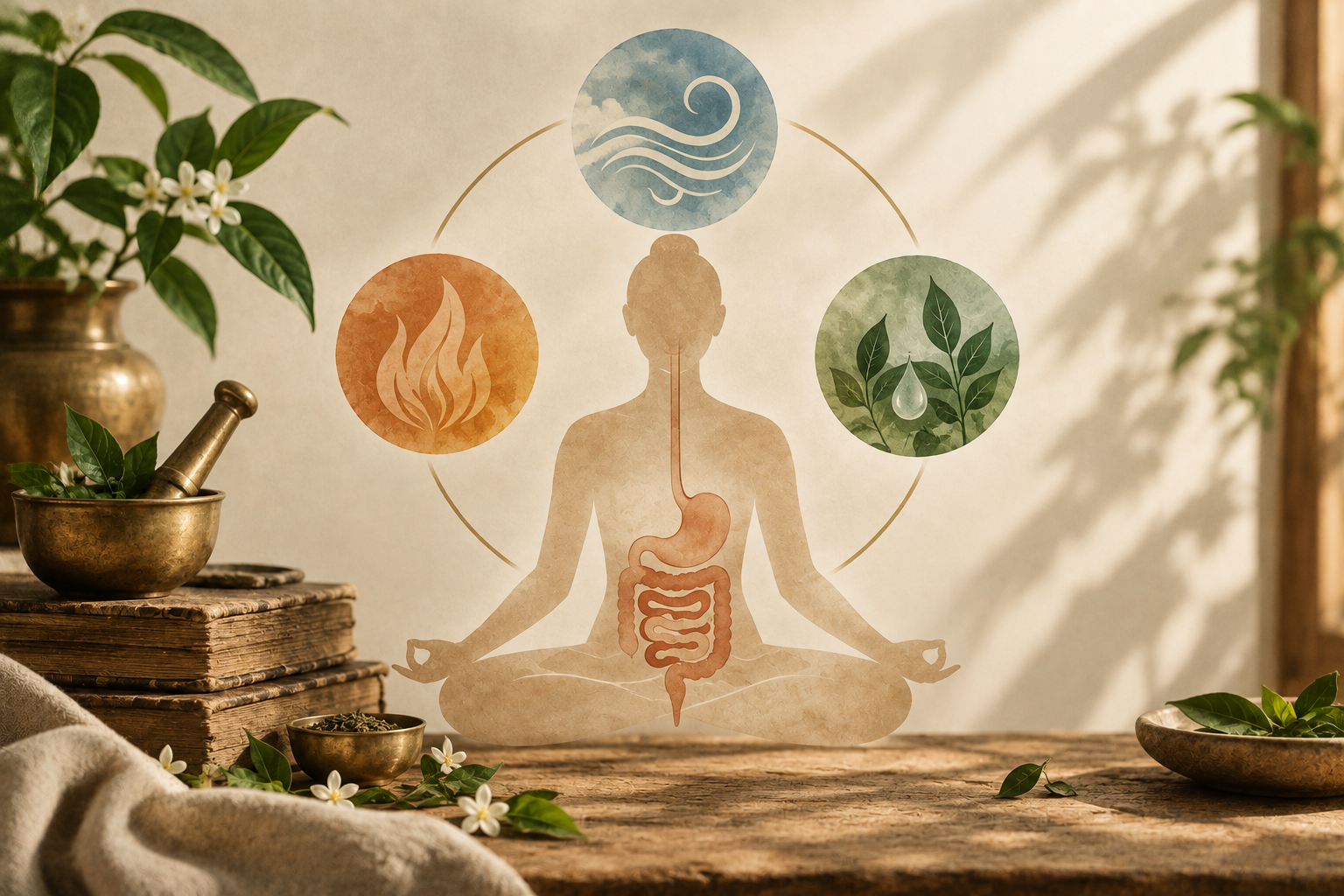
Today, let’s go back to the very beginning.   Before Doshas, before Agni, before all the specific topics we usually talk about, there is a bigger question. What is Ayurveda actually trying to do?   Most people think of it as a system to treat disease and yes, it does that. But that is only half of it.   Ayurveda comes from two Sanskrit words, Ayur meaning life and Veda meaning science. Therefore, Ayurveda translates to the science of life, and it cares just as much about keeping a healthy person healthy as it does about treating someone who is unwell.   In the Indian way of thinking, life has four goals. Dharma, Artha, Kama and Moksha.  And none of these are possible if your body and mind are struggling. So, health was never the end goal, it was what made everything else possible.   Now, to understand how Ayurveda looks at the body, you need to start with one idea. Pancha Mahabhuta.   We experience the world through five senses. Sight, touch, hearing, taste and smell. Ayurveda says everything around us can be understood through five elements that go with these: Akasha, Vayu, Agni, Jala and Prithvi. Space, air, fire, water and earth.   And this isn’t only about nature. Your body is made of these same elements, so is your food and so is your medicine. Even ordinary water isn’t just Jala. It carries all five, with one leading.   This is why Ayurveda never saw the body and the world as two separate things. What is outside you keeps becoming what is inside you, through food, water and air. And when the balance shifts within, your body tries to correct it. It lets go of what is in excess and asks for what is lacking. In a way, that is what a craving really is.   From these five elements come the three Doshas. Vata, Pitta and Kapha.   Vata is mostly space and air. It is movement. Breathing, speaking, and everything in your body that needs to be pushed forward.   Pitta is mostly fire. It is transformation. Digestion, forming blood, vision, memory, turning one thing into another.   Kapha is mostly water and earth. It is moisture and stability. It softens food for digestion, helps you taste, and nourishes the senses.   Something I always want people to understand is that these three are not sitting in separate corners of the body. They are everywhere but the concentration varies. Vata is mostly in the intestines and bones, Pitta is in the stomach and blood, Kapha in the chest and joints. When they are balanced, they hold you up. When they are disturbed, that is where disease begins.   Then come the Dhatus, the seven tissues that form the body’s structure. Rasa, Rakta, Mamsa, Meda, Asthi, Majja and Shukra. Plasma, blood, muscle, fat, bone, marrow and reproductive tissue.   And this matters because Doshas don’t affect the body randomly. The Dhatus are the first place they act. So, when you look at how a disease really develops, it almost always passes through them.   Which brings us back to Agni.   The food you eat comes from outside. It is unfamiliar to your body, and it has to be broken down and made into something your body can use.   Agni is what does that.   But there is not just one Agni. There is the main digestive fire in the gut. There are five Bhutagnis that turn the elements in your food into elements your body recognises. And there are seven Dhatvagnis, one for each tissue, turning nutrients into that specific tissue, step by step.   That is why Ayurveda treats Agni almost as the body itself. When someone comes in with a problem, a Vaidya often looks first at the state of their Agni. Because if that isn’t working well, nothing else will. Most Ayurvedic medicines are designed with this in mind.   Now here is the part I find the most personal.   Prakriti.   Ayurveda believes every person is unique, and Prakriti is the reason. At the time of conception, the Doshas present decide your natural constitution. It could be Vata, Pitta, Kapha, a mix of two, or a balance of all three. And it stays with you for life.   That is why Ayurveda says it treats the person, not the disease. Two people with the same illness may need very different treatment. Someone with a Vata Prakriti is more prone to Vata problems, so they are advised to avoid what aggravates Vata. A Pitta person is given cooling things. A Kapha person, warming things.   And the mind is part of this too. Prakriti is also described through Sattva, Rajas and Tamas, because Ayurveda never saw disease as only physical. The mind affects the body, and the body affects the mind. Which is why even a physical illness sometimes comes with steps for the mind.   Even medicines are understood this way. They carry the five elements as well, so Ayurveda looks at their taste, called Rasa, their qualities, called Guna, their potency, Virya, and their effect after digestion, Vipaka. And then there is something none of these can explain, the medicine’s special action, called Prabhava. Two medicines can be alike in every other way and still act differently because of this.   Now, none of this is meant to be memorised in one sitting. But if you step back, you can see how it all connects. The elements make the Doshas. The Doshas affect the tissues. Agni keeps the whole thing running. Prakriti decides how all of it shows up in you and the same logic carries over to food, medicine and even the mind.   That is what makes Ayurveda a system, and not just a collection of remedies.   And I think that is the real takeaway. When you understand these basics, you stop seeing Ayurvedic advice as random rules, like eat this, avoid that. You… Continue reading Principles of Ayurveda: What Everything Else Is Built On

Atman in Ayurveda: Understanding the Self, Mind, and Consciousness

Today, let’s talk about a concept in Ayurveda that is present in everything the system talks about, but not everyone gets into it or knows about it because the whole concept itself is too abstract on the surface.   I am talking about Atman, which translates to the self, the soul, or simply the knower.   Now, before jumping into what Atman really means, let’s start with something which we are more familiar with in terms of Ayurveda, which is the Manas, the mind.   So, mind is essentially the part of you that reacts. It takes in the stimulus and turns it into a response. It distinguishes between likes and dislikes. For example, if something you eat tastes good, you want to eat more of it, and if you experience pain, you pull away. You don’t want to experience it again.   This is what the Manas does.   However, Atman is something else entirely. It is a part of you that is aware that all of this is happening. It’s not the reaction itself, but it’s the one noticing the reaction.   While Manas distinguishes experiences into pain and pleasure, Atman is simply aware of the inside and outside, it is the very awareness of this experience.   Here’s a simple way of how I think about it.   When you’re feeling unwell, usually the food that you eat every time, or the food that you like, you don’t want to have it and it might even taste unpleasant to you.   But nothing about the food has changed. What changed is how it is being received by your body.   This shift, the change between you and your mind, is the job of Atman. It is adjusting your experiences based on what is happening inside you.   Now, Atman cannot itself be described the way we describe everything else in the body, because it has no color, no shape, no texture. Its presence is not known entirely or directly.   But even if you don’t see Atman, you infer it. How differently a person can respond to the same thing, and how something within them prompts them to respond in that particular way.   The whole Atman can also be understood through this perspective, from the whole idea of possession, how it naturally comes to us when we talk about our things.   When we say, “I am tired,” there is still this strange distinction between the one who is experiencing tiredness and the tiredness itself.   This distance implied between someone who possesses and something that is being possessed, is where the idea of Atman comes from.   All the parts of your body are what is possessed by you, the person. So, despite any changes or aging or anything, the one that is staying constant is me, my. The idea of the owner is what is Atma.   And this whole distinction isn’t just philosophical. There’s a real practical framework of diagnosis around it too.   In Ayurveda, illness comes in three severities. One is ordinary, one serious, and one that is heading to a very fatal outcome.   And the way you tell these apart isn’t just purely because of external signs, but how clearly the person can experience their own feeling.   How clearly can they experience things like their preference, discomfort, desire, how they feel, and if all of this is intact in a coherent way.   Because once illness starts to get serious, all of this starts to blur. The person struggles to clearly experience. Memory becomes hazy, and the coordination too falters.   And in most serious cases, the patients may not be able to experience anything at all. They might feel numb. They can’t tell you how they feel because the whole response, the whole connection between your Atma, Manas, and the senses has weakened and there’s only basic signs of life that’s left.   This is such a different way of thinking about diagnosis compared to how we actually imagine ancient medicine, which is reduced to something that is purely external, physical observation.   In Ayurveda, the presence of your mind and the clarity of your awareness itself is one of the most important ways to diagnose what is wrong inside you, and it is sometimes arguably more important than any physical sign.   Now, the takeaway from all of this is very simple, despite how abstract Atman sounds.   And before even Ayurveda gets into the details of the body, bones, tissues, or organs, it is first establishing that awareness that is present inside every one of us, and everything else is built on top of that basic confirmation.   Health is never only about visible, measurable parts of the body. It is always, at its core, something that is changing inside you.   And I think this is where Atman becomes much less abstract than it initially sounds.   Because when we hear words like soul or self, it can immediately feel like we’re entering a completely philosophical conversation, something very distant from the body and from medicine. But Ayurveda doesn’t really separate these things in the way that we might expect. The person who is experiencing the illness is not just the body that is carrying the illness.   There is the body, there are the senses, there is the mind, and there is this awareness that experiences all of it.   If ideas like this interest you, you can check out our courses on Charaka Samhita and Ashtanga Hridayam which talk in depth about how Ayurveda understands the self, the mind, and the body as one connected system and much more.

Why Your Body Isn’t Just “Tissues and Waste”

Most people, the moment they start reading about Ayurveda, land on this word, Dosha, almost immediately. Vata, Pitta, Kapha. And usually, the very first explanation they get is something like “Dosha means fault” or “Dosha means fluid,” and honestly, that explanation doesn’t help at all.   If anything, it makes the whole thing feel more confusing than before you started.   So let’s actually slow down and ask a more basic question first. What is the body even made of, according to Ayurveda?   Before we even get to Dosha, there are two other categories worth understanding, Dhatu and Mala, because once you see how these three relate to each other, Dosha suddenly makes a lot more sense.   Dhatu refers to everything in your body that’s meant to stay. Your blood, muscles, fat, bones, the fluid in your spinal cord, reproductive tissue, all of it.   These are structurally very different from each other, obviously, but they share one thing in common, none of them are meant to leave your body under normal circumstances.   When they do leave, by injury or bleeding or some other accident, your body doesn’t feel relieved. It feels depleted, anxious and weak. That’s the signature of a Dhatu, its presence sustains you, and its loss destabilizes you.   Mala is the exact opposite category. This is everything your body is meant to get rid of, stool, urine, sweat, and so on. And here’s the interesting part, getting rid of these isn’t a failure of the body, it’s actually a sign of it working properly.   Holding onto waste for too long doesn’t protect you, it burdens you. A Mala that overstays starts creating problems rather than preventing them.   So while Dhatu is defined by staying, Mala is defined by leaving, and both, in their own way, keep the body functioning.   Now here’s where it gets genuinely interesting, because Dosha doesn’t fit into either of these categories. It refuses to follow the rule.   Think about saliva for a second. It’s produced inside your body, moves through your salivary glands, briefly steps outside the boundary of your internal tissue system into your mouth, and then re-enters your body as you swallow it along with your food.   It doesn’t stay put like a Dhatu, and it doesn’t fully leave like a Mala either. It does something in between, and that “in between” behavior is exactly what defines a Dosha.   It moves out into contact with the world, and then brings something back in, and this back-and-forth movement is precisely what makes digestion, absorption, and basically your entire relationship with the outside environment possible.   This is such an important shift in how to think about Vata, Pitta, and Kapha. They’re not things that cause or lead up to a disease. They’re the functional bridges that let your body interact with everything you eat, breathe, and absorb from the world around you.   Vata handles movement, what you take in. Pitta governs transformation, converting of one thing into another. Kapha manages binding, lubrication, and the way things hold together and connect.   Without these three doing their job constantly, your Dhatus would never get built, and your Malas would never get properly separated out and removed.   And here’s something that genuinely surprised me the first time I really understood it, this dual-direction movement of the Doshas happens twice a day, in the gastrointestinal tract specifically.   If something you’re consuming regularly doesn’t actually suit your body, that excess starts getting expressed back out, sometimes as an unusually sour or pungent sensation, sometimes as a sweet, sticky feeling.   This isn’t randomness, it’s your body’s own feedback system, quietly telling you that whatever you keep feeding it in excess isn’t being absorbed the way you assume it is.   Most of us just don’t know how to read that signal.   This is also why identifying someone’s Prakriti, their natural constitutional dominance of one or two Doshas, matters so much in how Ayurveda actually treats a person. Two people can eat the exact same meal and metabolize it completely differently, purely because their underlying Dosha balance is different.   What nourishes one person can genuinely unsettle another. This is the entire logic behind why Ayurveda has never really believed in one-size-fits-all diet advice, it was never really about the food.   It was always about how well your Doshas are managing the exchange between what’s outside you and what needs to become a part of you.   So the next time someone tells you Dosha simply means “fault,” it’s worth remembering that it’s actually closer to the opposite. It’s not what goes wrong in the body. It’s the very mechanism that allows the body to keep working, keep exchanging, and keep staying alive in the first place.   If ideas like this interest you, our courses on Charaka Samhita and Ashtanga Hridayam go much deeper into how Dosha, Dhatu, and Mala work together as the foundation of the entire Ayurvedic system.