
Principles of Ayurveda: What Everything Else Is Built On

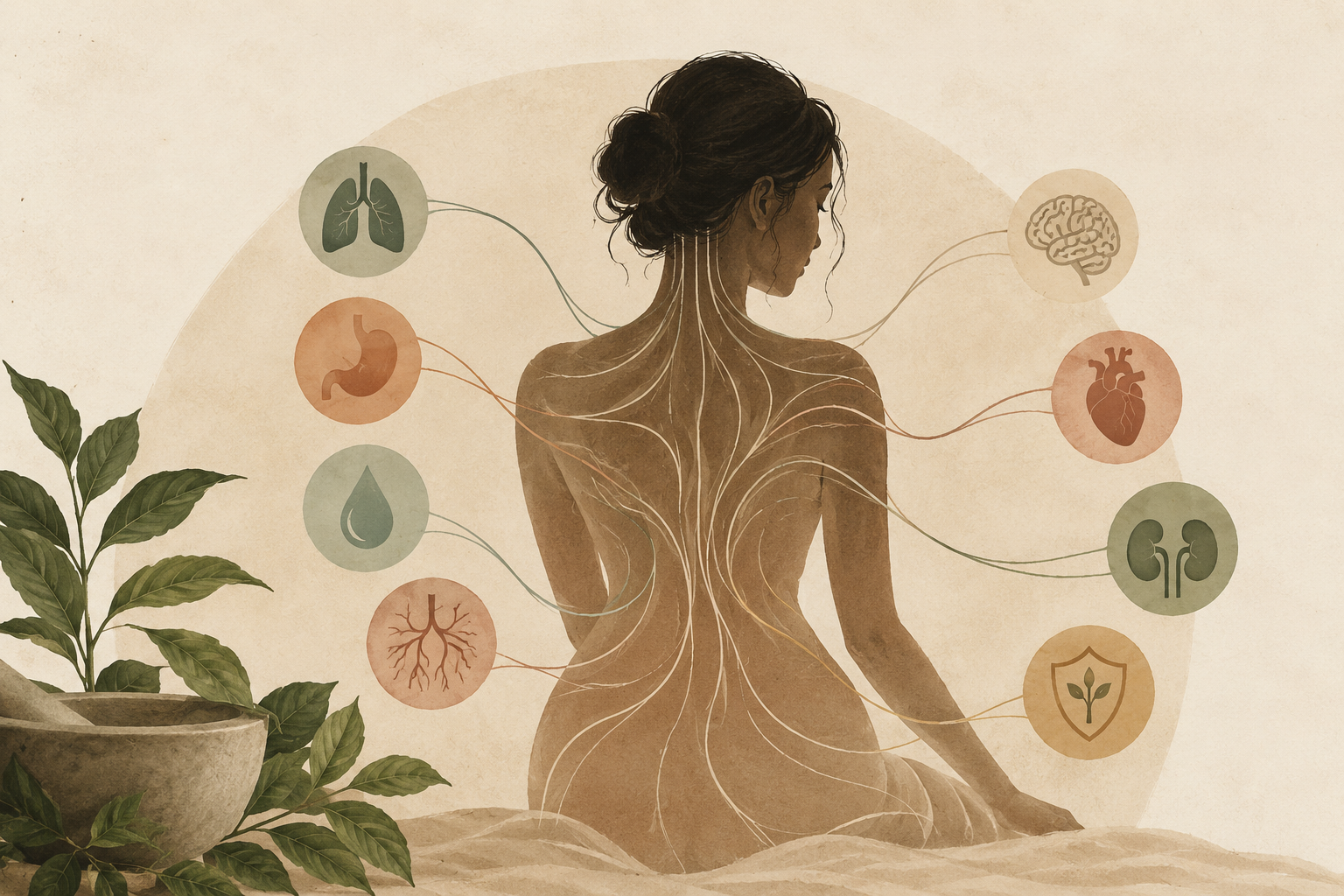
Today, let’s go back to the very beginning.   Before Doshas, before Agni, before all the specific topics we usually talk about, there is a bigger question. What is Ayurveda actually trying to do?   Most people think of it as a system to treat disease and yes, it does that. But that is only half of it.   Ayurveda comes from two Sanskrit words, Ayur meaning life and Veda meaning science. Therefore, Ayurveda translates to the science of life, and it cares just as much about keeping a healthy person healthy as it does about treating someone who is unwell.   In the Indian way of thinking, life has four goals. Dharma, Artha, Kama and Moksha.  And none of these are possible if your body and mind are struggling. So, health was never the end goal, it was what made everything else possible.   Now, to understand how Ayurveda looks at the body, you need to start with one idea. Pancha Mahabhuta.   We experience the world through five senses. Sight, touch, hearing, taste and smell. Ayurveda says everything around us can be understood through five elements that go with these: Akasha, Vayu, Agni, Jala and Prithvi. Space, air, fire, water and earth.   And this isn’t only about nature. Your body is made of these same elements, so is your food and so is your medicine. Even ordinary water isn’t just Jala. It carries all five, with one leading.   This is why Ayurveda never saw the body and the world as two separate things. What is outside you keeps becoming what is inside you, through food, water and air. And when the balance shifts within, your body tries to correct it. It lets go of what is in excess and asks for what is lacking. In a way, that is what a craving really is.   From these five elements come the three Doshas. Vata, Pitta and Kapha.   Vata is mostly space and air. It is movement. Breathing, speaking, and everything in your body that needs to be pushed forward.   Pitta is mostly fire. It is transformation. Digestion, forming blood, vision, memory, turning one thing into another.   Kapha is mostly water and earth. It is moisture and stability. It softens food for digestion, helps you taste, and nourishes the senses.   Something I always want people to understand is that these three are not sitting in separate corners of the body. They are everywhere but the concentration varies. Vata is mostly in the intestines and bones, Pitta is in the stomach and blood, Kapha in the chest and joints. When they are balanced, they hold you up. When they are disturbed, that is where disease begins.   Then come the Dhatus, the seven tissues that form the body’s structure. Rasa, Rakta, Mamsa, Meda, Asthi, Majja and Shukra. Plasma, blood, muscle, fat, bone, marrow and reproductive tissue.   And this matters because Doshas don’t affect the body randomly. The Dhatus are the first place they act. So, when you look at how a disease really develops, it almost always passes through them.   Which brings us back to Agni.   The food you eat comes from outside. It is unfamiliar to your body, and it has to be broken down and made into something your body can use.   Agni is what does that.   But there is not just one Agni. There is the main digestive fire in the gut. There are five Bhutagnis that turn the elements in your food into elements your body recognises. And there are seven Dhatvagnis, one for each tissue, turning nutrients into that specific tissue, step by step.   That is why Ayurveda treats Agni almost as the body itself. When someone comes in with a problem, a Vaidya often looks first at the state of their Agni. Because if that isn’t working well, nothing else will. Most Ayurvedic medicines are designed with this in mind.   Now here is the part I find the most personal.   Prakriti.   Ayurveda believes every person is unique, and Prakriti is the reason. At the time of conception, the Doshas present decide your natural constitution. It could be Vata, Pitta, Kapha, a mix of two, or a balance of all three. And it stays with you for life.   That is why Ayurveda says it treats the person, not the disease. Two people with the same illness may need very different treatment. Someone with a Vata Prakriti is more prone to Vata problems, so they are advised to avoid what aggravates Vata. A Pitta person is given cooling things. A Kapha person, warming things.   And the mind is part of this too. Prakriti is also described through Sattva, Rajas and Tamas, because Ayurveda never saw disease as only physical. The mind affects the body, and the body affects the mind. Which is why even a physical illness sometimes comes with steps for the mind.   Even medicines are understood this way. They carry the five elements as well, so Ayurveda looks at their taste, called Rasa, their qualities, called Guna, their potency, Virya, and their effect after digestion, Vipaka. And then there is something none of these can explain, the medicine’s special action, called Prabhava. Two medicines can be alike in every other way and still act differently because of this.   Now, none of this is meant to be memorised in one sitting. But if you step back, you can see how it all connects. The elements make the Doshas. The Doshas affect the tissues. Agni keeps the whole thing running. Prakriti decides how all of it shows up in you and the same logic carries over to food, medicine and even the mind.   That is what makes Ayurveda a system, and not just a collection of remedies.   And I think that is the real takeaway. When you understand these basics, you stop seeing Ayurvedic advice as random rules, like eat this, avoid that. You… Continue reading Principles of Ayurveda: What Everything Else Is Built On

Atman in Ayurveda: Understanding the Self, Mind, and Consciousness

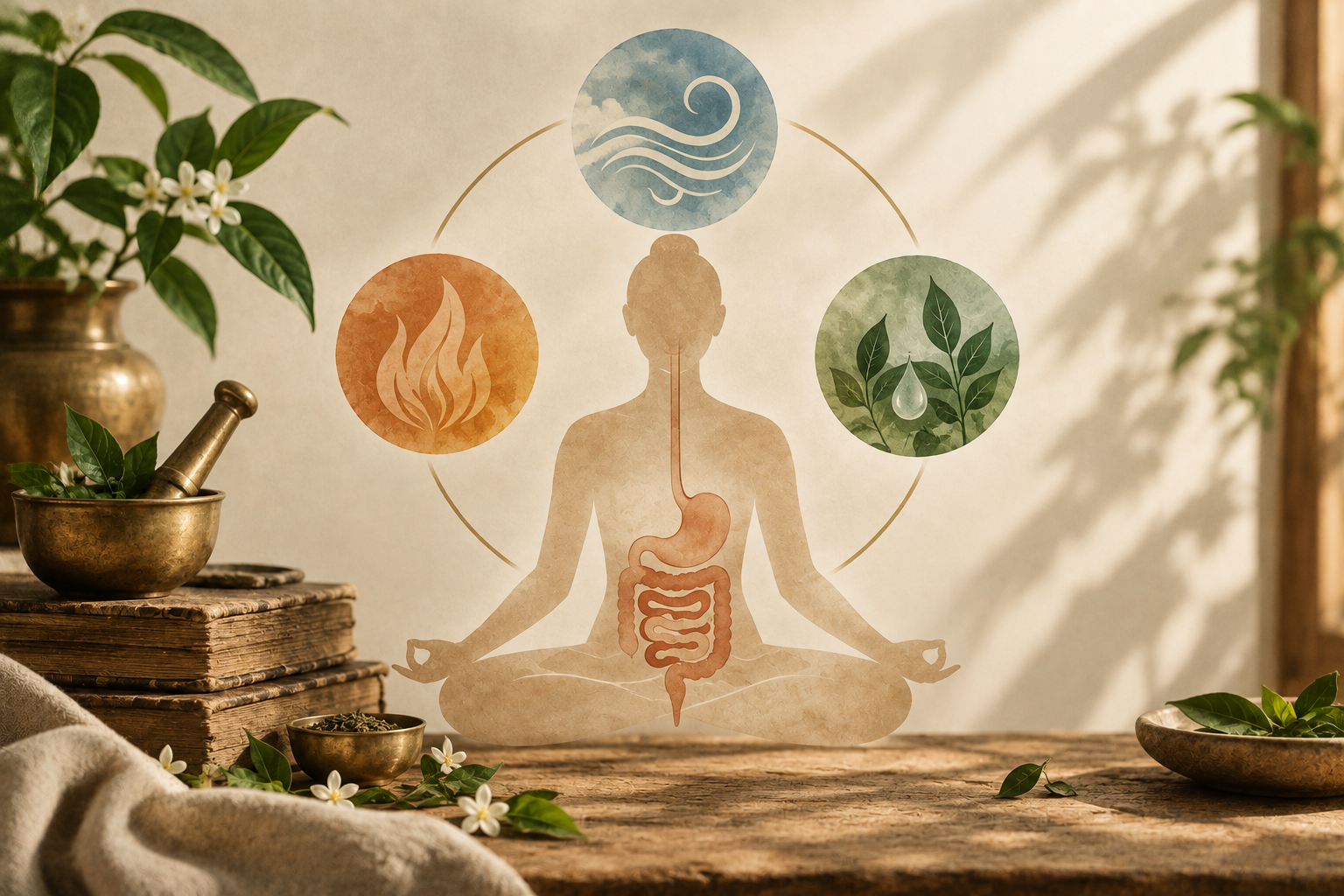
Today, let’s talk about a concept in Ayurveda that is present in everything the system talks about, but not everyone gets into it or knows about it because the whole concept itself is too abstract on the surface.   I am talking about Atman, which translates to the self, the soul, or simply the knower.   Now, before jumping into what Atman really means, let’s start with something which we are more familiar with in terms of Ayurveda, which is the Manas, the mind.   So, mind is essentially the part of you that reacts. It takes in the stimulus and turns it into a response. It distinguishes between likes and dislikes. For example, if something you eat tastes good, you want to eat more of it, and if you experience pain, you pull away. You don’t want to experience it again.   This is what the Manas does.   However, Atman is something else entirely. It is a part of you that is aware that all of this is happening. It’s not the reaction itself, but it’s the one noticing the reaction.   While Manas distinguishes experiences into pain and pleasure, Atman is simply aware of the inside and outside, it is the very awareness of this experience.   Here’s a simple way of how I think about it.   When you’re feeling unwell, usually the food that you eat every time, or the food that you like, you don’t want to have it and it might even taste unpleasant to you.   But nothing about the food has changed. What changed is how it is being received by your body.   This shift, the change between you and your mind, is the job of Atman. It is adjusting your experiences based on what is happening inside you.   Now, Atman cannot itself be described the way we describe everything else in the body, because it has no color, no shape, no texture. Its presence is not known entirely or directly.   But even if you don’t see Atman, you infer it. How differently a person can respond to the same thing, and how something within them prompts them to respond in that particular way.   The whole Atman can also be understood through this perspective, from the whole idea of possession, how it naturally comes to us when we talk about our things.   When we say, “I am tired,” there is still this strange distinction between the one who is experiencing tiredness and the tiredness itself.   This distance implied between someone who possesses and something that is being possessed, is where the idea of Atman comes from.   All the parts of your body are what is possessed by you, the person. So, despite any changes or aging or anything, the one that is staying constant is me, my. The idea of the owner is what is Atma.   And this whole distinction isn’t just philosophical. There’s a real practical framework of diagnosis around it too.   In Ayurveda, illness comes in three severities. One is ordinary, one serious, and one that is heading to a very fatal outcome.   And the way you tell these apart isn’t just purely because of external signs, but how clearly the person can experience their own feeling.   How clearly can they experience things like their preference, discomfort, desire, how they feel, and if all of this is intact in a coherent way.   Because once illness starts to get serious, all of this starts to blur. The person struggles to clearly experience. Memory becomes hazy, and the coordination too falters.   And in most serious cases, the patients may not be able to experience anything at all. They might feel numb. They can’t tell you how they feel because the whole response, the whole connection between your Atma, Manas, and the senses has weakened and there’s only basic signs of life that’s left.   This is such a different way of thinking about diagnosis compared to how we actually imagine ancient medicine, which is reduced to something that is purely external, physical observation.   In Ayurveda, the presence of your mind and the clarity of your awareness itself is one of the most important ways to diagnose what is wrong inside you, and it is sometimes arguably more important than any physical sign.   Now, the takeaway from all of this is very simple, despite how abstract Atman sounds.   And before even Ayurveda gets into the details of the body, bones, tissues, or organs, it is first establishing that awareness that is present inside every one of us, and everything else is built on top of that basic confirmation.   Health is never only about visible, measurable parts of the body. It is always, at its core, something that is changing inside you.   And I think this is where Atman becomes much less abstract than it initially sounds.   Because when we hear words like soul or self, it can immediately feel like we’re entering a completely philosophical conversation, something very distant from the body and from medicine. But Ayurveda doesn’t really separate these things in the way that we might expect. The person who is experiencing the illness is not just the body that is carrying the illness.   There is the body, there are the senses, there is the mind, and there is this awareness that experiences all of it.   If ideas like this interest you, you can check out our courses on Charaka Samhita and Ashtanga Hridayam which talk in depth about how Ayurveda understands the self, the mind, and the body as one connected system and much more.

Why Your Body Isn’t Just “Tissues and Waste”

Most people, the moment they start reading about Ayurveda, land on this word, Dosha, almost immediately. Vata, Pitta, Kapha. And usually, the very first explanation they get is something like “Dosha means fault” or “Dosha means fluid,” and honestly, that explanation doesn’t help at all.   If anything, it makes the whole thing feel more confusing than before you started.   So let’s actually slow down and ask a more basic question first. What is the body even made of, according to Ayurveda?   Before we even get to Dosha, there are two other categories worth understanding, Dhatu and Mala, because once you see how these three relate to each other, Dosha suddenly makes a lot more sense.   Dhatu refers to everything in your body that’s meant to stay. Your blood, muscles, fat, bones, the fluid in your spinal cord, reproductive tissue, all of it.   These are structurally very different from each other, obviously, but they share one thing in common, none of them are meant to leave your body under normal circumstances.   When they do leave, by injury or bleeding or some other accident, your body doesn’t feel relieved. It feels depleted, anxious and weak. That’s the signature of a Dhatu, its presence sustains you, and its loss destabilizes you.   Mala is the exact opposite category. This is everything your body is meant to get rid of, stool, urine, sweat, and so on. And here’s the interesting part, getting rid of these isn’t a failure of the body, it’s actually a sign of it working properly.   Holding onto waste for too long doesn’t protect you, it burdens you. A Mala that overstays starts creating problems rather than preventing them.   So while Dhatu is defined by staying, Mala is defined by leaving, and both, in their own way, keep the body functioning.   Now here’s where it gets genuinely interesting, because Dosha doesn’t fit into either of these categories. It refuses to follow the rule.   Think about saliva for a second. It’s produced inside your body, moves through your salivary glands, briefly steps outside the boundary of your internal tissue system into your mouth, and then re-enters your body as you swallow it along with your food.   It doesn’t stay put like a Dhatu, and it doesn’t fully leave like a Mala either. It does something in between, and that “in between” behavior is exactly what defines a Dosha.   It moves out into contact with the world, and then brings something back in, and this back-and-forth movement is precisely what makes digestion, absorption, and basically your entire relationship with the outside environment possible.   This is such an important shift in how to think about Vata, Pitta, and Kapha. They’re not things that cause or lead up to a disease. They’re the functional bridges that let your body interact with everything you eat, breathe, and absorb from the world around you.   Vata handles movement, what you take in. Pitta governs transformation, converting of one thing into another. Kapha manages binding, lubrication, and the way things hold together and connect.   Without these three doing their job constantly, your Dhatus would never get built, and your Malas would never get properly separated out and removed.   And here’s something that genuinely surprised me the first time I really understood it, this dual-direction movement of the Doshas happens twice a day, in the gastrointestinal tract specifically.   If something you’re consuming regularly doesn’t actually suit your body, that excess starts getting expressed back out, sometimes as an unusually sour or pungent sensation, sometimes as a sweet, sticky feeling.   This isn’t randomness, it’s your body’s own feedback system, quietly telling you that whatever you keep feeding it in excess isn’t being absorbed the way you assume it is.   Most of us just don’t know how to read that signal.   This is also why identifying someone’s Prakriti, their natural constitutional dominance of one or two Doshas, matters so much in how Ayurveda actually treats a person. Two people can eat the exact same meal and metabolize it completely differently, purely because their underlying Dosha balance is different.   What nourishes one person can genuinely unsettle another. This is the entire logic behind why Ayurveda has never really believed in one-size-fits-all diet advice, it was never really about the food.   It was always about how well your Doshas are managing the exchange between what’s outside you and what needs to become a part of you.   So the next time someone tells you Dosha simply means “fault,” it’s worth remembering that it’s actually closer to the opposite. It’s not what goes wrong in the body. It’s the very mechanism that allows the body to keep working, keep exchanging, and keep staying alive in the first place.   If ideas like this interest you, our courses on Charaka Samhita and Ashtanga Hridayam go much deeper into how Dosha, Dhatu, and Mala work together as the foundation of the entire Ayurvedic system.  

Dinacharya in Ayurveda: The Art of Living in Rhythm With Your Body

What comes to your mind when you hear the word Dinacharya?   You might think the words morning routine, right?   And what does your morning routine include?   Waking up early, brushing your teeth, scraping your tongue, drinking warm water, exercising, meditating, and perhaps some oil pulling. Then you begin your day feeling particularly disciplined.   Yes, some of these practices are indeed part of the Ayurvedic approach to daily living, but Dinacharya is much bigger than this list of things that we do.   It extends far beyond waking up and going to bed. Even the way we eat, the timing of our meals and the way food is prepared can influence how we experience our day-to-day health.   I recently spoke about some of these in my new YouTube video, “5 Ayurvedic Eating Habits I Wish Everyone Knew | Part 1.” If you want to understand how everyday eating habits can be approached, I go into this in much more detail there.   [Watch: 5 Ayurvedic Eating Habits I Wish Everyone Knew | Part 1]   Ashtanga Hridayam has an entire chapter dedicated to Dinacharya, and Vagbhata begins the chapter with a very simple instruction:   “Brahme muhurte uttishthēt.”   Wake up during Brahma Muhurta.   Now, what exactly is Brahma Muhurta?   A Muhurta is a traditional unit of time, approximately 48 minutes. Brahma Muhurta refers to the period before sunrise, traditionally beginning two Muhurtas, or approximately 96 minutes, before sunrise and lasting for about 48 minutes. So, depending on the time of sunrise, it generally falls somewhere around 1.5 hours before sunrise.   And there is a reason Ayurveda places such importance on this particular window.   This is considered a time dominated by Vata, the Dosha associated with movement, lightness and subtle activity. It is the transition between night and day. The environment is quieter, there is less sensory stimulation, and the mind is considered to be more receptive and clear.   The chapter then talks about Danta Dhavana, using twigs from specific trees like Arka, Nyagrodha, Khadira, and Karanja, chosen for tastes that are Kashaya (astringent), Katu (pungent), or Tikta (bitter). And it specifically mentions cleaning your teeth without hurting the gums, “dantamaamsaanyabaadhayan.”   It’s such a small detail, but it tells you something important about how nothing is too minor to matter. Even your mouth, the very first point of contact between you and your food, gets its own careful instruction.   The body is made up of all these small things, and the way you care for them every day eventually becomes part of your overall health.   From Danta Dhavana, the text moves into Anjana, or the care of the eyes. Vagbhata recommends Sauviranjana as a daily practice for the eyes and mentions Rasanjana at intervals for cleansing.   Again, what stands out to me is the attention to detail. The eyes are not treated as something separate from the rest of the body. They are another part of the body that needs regular care. And when you think about how much of our day today is spent looking at screens, this idea of simply paying attention to the condition of our eyes feels particularly relevant.   Then comes Nasya, Gandusha, and Dhoomapana, with the use of Tambula. These practices belong to a very different medical context, and they should not simply be copied into a morning routine without understanding who they are intended for and under what circumstances.   But what is interesting, and what I want to point out here, is how comprehensive the total idea of daily care was.   From the mouth, nose, eyes, skin, the head, and all the senses, everything had a place in Dinacharya. There was an understanding that health was made up of all these systems that need to be cared for continuously. It was not about waiting for something to go wrong and then addressing it.   And then we come to Abhyanga, which is one of the most recognisable practices today. Vagbhata says, “Abhyangam acharet nityam.” He recommended regular oiling of the body, emphasising particularly on the head, ears, and feet, and describing benefits related to the skin, vitality, strength and sleep.   I have also made a detailed video about Abhyanga, if you wish to understand the practice in more detail. [Watch the video here.]   Then finally comes Vyayama, or exercise.   Exercise that is appropriate can bring lightness to the body, improve our capacity for work, support digestion and help reduce excess fat. But we must understand that exercise is not the same for everybody, and it is certainly not meant to be excessive.   Vagbhata actually gives detailed instructions about who should exercise, how much they should exercise and when exercise should be avoided. He says that exercise should be done up to approximately half of one’s capacity, rather than pushing the body beyond what it can comfortably tolerate.   And I think this is an important distinction.   And Dinacharya doesn’t just stop with the physical body.   This is where I find the chapter particularly interesting, because Vagbhata gradually moves from taking care of your body to how you conduct yourself.   He speaks about using words that are truthful, measured and pleasant:   “Kāle hitam mitam brūyād avisaṃvādi peśalam.”   Speak at the right time. Speak what is beneficial, measured, truthful and pleasant.   He speaks about compassion, generosity, humility and how we should conduct ourselves even when dealing with people who may not treat us well in return.   And this tells us something important about what Ayurveda actually meant by health.   It was never only about physical health. The way you conduct yourself is also part of your well-being.   The way you speak, the way you behave, the conflicts that you create, the anger you hold on to, and the way you treat other people all become part of the environment in which your body and mind have… Continue reading Dinacharya in Ayurveda: The Art of Living in Rhythm With Your Body

Ama: When Digestion Is Incomplete

After you have had your meal, there might be times when you feel heavy. It is not exactly tiredness, but you do not feel nourished either. Your head feels foggy, there is a discomfort you cannot quite ignore, and yet it is not severe enough to feel like something is seriously wrong.   There may also be a feeling that you have not experienced complete satisfaction from the meal. It is almost as though something inside you is saying that the process is not finished, that the job has not been completed.   Today, we are going to talk about one of the widely spoken-about concepts in Ayurveda: Ama. When the accumulation of Ama is greater, it can give rise to a condition described as Amadosha.   To understand Ama, we have to go back to something we have spoken about before: Agni, our digestive fire.   What Is Ama?   Ashtanga Hridayam describes this state directly. When the digestive strength is low, the very first tissue formed from food, which remains undigested, becomes vitiated and gets lodged in the stomach as unprocessed matter. This is described as Ama.   When Agni is working the way it should, the food we consume gets properly digested, absorbed, and converted into Rasa Dhatu, the first and most essential tissue our body produces after digestion.   But when Agni is weak, this conversion does not happen cleanly. Your food is not entirely digested, but it is not entirely rejected either. Some of it remains half-processed, turning into something called Ama.   Ama is not exactly food. It is not waste either. It is something caught in between the two, the result of incomplete digestion and improper transformation.   What Causes Ama?   One of the causes is eating more than what your hunger can accommodate.   Ayurveda describes this as atimātrā āhāra, or consuming food in excessive quantity. When food is consumed in a quantity greater than what the digestive capacity can handle, it places a burden on Agni. This can lead to the aggravation of all three doshas and interfere with proper digestion.   But it is not exactly about quantity alone. The nature of the food also matters.   Food that is heavy, dry, or cold can contribute to the formation of ama, even when it is eaten in a reasonable amount.   And it is not just about food.   Your lifestyle, mental strain, and the mental state you carry throughout the day can also contribute. When your digestive capacity is compromised, even food that you consider light or harmless may not be processed properly.   When Agni is weak, food does not necessarily provide the nourishment your body requires. Instead, according to the Ayurvedic understanding of ama, incompletely processed material can behave like a slow-acting poison within the body.   What Happens When Ama Interacts With the Doshas?   As this undigested or improperly processed material interacts with the doshas, its effects can vary depending on how the body responds.   It may become trapped and cause a condition described in Ayurveda as Alasaka. Or it may be expelled violently from the body, which is described as Vishoochika.   Either way, the body is signalling that something has gone wrong in the process of digestion and assimilation.   The manifestation can also differ depending on which dosha is involved.   When Pitta is involved, you may see signs such as a burning sensation, excessive thirst, and disturbances in the mouth, reflecting more heat-related expressions.   When Kapha is involved, it can manifest differently, with congestion-type conditions, urinary disorders, and other Kapha-dominant patterns.   This is why Ayurveda does not look at digestion as simply a matter of what you eat. It considers the strength of Agni, the nature and quantity of food, the timing of meals, lifestyle, mental state, and the condition of the doshas together.   Ama, in this sense, is not simply about having eaten something unhealthy. It is about what happens when the body is unable to properly process what it has received.   What Are the General Properties of Ama?   Ayurveda describes Ama as having certain characteristic properties.   It is guru, meaning heavy and difficult to digest.   It is drava, meaning it has a liquid nature.   It is aneka-varṇa, meaning it can present in different colours.   And it is picchila, meaning slimy or sticky in nature.   The symptoms associated with ama are often the kind most of us have experienced at some point.   There may be a sense of blockage or obstruction, general exhaustion, heaviness in the head, dizziness, stiffness in the back and hips, unusual thirst, and that general feeling that whatever you eat is simply not sitting right.   Individually, none of these symptoms may seem particularly alarming.   But when several of them appear together, they can indicate that something is not functioning properly within the digestive system.   The answer is not always to simply eat less, eliminate one particular food, or ignore the discomfort and wait for it to disappear.   Ayurveda asks us to look deeper at Agni.   How strong is your digestion? Are you eating according to your hunger? Are you eating at regular times? Is the food appropriate for your digestive capacity? Is your lifestyle supporting digestion, or constantly working against it?   Because digestion is not merely about what happens to food after you swallow it. It is about how well the body is able to transform what it receives into nourishment.   If ideas like Ama and Agni interest you, our courses on Charaka Samhita and Ashtanga Hridayam go much deeper into understanding digestion, imbalance, and the way our body responds to what we eat, how we live, and how we care for ourselves.  

What Your Body Is Telling You Before You Ask It

There’s actually a lot we can tell about a person without asking them a single question.   If they are not feeling well, you can notice the way they look unusually pale, or that their voice sounds different, weaker than usual. Their eyes may look different, their skin may look dry, their lips may look chapped, or maybe they might just look exhausted.   These are just some observations.   Ayurveda actually has an entire section in the Charaka Samhita talking about this kind of observation called Indriya Sthana. The very first chapter is called Varṇasvarīyam Indriyam where Charaka describes how a physician should pay attention to changes in a person’s complexion, voice, and other signs when assessing an illness or the severity of a disease.   Because Ayurveda doesn’t look at the simple question of what disease this person is actually having. It instead goes a little deeper into asking what the body is telling us about the illness.   It is actually our body that gives out the first signs of illness before it becomes something more obvious. Disease isn’t always the beginning of the story. It is ultimately important to keep in check the signs that our body is giving away, always.   यच्चान्यदपि किंचिद्वर्णवैकृतमभूतपूर्वं सहसोत्पद्येतानिमित्तमेव हीयमानस्यातुरस्य शश्वत्, तदरिष्टमिति विद्यात्।   An abnormal change that was not present before, appears suddenly, and occurs in someone whose condition is already declining. Such a change, Charaka says, should be recognized as an ariṣṭa, an ominous prognostic sign.   Now, one of the most important ideas in the chapter is the distinction between Prakriti and Vikriti.   Prakriti refers to a person’s natural state, while Vikriti refers to the deviation from that state.   A person’s appearance may naturally vary depending upon their constitution, age, environment, and other individual characteristics. So we can’t just vaguely determine that one particular complexion may be healthy or unhealthy. We need to look a little deeper.   Charaka’s list of things to examine is very extensive. He not just mentions the complexion and voice, but also the smell, taste, touch, eyes, ears, nose, the mental state, and many more. The list goes on.   In fact, Charaka tells us that a person should be observed as a whole, because a single unusual sign doesn’t entirely tell the entire story.   A temporary change with an obvious explanation is different from a sudden change that appears without apparent reason in someone whose condition may already be deteriorating.   So generally, the whole idea is that observation becomes meaningful when it is placed in context.   The entire emphasis here is on the change that you witness within your body.   And I think this is where this idea becomes useful even outside the context of an Ayurvedic physician examining a patient.   Because most of us don’t necessarily pay attention to our own bodies or the signs they are giving out.   We know how we feel ultimately, whether our face is looking normal when we wake up, or if our skin is feeling as usual. We know our baseline.   But when you wake up feeling different we brush it off as, “Maybe I have not rested well.”   But you need to understand that the baseline is important.   Because if you suddenly feel unusually tired for several days, or maybe your appetite has changed, or there are other signs your body that are trying to tell you, then I think this is where we need to stop looking and start observing what is wrong.   Because from an Ayurvedic point of view, disease is never something that simply comes overnight. Long before it becomes serious, your body is already trying to protest against it through different signs.   None of those signs individually might feel like a big deal. And that is exactly why they get ignored.   But when you look at the whole picture, these small signs can slowly lead up to something more serious.   Disease isn’t the starting point, it is actually much closer to the end of the story that your body has already been trying to tell you for a while now.   We are often quick to notice when there is something wrong with our phones, our cars, or our laptops. We notice that the battery is draining faster than usual, or the screen is running slow, or the phone is lagging a bit.   But when it comes to our bodies, we often ignore the same signs.   And maybe it is because our lifestyle has changed. We sleep less, work more, eat at odd hours, and keep pushing ourselves through the day.   We think our body is adaptable, but it isn’t.   Your body is constantly giving you information. The question is whether you are paying enough attention to notice it.   You don’t have to become an expert at interpreting every single sign. You just need to know what your normal looks and feels like, so you can recognize when something starts to change.   If you want to understand your body a little more deeply, you can explore our courses on the Charaka Samhita and Ashtanga Hridayam, and learn how these texts approach the body, health, and the signs it gives us.

Your Gut, Brain, Blood and Breath Aren’t as Separate as You Think

Think about everything your body has to move around all day.   Food, water, oxygen, nutrients, hormones, waste.   Nothing just sits there. Everything is constantly travelling somewhere, through something.   And when that movement gets disturbed, your body usually has a way of showing you. Bloating, sluggishness, poor digestion, congestion, changes in your skin, feeling unusually tired.   Ayurveda has a rather interesting way of explaining why this happens.   It’s called Srotas.   Srotas literally means channel, and the idea behind it is honestly pretty simple once you get it. Your body isn’t one solid block of tissue. It’s a network, an endless system of channels and pathways carrying stuff around, nutrients in and waste out.   And not just fluids, it also carries your thoughts, emotions and your immune responses.   Charaka mentioned that the human body is a pile of these channels, so many of them that you couldn’t hope to count them all. But he and Sushruta still tried to organise the important ones into thirteen main Srotas, each responsible for carrying something specific through the body.   Let me give you a sense of how detailed they are.   There’s Pranavaha Srotas, the channel for breath and oxygen, roughly matching what we’d now call the respiratory system. The Annavaha Srotas, carries food through digestion. Rasavaha and Raktavaha handle plasma and blood while Swedavaha Srotas for sweat, and Mutravaha for urine.   And then there’s the one I find most fascinating, Manovaha Srotas, the channel through which thoughts and emotions are believed to move.   Yes, your mind has its own channel too, right alongside your blood vessels and your gut.   Strotas aren’t just for moving things around, they also help us understand something we’ve all felt but never really questioned. Why does anxiety sit in your stomach? Why does a stressful week somehow show up as a breakout, or a headache, or a flare-up in your gut?   Ayurveda’s answer is that these channels aren’t separate systems running in isolation, they’re connected. A disturbance in one can easily spill into another.   Modern medicine, interestingly, is inching toward the same conclusion. There’s actual research now on the gut-brain axis, the idea that your digestive system and your nervous system are in constant conversation, influencing each other more than we ever gave them credit for.   Ayurveda was describing something remarkably similar centuries ago.   Here’s the part that really changes how you look at illness though.   Ayurveda believed most diseases begin the same way. Not with a sudden attack from nowhere, but with a Srotas getting disturbed. And it described this disturbance, called Srotodushti, in a few specific ways. A channel can get blocked, it can narrow. It can widen beyond what it should. It can even start carrying things in the wrong direction entirely.   I think this reframes a lot of things we brush off too quickly. That afternoon brain fog you get after a heavy meal? Ayurveda would say your Annavaha Srotas, the digestive channel, is overloaded, and that congestion is now affecting clarity elsewhere. Random skin flare-ups with no obvious trigger? Possibly a disturbance that finally found somewhere to surface.   None of this means Ayurveda had X-ray vision into the body, it didn’t have MRIs or blood panels. What it had was centuries of careful observation, watching how symptoms moved, repeated and connected across generations of patients. And through that, it built an entire model of the body based on flow, not fixed parts.   This is actually a pretty different way of thinking about health compared to how most of us were taught. We tend to think in terms of organs like the stomach handles digestion, the lungs handle breathing and the brain handles thinking, full stop. Ayurveda asked a slightly bigger question. Not just what does each part do, but how does everything stay connected, and what happens when that connection breaks down.   Keeping these channels clear was never treated as an afterthought in Ayurveda either. It’s actually one of the reasons practices like proper digestion, regular elimination, oil massage and even breathing exercises show up so often in Ayurvedic practices.  They were seen as basic maintenance for keeping the body’s channels open and functioning the way they’re meant to.   But once you actually understand Srotas, a lot of Ayurveda’s other ideas start clicking into place too. Why Dinacharya matters, why Ama, the toxin buildup we mentioned earlier, is taken so seriously, why treating one symptom in isolation was never really Ayurveda’s style to begin with.   Long before modern medicine started mapping out the gut-brain axis or the lymphatic system in real detail, Ayurveda had already sketched out its own map, one built entirely on the idea that nothing in the body works alone.   If ideas like this interest you, our guided courses on Charaka Samhita and Ashtanga Hridayam explore concepts like Srotas straight from the original texts.

Your Moods Have a Pattern Too, Here’s What Ayurveda Says

Ever had one of those days where you feel completely calm and clear-headed, like nothing can shake you?   And then there are days where you feel restless, edgy, almost itching to argue with someone over nothing?   And then, of course, there are the days where you don’t want to do anything at all. Not work, not talk, not even get off the couch.   If you’ve felt all three of these at different points in your life, you already understand the Trigunas, even if you’ve never heard the word before.   We talk a lot about Doshas when it comes to Ayurveda, Vata, Pitta, Kapha. But those three govern the body. What most people don’t know is that Ayurveda had a separate set of three for the mind. These are called the Trigunas: Sattva, Rajas and Tamas.   And honestly, I think this is one of the more underrated ideas in the whole system.   Let’s break it down simply.   Sattva is that calm, clear state of mind. Sharp focus, a settled heart, the kind of headspace where good decisions just come naturally.   Rajas is the restless one, driven, ambitious, a little impatient, always chasing the next thing.   Tamas is the heavy one, sluggish, foggy, the mental version of hitting snooze five times in a row.   Here’s the part I find genuinely interesting. Ayurveda didn’t treat these as personality types you’re stuck with. Unlike your Dosha, which is largely fixed from birth, your Guna shifts, sometimes within the same day.   You could wake up Sattvic, turn Rajasic by 3pm after back-to-back meetings, and end the night fully Tamasic on the couch, scrolling your phone with zero motivation to move. Same person, three different mental states, all in twelve hours.   That alone tells you something important. Ayurveda wasn’t describing who you are, it was describing where your mind happens to be, right now.   And that’s a much more useful way to think about your own moods, isn’t it?   We tend to label ourselves. “I’m just a lazy person.” “I’m always anxious.” “I’m just wired this way.”   Ayurveda would gently push back on that. It would say, you’re not permanently anything.   This is honestly a bit of a relief when you sit with it.   Ayurveda also didn’t leave you to just observe your Guna. It gave you actual levers to pull.   Food, for one.   Ever notice how a heavy, greasy meal makes you want to do absolutely nothing afterward? That’s Tamas showing up through your plate.   Ayurveda classified food the same way it classified minds: Sattvic, Rajasic and Tamasic, and it genuinely believed what you eat nudges your mental state, not just your waistline.   Sleep, company, the media you consume, even the pace of your day. Ayurveda considered all of it capable of tilting you toward one Guna or another.   This is where it gets a little uncomfortable, in a good way.   Because it means your 2am doom-scrolling isn’t just a habit. It’s actively feeding a Tamasic state.   And that overpacked schedule you’re proud of might be keeping you stuck in Rajas far more than you realise, wired, busy, but never actually at peace.   Ayurveda wasn’t saying Rajas or Tamas are bad, by the way.   You need Rajas to get out of bed and get things done. You need a bit of Tamas to actually rest. The goal was never to eliminate them. It was to notice which one you’re leaning on too heavily, and gently steer yourself back toward Sattva, the state Ayurveda considered closest to genuine wellbeing.   So why doesn’t this concept come up as often as Doshas do?   I think it’s because Doshas feel more “medical.” They explain digestion, body type, physical symptoms, things that are easy to point to.   Gunas are quieter. They live in your mood, your focus, your patience, things we’re used to blaming on stress or personality instead of actually examining.   But if you ask me, understanding your Guna day to day might be more useful than knowing your Dosha.   Because most of us aren’t struggling with our body type. We’re struggling with why we feel foggy, restless or completely unmotivated, and not knowing there was ever a name for it, or a way back to balance.   If ideas like this interest you, our guided courses on Charaka Samhita and Ashtanga Hridayam explore concepts like the Trigunas straight from the original texts.

Ojas: The Ayurvedic Concept Modern Medicine Doesn’t Have a Word For

Before we talk about Ojas, let me ask you a question.   What keeps you from falling sick?   Your answer would probably have been immunity, right?!   Ayurveda has a broader concept for this term called immunity, it’s called Ojas.   Most people, when talking about Ayurveda, must have heard or come across its fundamental concepts like Doshas and Agni. But very few have heard of Ojas, even though classical texts like the Charaka Samhita treat it as one of the most important substances in the body.   So what exactly is it?   Ayurveda describes Ojas as the final, most refined product of digestion. Food is broken down and transformed through seven progressive tissue layers, called Dhatus, each one nourishing the next. At the very end of this chain sits Ojas, described as the essence that remains once digestion and tissue formation have been completed properly.   In simple terms, Ojas is what your body produces when everything upstream, digestion, absorption, sleep, stress and lifestyle, is working the way it is supposed to.   This is very different from how modern medicine defines immunity.   Modern immunology has largely been about defence. It studies how white blood cells recognise a threat, how antibodies respond to an infection, how inflammation rises and eventually settles down. So much of the field is built around one fundamental question: what does the body do to fight disease once the disease has already appeared?   Ayurveda asked a slightly different question. Instead of only asking how the body fights disease once it appears, it asked what keeps a person resilient enough that disease struggles to take hold in the first place.   This is where Ojas becomes more than just another word for immunity. It points to the body’s underlying capacity to remain nourished and resilient.   Ayurveda describes Ojas as responsible not only for physical resistance to illness, but also for mental steadiness, emotional stability and general vitality. A person with strong Ojas is described as calm and capable of recovering quickly from physical or emotional strain. A person with depleted Ojas is described as fatigued, anxious and repeatedly falling ill.   Sounds familiar?   This is remarkably close to a field in modern medicine called psychoneuroimmunology, the study of how the mind and the immune system influence each other. Research in this space has repeatedly shown that chronic stress suppresses immune function, lowers the activity of certain immune cells, and disrupts hormonal balance over time.   Ayurveda arrived at a this conclusion, though earlier and through a completely different method.   According to Ayurvedic texts, Ojas exists in two forms. Para Ojas, a small, fixed reserve said to be located in the heart, considered essential to life itself. And Apara Ojas, a larger, circulating form that fluctuates based on how a person lives. Apara Ojas is what rises with good digestion, adequate sleep, emotional balance and a stable routine. It is also what depletes with poor diet, chronic stress, overexertion and disrupted sleep.   This is an important detail, because it means Ayurveda never treated immunity as fixed. It treated it as something built daily, and something that can just as easily be worn down daily.   That idea alone reframes a lot of modern health conversations.   We tend to think of immunity reactively. Ayurveda asked people to think of it proactively, as something to be cultivated through Ahara, or diet, Nidra, or sleep, and Brahmacharya, a disciplined, balanced lifestyle.   Rasayana, the branch of Ayurveda focused on rejuvenation, exists almost entirely around this idea. Its routines and therapies are not designed to treat a specific illness but to strengthen Ojas itself, on the belief that a body with strong Ojas is naturally less susceptible to disease in the first place.   This is a meaningfully different starting point from most of modern healthcare, where treatment typically begins after a diagnosis.   None of this means Ayurveda and modern immunology are describing identical things. Ojas is a broader, more integrated concept, tying together digestion, sleep, emotional health and physical resilience in a way modern immunology usually studies as separate systems. But the overlap is close enough that researchers today are actively exploring where classical descriptions of Ojas align with measurable biomarkers of immune and stress response.   Which brings us back to the original question.   If Ayurveda already had a framework for resilience that considered the body and mind as one system, why did it stay this unfamiliar to most people?   Likely for the same reason so much of Ayurveda’s deeper philosophy gets overlooked.  Concepts like Ojas require explanation, context and patience to be understood.   But this is also exactly why concepts like Ojas are worth understanding properly, and not just referencing in passing.   Because long before immunity became a trending word, Ayurveda had already built an entire framework around what it actually takes for a body to stay resilient, not just after illness, but before it ever begins.   If topics like this interest you, our courses on Charaka Samhita and Ashtanga Hridayam explore concepts like Ojas in far greater depth, straight from the original texts.  

Ayurveda Named the Reason We Keep Doing Things We Know Are Bad For Us

Have you ever eaten an extra serving despite being full?   Have you ever stayed up scrolling through your phone and lost track of time?   Have you ever decided to be a little lazy and skip your workout?   Admit it, we’ve all at least done any one of these once in our lives.   And here’s the thing, none of us do this because we don’t know better. We know exactly what we’re doing. We just do it anyway.   Ayurveda had a word for this, thousands of years before behavioural science made a whole field out of it. It’s called Pragyaparadha.   And according to Ayurveda, this one idea sits behind almost every disease we end up bringing on ourselves.   The word comes from two Sanskrit roots. Pragya, meaning wisdom or intellect. Aparadha, meaning offence or crime. Put the two together and Pragyaparadha literally means an offence against wisdom.   Not a lack of wisdom but an offence against it.   That difference matters a lot. Ayurveda wasn’t talking about ignorance here, it was talking about something far more familiar and honestly, a little harder to admit to. Knowing exactly what’s good for you, and choosing the opposite anyway.   Ayurvedic texts describe Pragyaparadha as actions of the body, mind or speech, done despite knowing better. Eating something you already know doesn’t suit you. Brushing off clear signs that you’re exhausted. Saying something in anger that you know you’ll regret the second it leaves your mouth. None of this needs ignorance. It just needs one moment where awareness loses to impulse.   Ayurveda believed that this pattern, repeated enough times, becomes one of the root causes of disease itself.   This is a very different starting point from how most of us think about getting sick.   When something goes wrong with our health, we usually look outward first. We look for the virus, the deficiency, the bad gene, the environmental trigger, the food we ate, or sometimes, simply, bad luck. And of course, these things matter.   Ayurveda never claimed that everything that happens to the body is a consequence of personal choices. But it also asked us to look somewhere else, somewhere most of us are much less comfortable looking: at the small, repeated choices we make against our own better judgement.   Because sometimes, we already know.   We know we are tired, but we stay up anyway. We know we are full, but we take another serving because it tastes good. We know that certain foods leave us feeling terrible, yet somehow, they keep finding their way back onto our plates. We know we need to move, rest, slow down, or stop stressing about something, and still find ourselves doing the exact opposite.   We think subconsciously that stayiny up one late night is not going to affect our health, one indulgent meal is not going to make us sick. But we forget that we keep repeating these things quietly, so much so that you’ll realise it stopped becoming a choice and started becoming a pattern.   The doshas getting disturbed again and again by the same habits. The body constantly having to compensate for the same disruptions. Small imbalances being ignored because they are still small enough to live with. Until, eventually, the body cannot keep correcting itself quite as easily as it once did, and disease gets the room it needs to take hold.   And honestly, this sounds a lot like something we are already talking about today.   There is an entire area of behavioural science concerned with the distance between what we know and what we actually do. It is often described as the knowledge-behaviour gap, and you do not need a psychology degree to recognise it in your own life.   We are not exactly short on information.   And yet, somehow, knowing all of this does not guarantee that we will act on it.   We can have all the information in the world and still find ourselves repeating the same habits we promised ourselves we were going to change.   And this is where I think the concept gets particularly interesting, because Pragyaparadha is not really about not knowing better. It is about knowing better and then, for whatever reason, choosing otherwise.   There is something almost painfully human about that.   And here is what I particularly like about the Ayurvedic approach to this. It does not seem interested in turning that observation into another reason for us to feel terrible about ourselves.   There is already enough guilt attached to health. Every day, we are given another reason to feel like we are failing at taking care of ourselves.   Pragyaparadha gives us a slightly different way of looking at the problem. Instead of asking, What is wrong with me that I keep doing this?, perhaps the more useful question is, Why did I act against what I already knew?   That question takes us somewhere much more interesting.   Ayurveda places importance on cultivating Sattva, a state associated with clarity, steadiness and a balanced mind. The answer, therefore, was not simply to keep collecting more knowledge. It was to develop the mental clarity required to actually live according to the knowledge you already have.   Because there is a huge difference between knowing something and being able to act on it.   And this is also why practices like Dinacharya, the Ayurvedic approach to daily routine, make more sense when viewed through this lens. They were not simply a collection of rituals designed to give you another checklist to complete every morning. At their best, routines create regularity, and regularity gives you the opportunity to notice yourself.   You start noticing when you are actually hungry instead of eating because the clock says it is lunchtime. You notice when your sleep is beginning to deteriorate. You notice when your digestion feels different, when your energy is lower than usual, when… Continue reading Ayurveda Named the Reason We Keep Doing Things We Know Are Bad For Us