
Why Your Body Isn’t Just “Tissues and Waste”

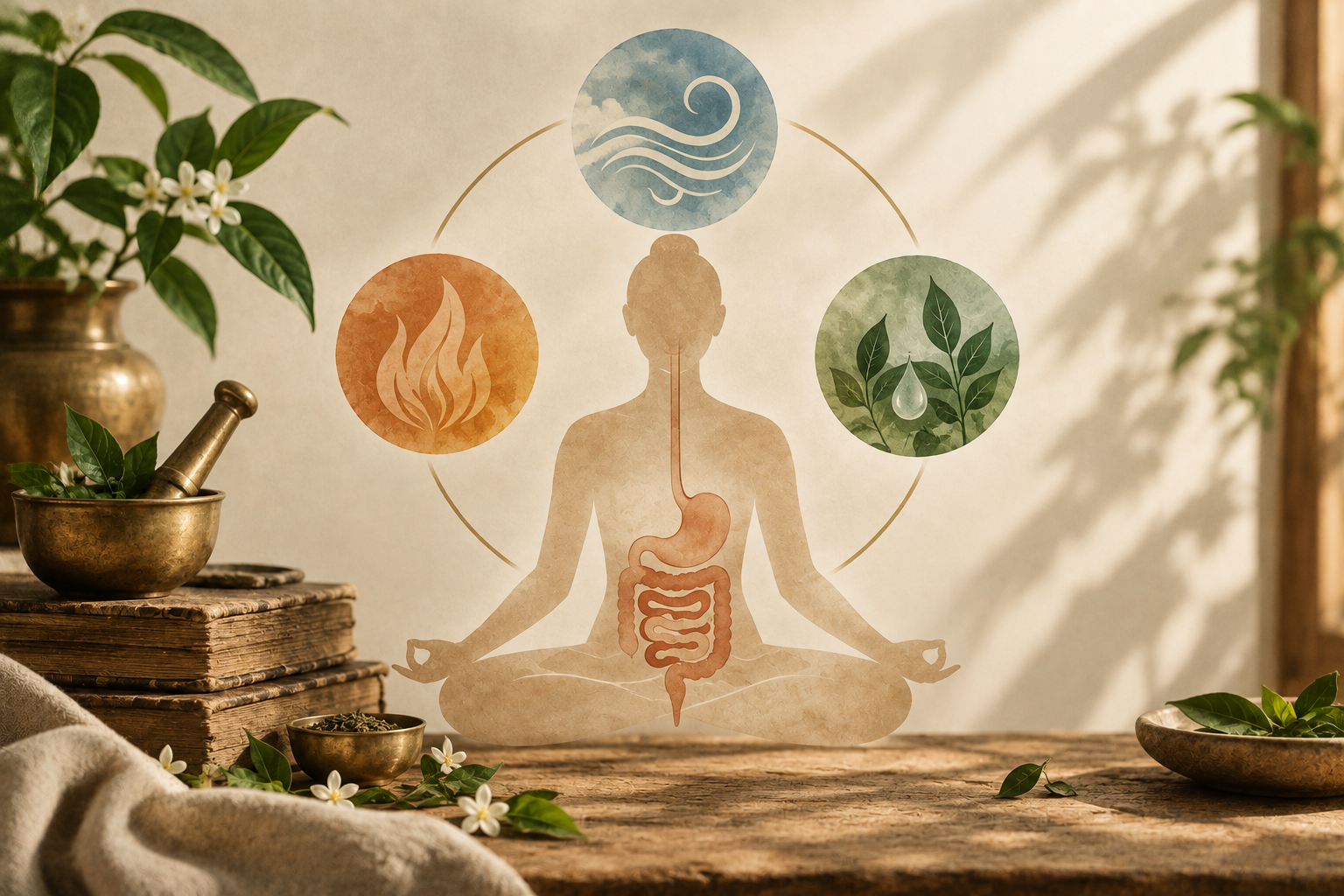
Most people, the moment they start reading about Ayurveda, land on this word, Dosha, almost immediately. Vata, Pitta, Kapha. And usually, the very first explanation they get is something like “Dosha means fault” or “Dosha means fluid,” and honestly, that explanation doesn’t help at all.   If anything, it makes the whole thing feel more confusing than before you started.   So let’s actually slow down and ask a more basic question first. What is the body even made of, according to Ayurveda?   Before we even get to Dosha, there are two other categories worth understanding, Dhatu and Mala, because once you see how these three relate to each other, Dosha suddenly makes a lot more sense.   Dhatu refers to everything in your body that’s meant to stay. Your blood, muscles, fat, bones, the fluid in your spinal cord, reproductive tissue, all of it.   These are structurally very different from each other, obviously, but they share one thing in common, none of them are meant to leave your body under normal circumstances.   When they do leave, by injury or bleeding or some other accident, your body doesn’t feel relieved. It feels depleted, anxious and weak. That’s the signature of a Dhatu, its presence sustains you, and its loss destabilizes you.   Mala is the exact opposite category. This is everything your body is meant to get rid of, stool, urine, sweat, and so on. And here’s the interesting part, getting rid of these isn’t a failure of the body, it’s actually a sign of it working properly.   Holding onto waste for too long doesn’t protect you, it burdens you. A Mala that overstays starts creating problems rather than preventing them.   So while Dhatu is defined by staying, Mala is defined by leaving, and both, in their own way, keep the body functioning.   Now here’s where it gets genuinely interesting, because Dosha doesn’t fit into either of these categories. It refuses to follow the rule.   Think about saliva for a second. It’s produced inside your body, moves through your salivary glands, briefly steps outside the boundary of your internal tissue system into your mouth, and then re-enters your body as you swallow it along with your food.   It doesn’t stay put like a Dhatu, and it doesn’t fully leave like a Mala either. It does something in between, and that “in between” behavior is exactly what defines a Dosha.   It moves out into contact with the world, and then brings something back in, and this back-and-forth movement is precisely what makes digestion, absorption, and basically your entire relationship with the outside environment possible.   This is such an important shift in how to think about Vata, Pitta, and Kapha. They’re not things that cause or lead up to a disease. They’re the functional bridges that let your body interact with everything you eat, breathe, and absorb from the world around you.   Vata handles movement, what you take in. Pitta governs transformation, converting of one thing into another. Kapha manages binding, lubrication, and the way things hold together and connect.   Without these three doing their job constantly, your Dhatus would never get built, and your Malas would never get properly separated out and removed.   And here’s something that genuinely surprised me the first time I really understood it, this dual-direction movement of the Doshas happens twice a day, in the gastrointestinal tract specifically.   If something you’re consuming regularly doesn’t actually suit your body, that excess starts getting expressed back out, sometimes as an unusually sour or pungent sensation, sometimes as a sweet, sticky feeling.   This isn’t randomness, it’s your body’s own feedback system, quietly telling you that whatever you keep feeding it in excess isn’t being absorbed the way you assume it is.   Most of us just don’t know how to read that signal.   This is also why identifying someone’s Prakriti, their natural constitutional dominance of one or two Doshas, matters so much in how Ayurveda actually treats a person. Two people can eat the exact same meal and metabolize it completely differently, purely because their underlying Dosha balance is different.   What nourishes one person can genuinely unsettle another. This is the entire logic behind why Ayurveda has never really believed in one-size-fits-all diet advice, it was never really about the food.   It was always about how well your Doshas are managing the exchange between what’s outside you and what needs to become a part of you.   So the next time someone tells you Dosha simply means “fault,” it’s worth remembering that it’s actually closer to the opposite. It’s not what goes wrong in the body. It’s the very mechanism that allows the body to keep working, keep exchanging, and keep staying alive in the first place.   If ideas like this interest you, our courses on Charaka Samhita and Ashtanga Hridayam go much deeper into how Dosha, Dhatu, and Mala work together as the foundation of the entire Ayurvedic system.  

What Your Body Is Telling You Before You Ask It

There’s actually a lot we can tell about a person without asking them a single question.   If they are not feeling well, you can notice the way they look unusually pale, or that their voice sounds different, weaker than usual. Their eyes may look different, their skin may look dry, their lips may look chapped, or maybe they might just look exhausted.   These are just some observations.   Ayurveda actually has an entire section in the Charaka Samhita talking about this kind of observation called Indriya Sthana. The very first chapter is called Varṇasvarīyam Indriyam where Charaka describes how a physician should pay attention to changes in a person’s complexion, voice, and other signs when assessing an illness or the severity of a disease.   Because Ayurveda doesn’t look at the simple question of what disease this person is actually having. It instead goes a little deeper into asking what the body is telling us about the illness.   It is actually our body that gives out the first signs of illness before it becomes something more obvious. Disease isn’t always the beginning of the story. It is ultimately important to keep in check the signs that our body is giving away, always.   यच्चान्यदपि किंचिद्वर्णवैकृतमभूतपूर्वं सहसोत्पद्येतानिमित्तमेव हीयमानस्यातुरस्य शश्वत्, तदरिष्टमिति विद्यात्।   An abnormal change that was not present before, appears suddenly, and occurs in someone whose condition is already declining. Such a change, Charaka says, should be recognized as an ariṣṭa, an ominous prognostic sign.   Now, one of the most important ideas in the chapter is the distinction between Prakriti and Vikriti.   Prakriti refers to a person’s natural state, while Vikriti refers to the deviation from that state.   A person’s appearance may naturally vary depending upon their constitution, age, environment, and other individual characteristics. So we can’t just vaguely determine that one particular complexion may be healthy or unhealthy. We need to look a little deeper.   Charaka’s list of things to examine is very extensive. He not just mentions the complexion and voice, but also the smell, taste, touch, eyes, ears, nose, the mental state, and many more. The list goes on.   In fact, Charaka tells us that a person should be observed as a whole, because a single unusual sign doesn’t entirely tell the entire story.   A temporary change with an obvious explanation is different from a sudden change that appears without apparent reason in someone whose condition may already be deteriorating.   So generally, the whole idea is that observation becomes meaningful when it is placed in context.   The entire emphasis here is on the change that you witness within your body.   And I think this is where this idea becomes useful even outside the context of an Ayurvedic physician examining a patient.   Because most of us don’t necessarily pay attention to our own bodies or the signs they are giving out.   We know how we feel ultimately, whether our face is looking normal when we wake up, or if our skin is feeling as usual. We know our baseline.   But when you wake up feeling different we brush it off as, “Maybe I have not rested well.”   But you need to understand that the baseline is important.   Because if you suddenly feel unusually tired for several days, or maybe your appetite has changed, or there are other signs your body that are trying to tell you, then I think this is where we need to stop looking and start observing what is wrong.   Because from an Ayurvedic point of view, disease is never something that simply comes overnight. Long before it becomes serious, your body is already trying to protest against it through different signs.   None of those signs individually might feel like a big deal. And that is exactly why they get ignored.   But when you look at the whole picture, these small signs can slowly lead up to something more serious.   Disease isn’t the starting point, it is actually much closer to the end of the story that your body has already been trying to tell you for a while now.   We are often quick to notice when there is something wrong with our phones, our cars, or our laptops. We notice that the battery is draining faster than usual, or the screen is running slow, or the phone is lagging a bit.   But when it comes to our bodies, we often ignore the same signs.   And maybe it is because our lifestyle has changed. We sleep less, work more, eat at odd hours, and keep pushing ourselves through the day.   We think our body is adaptable, but it isn’t.   Your body is constantly giving you information. The question is whether you are paying enough attention to notice it.   You don’t have to become an expert at interpreting every single sign. You just need to know what your normal looks and feels like, so you can recognize when something starts to change.   If you want to understand your body a little more deeply, you can explore our courses on the Charaka Samhita and Ashtanga Hridayam, and learn how these texts approach the body, health, and the signs it gives us.