Is It So Difficult to Be Content With What We Have?

Have you noticed how quickly we get used to things?   You save up months to buy that one bag that’s been on your wishlist. When you finally buy it, you are incredibly happy, thinking of taking it out everyday. But then, as days pass, the bag sits on one of the shelves at home while there is already another bag on your wishlist you are saving up for again.   Similarly, you spend months wanting a particular job. You finally get it, feel happy for a few days and then start thinking about the next promotion.   It’s strange, isn’t it? We spend so much time looking forward to things, but once they become part of our lives, we rarely pause to enjoy them.   There is always something else we want. Something better, something newer, something we haven’t experienced yet.   And perhaps there is nothing inherently wrong with wanting more. Ambition, curiosity and the desire to improve are all part of being human.   But when did wanting a better life become the same thing as being dissatisfied with the one we already have?   Indian philosophy has explored this question in some rather interesting ways. Two concepts, Santosha and Aparigraha, offer a different perspective on our relationship with desire, possessions and happiness.   Santosha: The art of being content   The Sanskrit word Santosha is commonly translated as contentment.   It is one of the five Niyamas described by Patanjali in the Yoga Sutras (2.32). The Niyamas are personal observances that form part of the eight limbs of Yoga.   Patanjali gives Santosha a particularly interesting place in this discussion.   Santosha anuttamah sukha labhah.   Through contentment, happiness is attained.   Now, before we misunderstand this, Santosha does not mean that we should stop having ambitions, give up our goals or convince ourselves that everything is perfect.   It is not about pretending to be happy with circumstances that need to change. It is about learning not to make our happiness entirely dependent on everything going according to our expectations.   Think about it.   You can work towards a better job without spending every day feeling miserable about your current one. You can want a bigger home without treating your present home as inadequate. You can work on improving your health without constantly criticising your body.   There is a difference between wanting to improve your circumstances and believing that your life cannot be good until those circumstances change.   Santosha lies in recognising that difference.   Why do we always want something else?   Part of the problem is that we are constantly comparing our lives with what we see around us.   Someone gets a promotion, and suddenly our own career feels stagnant. Someone buys a house, and we start wondering why we haven’t done the same. Someone travels to an interesting destination, and our ordinary weekend begins to feel rather uneventful.   Social media makes this particularly easy.   We are exposed to other people’s achievements, holidays, relationships, homes and lifestyles every single day. We see the exciting parts of their lives, often without knowing anything about the circumstances behind them.   And without realising it, we start using someone else’s life as the standard against which we measure our own.   There is an interesting distinction in Indian philosophy between desire and the attachment that develops around it.   The Bhagavad Gita, particularly Chapter 2, Verses 62–63, describes how dwelling repeatedly on sense objects can lead to attachment, desire and eventually anger when those desires are not attained.   Sometimes, the problem isn’t the thing we desire. It is how much of our peace we have handed over to the possibility of obtaining it.   Aparigraha: You don’t have to hold on to everything   The second concept is Aparigraha, often translated as non-possessiveness or non-hoarding.   It is one of the five Yamas in Patanjali’s Yoga Sutras. The Yamas describe ethical principles that guide our relationship with the world around us.   At its simplest, it encourages us not to accumulate or cling unnecessarily.   But I think the idea can be understood in a much broader way. We accumulate things, certainly. Clothes we never wear, gadgets we barely use, objects we keep because we might need them someday.   But we also accumulate expectations. We hold on to old disappointments, the need for approval, the desire to control every situation and the belief that we must keep up with everyone around us.   Sometimes, we are not even enjoying the things we possess. We are simply worried about losing them.   Do we really need everything we are trying to acquire? Are we enjoying what we already have? Or have we become so occupied with collecting more that we have forgotten how to appreciate anything?   It is an interesting question to ask, especially in a world that constantly encourages us to buy, upgrade and replace.   Contentment doesn’t mean giving up on your dreams   This is probably where people misunderstand the idea of contentment the most.   If we are supposed to be content, does that mean we shouldn’t aim for anything?   Should we stop pursuing better opportunities, learning new skills, travelling, building relationships or working towards financial security?   Of course not.   There is nothing wrong with wanting a better life.   The distinction is between pursuing something because it matters to you and pursuing it because you believe you are not enough without it.   Practising contentment in ordinary life   We don’t need to retreat to a mountain or spend hours meditating to begin exploring these ideas. In fact, some of the simplest ways to practise contentment are found in ordinary routines.   Stop postponing enjoyment.   Don’t wait until you get a promotion, lose a certain amount of weight or buy something expensive before allowing yourself to enjoy your life. Find small things to appreciate in the present.  … Continue reading Is It So Difficult to Be Content With What We Have?

Can We Be a Little Unserious About Our Health, Please?

girl practicing yoga and healthy icons character

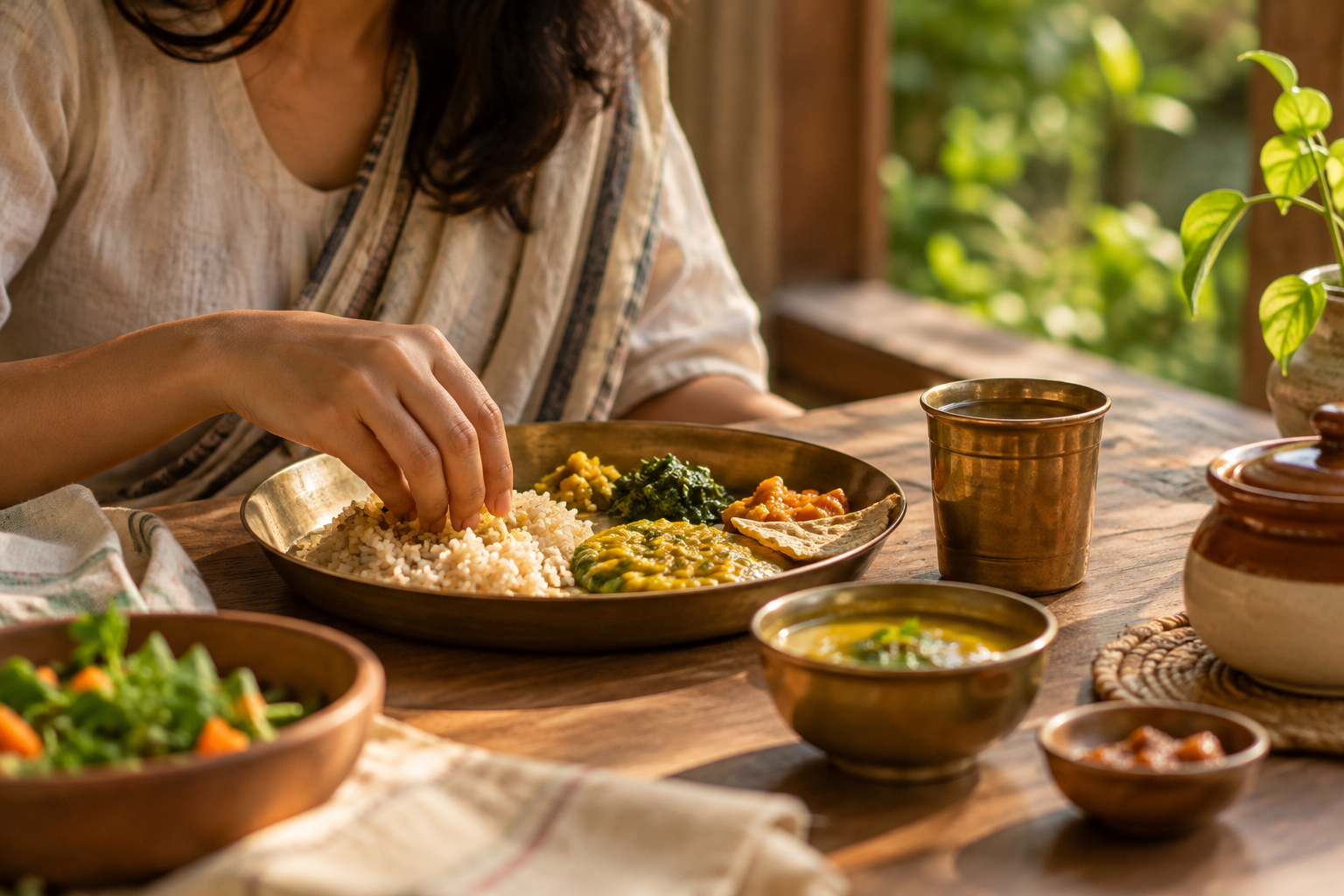
At what point did being healthy become such a serious business?   I mean, when did going for a walk require a fitness tracker, a step-count goal and a way to optimising your life? And why does eating a normal meal now has to account for how much protein, fibre, carbohydrates, gut health and whatever else you need to be adding to your diet?   Somewhere along the way, taking care of ourselves became our another full time job.   From waking up at 5 AM, drinking warm lemon water, meditatation, getting 10,000 steps, taking your supplements, avoiding sugar, sleeping eight hours. Didn’t it just become a series of checklists to complete?   Don’t get me wrong. Looking after your health matters. But I sometimes wonder whether we’ve made it unnecessarily complicated. Health has become so wrapped up in routines, discipline, products and perfect habits that we’ve forgotten something rather important: it is supposed to make our lives better, not become our entire life.   Perhaps we need to learn to be a little unserious about it. A little less obsessed with getting everything right.   You don’t need a perfect morning routine.   You don’t have to punish yourself if you can’t wake up early in the morning. It’s okay to sleep in on days you are tired. You don’t need to wake up right at 5 am every morning.   While waking up at brahma muhurta is preferred, the transition to waking up early should be much smoother.   If you wake up at 7 everyday, you can’t outrightly punish yourself to get up at 5 the next day. Start by waking up 15 minutes early, then 30 minutes early. Let your body get used to it naturally.   Eating your food shouldn’t feel like calorie count.     One day it’s carbohydrates, the next day it’s seed oils. Then someone on the internet tells you that the food you’ve been eating since childhood is terrible for your gut.   It is very exhausting, isn’t it?   Instead of trying to follow every food trend, start with the basics. Eat regular meals, include some vegetables, have fruit when you can, drink enough water and make sure you’re eating enough. Add a little variety to your plate.   And please, enjoy your food. Be mindful when you are having your dinner, lunch or breakfast.   You don’t have to calculate the nutritional value of every bite to deserve a healthy body. A home-cooked meal, a bowl of dal and rice, some vegetables or your favourite breakfast can all be part of a perfectly reasonable routine.   The thought of exercising shouldn’t make you groan.   Walking is exercise. Dancing around your room is movement. Taking the stairs, cycling, stretching or playing a sport counts too.   You don’t have to sign up for an expensive gym membership or suddenly become someone who enjoys running at 6 AM.   Find something you actually like doing. Even a 15-minute walk after lunch or dinner is a good place to begin. Consistency matters more than making every workout look impressive.   Sleep. Seriously, just sleep.   We’ve somehow normalised being exhausted all the time. We stay up scrolling, wake up tired, survive on coffee and then wonder why we feel like our brains are running on an outdated operating system.   Try having a somewhat consistent bedtime. Put your phone away a little earlier. Give yourself enough time to rest.   You don’t need an elaborate nighttime routine involving twelve products and a candle. Sometimes, all you need is to stop watching one more episode and go to bed.   Take care of your mind, too.   Not every uncomfortable feeling needs to become a self-improvement project.   Sometimes you need to journal. Sometimes you need to talk to someone. Sometimes you need a quiet afternoon, a good book, a long phone call with a friend or absolutely nothing on your schedule.   Give yourself room to exist without constantly evaluating how well you’re doing.   Start small. Really small.   If you’re someone who struggles to maintain routines, don’t suddenly introduce fifteen new habits on a Monday morning. You already know how that story ends   Pick two or three things.   Do them until they become ordinary. Then, if you feel like it, add something else.   You don’t need to change your entire life by next week.   And remember, these little habits are not substitutes for medical care. Regular check-ups, appropriate screenings and seeking professional advice when something feels wrong are important too.   A little less pressure, a little more living.   There is always another routine to follow, another supplement to try, another food to eliminate and another person on the internet telling us that we’re ageing incorrectly.   But health isn’t a competition. There isn’t a prize for having the most disciplined morning routine or for being the person who never misses a workout.   You are allowed to have an imperfect week. You’re allowed to eat the cake, miss a workout, sleep in on Sunday and occasionally forget that you own a water bottle.   The goal is not to become the healthiest person on the internet. It’s to feel reasonably good in your own body, have the energy to do the things you enjoy and build habits that you can actually live with.   So, drink your water. Eat your vegetables. Go for that walk. Get some sleep.   And then go live your life.   Because, honestly, isn’t that the whole point of being healthy in the first place.

Are We Overstimulating Our Senses? What Ayurveda Says About the Five Senses

Think about how you started your day today.   Did you reach for your phone the moment you woke up? Did you listen to music while getting ready, check your messages while having breakfast, and spend the rest of the morning looking at one screen or another?   By the time the day is over, you’ve probably seen hundreds of images, heard countless sounds, tasted different things, touched dozens of objects and taken in more information than you can remember.   We don’t usually think twice about any of this. Our senses are constantly working, and we’ve become so accustomed to stimulation that silence or doing absolutely nothing can sometimes feel uncomfortable.   But have you ever wondered whether the way we use our senses has anything to do with our health?   Interestingly, Ayurveda explored this question through a concept called Asatmya Indriyartha Samyoga.   It refers to how the way we interact and perceive things with our sense organs affects our overall health. It also discusses what happens when we use them too little or in the wrong way.   Let’s understand this.   What is Asatmya Indriyartha Samyoga?   The term is made up of four words: Asatmya: Unsuitable or incompatible Indriya: Sense organs Artha: Objects or subjects of perception Samyoga: Contact or association   Together, Asatmya Indriyartha Samyoga refers to an unsuitable or improper interaction between our sense organs and their respective objects.   In Charaka Samhita, Acharya Charaka discusses this in the eleventh chapter of Sutrasthana, where he identifies it as one of the three fundamental causes of disease.   But what makes this concept particularly interesting is that it is divided into three forms:   Atiyoga: Excessive use Ayoga: Insufficient or lack of use Mithyayoga: Improper use   Let’s look at what each of these means.   Atiyoga: When we use our senses excessively   Atiyoga refers to excessive use of our sense organs.   And honestly, this is something we can relate to quite easily today.   Think about your eyes.   Most of us spend a considerable part of our day looking at screens. We move from our laptops to our phones, from our phones to televisions, and sometimes back to our laptops again.   It is clearly an example of Atiyoga of the eyes.   Similarly, listening to excessively loud sounds and repeatedly exposing the sense of smell to very strong odours are described as forms of excessive sensory use.   The idea is that even something our senses are naturally meant to experience can become unsuitable when the exposure is excessive.   It isn’t necessarily about avoiding these experiences altogether. It is about recognising that our senses also have limits.   Ayoga: When we don’t use our senses enough   Now, this is something we don’t usually think about.   Ayoga refers to insufficient use or the complete absence of appropriate engagement with the sense organs.   For instance, Charaka describes not seeing anything at all as an example of Ayoga of the sense of vision. Similarly, not hearing or smelling anything represents insufficient engagement with those respective senses.   Think about how different our experiences would be if we completely stopped engaging with the world around us.   We need our senses to interact with our surroundings, recognise things, experience our environment and respond to what is happening around us.   So the discussion isn’t simply about reducing sensory stimulation.   It is about maintaining an appropriate relationship with the things our senses are meant to experience.   Mithyayoga: When we use our senses improperly   This is perhaps the most interesting of the three.   Mithyayoga refers to the improper or unsuitable use of the sense organs.   It isn’t necessarily about using them too much or too little. It is about the nature of the experience itself.   For the eyes, looking at objects that are excessively close or far away, or repeatedly exposing oneself to disturbing and frightening sights, are discussed as improper sensory experiences.   For hearing, listening to harsh, frightening or unpleasant sounds is described as Mithyayoga.   Similarly, exposure to unpleasant or harmful smells is discussed under the improper use of the sense of smell.   When you look at these examples, you realise that Ayurveda wasn’t only concerned with how much sensory stimulation we experience. It also considered what kind of stimulation we expose ourselves to.   What about taste and touch?   Of course, Ayurveda doesn’t stop with sight, sound and smell.   It also discusses the senses of taste and touch.   Food isn’t just something we consume to satisfy hunger. Taste is one of the ways we experience it. And Ayurveda considers the relationship between taste, food and the individual an important part of understanding nourishment.   Then comes touch.   Charaka discusses excessive exposure to extremely hot or cold sensations as Atiyoga, while inappropriate contact with objects or environments is considered Mithyayoga.   So, when you look at all five senses together, the underlying idea becomes clearer.   Ayurveda considers not just what we experience through our senses, but also the frequency, intensity and nature of that experience.   Why does this matter today?   We live in a world where constant stimulation has become completely normal.   There is always something to watch, something to listen to, something to read or something to respond to.   Even when we are eating, travelling or simply sitting alone, we often look for something to occupy our attention.   Think about the last time you sat in a room without music, television or your phone. Did you feel comfortable, or did you immediately feel the need to reach for something?   We rarely give ourselves the opportunity to experience our surroundings without constantly adding something to them.   Are we constantly exposing our eyes to intense stimulation? Do we ever give ourselves a break from noise? Are we mindful of the sounds, sights and experiences we allow into our… Continue reading Are We Overstimulating Our Senses? What Ayurveda Says About the Five Senses

Maybe It Is Not Just What You Eat, But How Much

We have become very good at asking what we should eat.   What is the healthiest breakfast? Which oil should we use? Is rice better than roti? Should we have more protein? What should we eat for good digestion? There is always another food to add, remove, replace or worry about.   But there is one much simpler question that often gets lost: how much are you actually eating?   Ayurveda has been asking this question for a very long time. In the Matrashiteeya chapter of the Charaka Samhita, the discussion begins with something remarkably straightforward: matrashī syāt, essentially, one should eat in the right quantity.   And then comes the important part that quantity is not exactly the same for everyone. It depends on the strength of one’s digestion.   That immediately makes the conversation about food a little more interesting. Because we often speak about food as though the food itself is the whole story. We label something “light” or “heavy” and assume that its effect will be the same every time we eat it.   But even foods considered naturally light or heavy still depend on quantity. Something that is generally easy to digest can become difficult when eaten in excess, while a heavier food may be manageable in an appropriate amount depending on the person’s digestive capacity.   In other words, there is no point in asking only, “Is this food healthy?” without also asking, “Is this the right amount for me, at this time?”   Eat according to the proper measure; the proper measure of food depends on the strength of digestion. It sounds almost obvious when you hear it, but think about how rarely we actually apply this idea.   We eat because it is lunchtime even when we are not hungry. We continue eating because the food tastes good even after we are full. We finish everything on the plate because that is what we were taught to do.   We order more because we are out with friends. Sometimes we eat very little all day and then compensate with a huge dinner because we are exhausted and starving. The food may not necessarily be the problem. Sometimes it is simply the relationship we have with quantity.   The chapter makes another interesting distinction between foods that are naturally lighter and those that are naturally heavier. It mentions foods such as rice, green gram and certain meats among the lighter foods, while describing things such as preparations made from flour, sesame, black gram, milk and certain meats like fish as heavier.   But even here, food is not reduced to a simple good-food versus bad-food list. It repeatedly brings the discussion back to quantity and digestive strength. This is important because the idea is not to become afraid of foods that are described as heavy.   It is to understand that the same food can behave differently depending on how much of it you eat, how strong your digestion is and what else is happening in your body.   You do not have to create a permanent list of foods you are “allowed” to eat and foods you are not. You can instead become more attentive to what happens after you eat.   Do you feel comfortable? Does the meal digest without leaving you excessively heavy or sluggish? Are you hungry again at an appropriate time? Do you feel energised or do you feel like you need to lie down immediately? These observations are not meant to turn eating into another thing to obsess over. They are simply a way of becoming familiar with your own body.   The appropriate quantity of food often supports one’s strength, complexion, comfort and longevity. That is quite different from the way we often talk about food today, where every meal can start to feel like a calculation of calories, protein, carbohydrates, fats and restrictions.   Ayurveda’s concern here is much more functional: what does this food, in this amount, do to the person eating it?   And it does not just stop with food.   Health is maintained through small acts of care repeated regularly.   Take something as ordinary as brushing the teeth.   Your body is something you maintain, not something you only attend to when something goes wrong.   We have a strange relationship with self-care today. We can spend hundreds of rupees on a product marketed as a “self-care essential” and still forget the basics. We can have a complicated skincare routine but sleep four hours.   We can buy supplements while eating at completely irregular times. We can spend an hour researching the perfect shampoo and then ignore the fact that we are exhausted all week. Sometimes care becomes another form of consumption instead of something we actually practise.   The Matrashiteeya chapter offers a much quieter idea of care. Eat in the right quantity. Keep yourself clean. Take care of the senses. Pay attention to the body. Maintain routines. Do things regularly rather than waiting until a problem becomes severe. There is a sense of maintenance rather than constant correction.   And perhaps that is the part of this chapter that feels most relevant now.   Eating when we are actually hungry. Stopping before we have eaten far beyond what we need. Paying attention to how a meal makes us feel instead of blindly following a food trend. Keeping our bodies clean. Taking a few minutes to care for our skin, hair, feet and senses. Giving the body enough rest. Building routines that are sustainable rather than impressive for a week.   There is also something important in the way the chapter describes the body: almost as something that deserves regular attention and respect.   Maybe that is what we miss when we reduce healthy living to individual foods and isolated habits.   Because sometimes the most useful change is not finding a better food.   It is learning when enough is enough. Health does not always come from… Continue reading Maybe It Is Not Just What You Eat, But How Much