
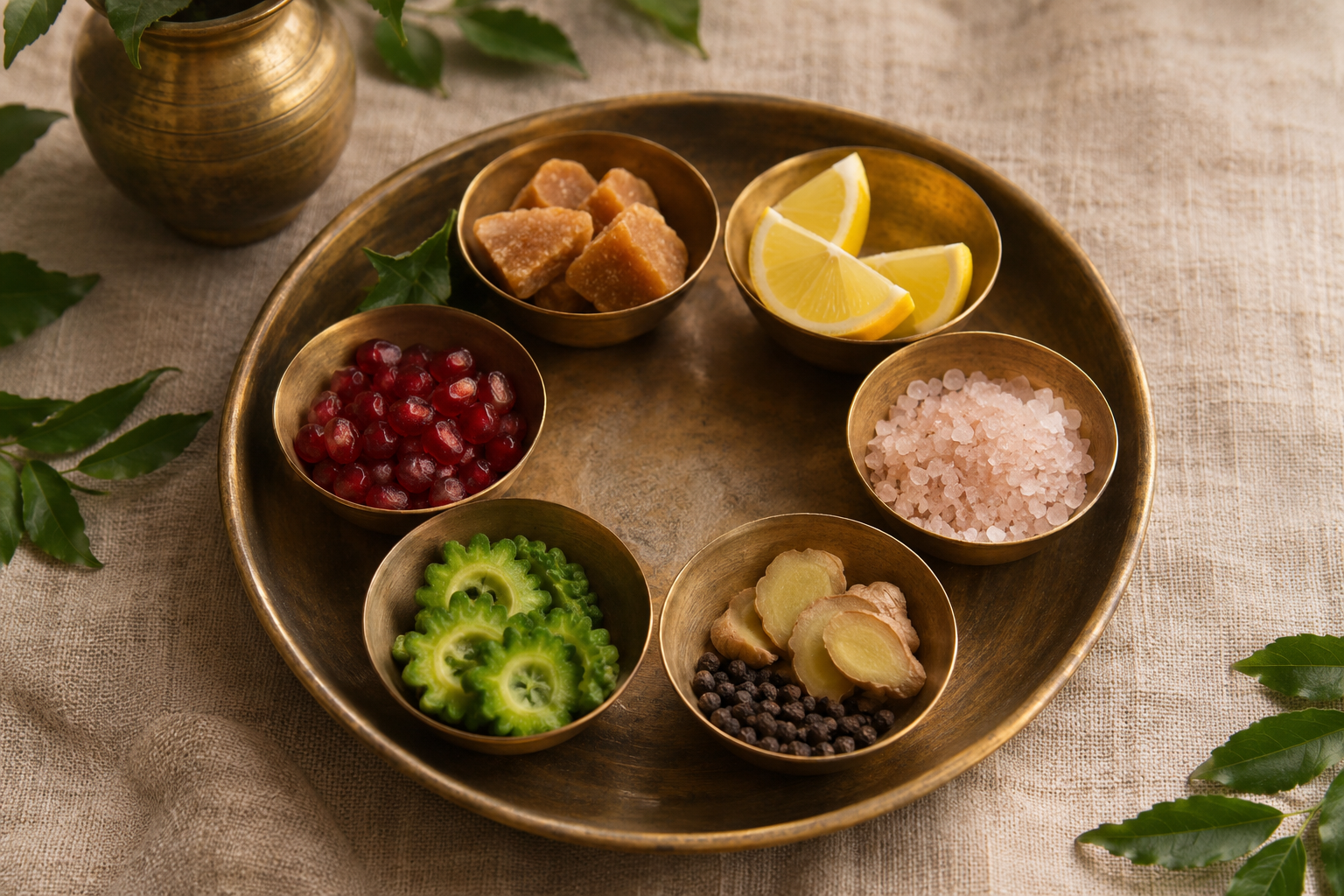
Think about your favourite meal for a moment. Maybe it’s something sweet, something spicy, or a combination of flavours that you simply cannot get enough of. Now think about the foods you usually avoid. Perhaps you don’t enjoy bitter vegetables, or you find certain sour foods too strong. We all have our preferences when it comes to taste. But have you ever wondered why Ayurveda places so much importance on the different tastes we experience through food? In fact, the classical Ayurvedic texts describe six distinct tastes, known as Shad Rasa. And what’s interesting is that these tastes aren’t simply classified according to how they feel on your tongue. Each one is associated with particular qualities and effects on the body. Ayurveda even considers the balance of these six tastes important when deciding what and how we should eat. Let’s understand what these six tastes are and why they matter. What are the six Rasas? In Ayurveda, the word Rasa refers to taste, which is perceived through the tongue. Charaka Samhita, in Sutrasthana 26, describes a rather interesting discussion among several sages about how many tastes actually exist. Some believed there were four, others suggested five, seven or even innumerable tastes. But Acharya Punarvasu Atreya eventually established that there are six primary tastes. These are: Madhura: Sweet Amla: Sour Lavana: Salty Katu: Pungent Tikta: Bitter Kashaya: Astringent Ayurveda doesn’t consider these tastes interchangeable. Each has its own qualities, and each interacts differently with the three Doshas. Let’s take them one by one. Madhura Rasa: The sweet taste Let’s start with the one most of us are familiar with. Madhura means sweet, and it is associated with satisfaction and a sense of fullness. But when Ayurveda talks about sweet taste, it isn’t referring only to sugar, chocolates or desserts. Rice, wheat, milk, dates and many other foods also fall under the broad category of Madhura Rasa. According to Ayurveda, sweet taste is generally heavy and cooling in nature. It is traditionally associated with nourishment and the development of bodily tissues. It also helps pacify Vata and Pitta. Think about how a simple meal of rice and milk or a bowl of cooked grains can feel satisfying and comforting. That’s the kind of nourishing quality associated with Madhura Rasa. However, Ayurveda also emphasizes against excessive consumption. Too much sweet taste can aggravate Kapha and is associated with heaviness, excessive nourishment and accumulation. So, while sweet taste has an important place in the diet, more of it doesn’t necessarily mean better nourishment. Amla Rasa: The sour taste Next comes Amla, or sour taste. Squeezing a lemon over your food, eating a piece of tamarind or tasting a raw mango, that immediate sourness, the way your mouth begins watering and your cheeks almost tighten, is what Amla Rasa feels like. Ayurveda describes sour taste as warming, slightly oily and relatively light. It is traditionally associated with stimulating appetite, increasing salivation and supporting digestion. It also helps pacify Vata, but excessive sour taste can aggravate Pitta and Kapha. This is why Ayurveda pays attention not just to the taste itself but also to how much of it we consume. Something that makes food more enjoyable and stimulates the appetite in an appropriate amount may become unsuitable when consumed excessively. Lavana Rasa: The salty taste We can never imagine eating a meal without any salt. Even if all the ingredients are perfectly cooked, something might feel missing. That’s because salt plays a rather important role in how we experience food. Lavana Rasa is the salty taste. Ayurveda describes it as warming, heavy and unctuous. It is traditionally associated with enhancing taste, promoting salivation and supporting digestion. It also helps pacify Vata. But excessive consumption of salty foods is associated with aggravation of Pitta and Kapha. The classical texts also describe excessive salt consumption in relation to thirst, water retention and certain other disturbances. And this is a particularly relevant reminder today, considering how much salt can be hidden in packaged foods, sauces and processed snacks. The idea isn’t to eliminate salt altogether. It is to understand the importance of moderation. Katu Rasa: The pungent taste This is for all those who enjoy spicy food. Katu refers to pungent taste. Think about biting into a piece of fresh ginger, tasting black pepper or eating something with a generous amount of chilli. You can almost feel the heat spreading through your mouth. Ayurveda describes Katu Rasa as light, dry and heating in nature. It is traditionally associated with stimulating digestion, reducing excess Kapha and helping clear certain accumulations. It also helps pacify Kapha, but excessive pungent taste can aggravate Vata and Pitta. And here’s something worth remembering. Just because a food makes you sweat or produces a strong sensation in your mouth doesn’t necessarily mean it is improving your digestion. Ayurveda considers the overall qualities and quantity of the food, rather than assuming that stronger flavours always produce better results. Tikta Rasa: The bitter taste This is probably the taste many people try to avoid. Bitter vegetables, neem leaves, certain medicinal herbs and some leafy greens are familiar examples of Tikta Rasa. Unlike sweet or sour foods, bitter foods aren’t always particularly enjoyable to eat. But Ayurveda gives bitter taste an important place. It is described as light, dry and cooling in nature. It is traditionally associated with reducing Pitta and Kapha, and is used in classical formulations for various purposes. Excessive bitter taste, however, can aggravate Vata. What’s interesting is that Ayurveda doesn’t judge the value of a food only by how pleasant it tastes. Something doesn’t have to be… Continue reading Why Ayurveda Believes Every Taste Has a Purpose: Understanding the Six Rasas