
Is IBS Really a Gut Problem? Or Is It an Agni Problem?

If you’re reading this, chances are you’ve been struggling with digestive issues for quite some time.   You’ve had tests done, tried different diets, cut out foods you enjoy, and perhaps even taken medications to manage the symptoms.   Yet despite all of this, you still experience bloating, abdominal discomfort, constipation, diarrhea, or a constant feeling that your digestion is not quite right.   Then as an Ayurvedic doctor, let me offer you a different perspective   What if IBS is not primarily a gut problem?   What if it’s an Agni problem?   First, Let’s Understand IBS   Irritable Bowel Syndrome (IBS) is a chronic digestive disorder that affects the way the gastrointestinal tract functions. It is one of the most common digestive conditions that significantly impacts a person’s quality of life.   People with IBS commonly experience symptoms such as abdominal pain, bloating, excessive gas, constipation, diarrhea, or a combination of both.   While IBS is not considered a life-threatening condition, it can be extremely frustrating because the symptoms tend to come and go, often affecting daily activities, work, travel, social gatherings, and especially a person’s relationship with food.   What makes IBS particularly challenging is that the symptoms can vary from person to person. One individual may primarily suffer from constipation, another may struggle with frequent loose stools, while someone else may alternate between both.   Despite these differences, one thing remains common: digestion becomes unpredictable.   Now many IBS patients undergo scans, blood tests, colonoscopies but most of the time, nothing serious is found.   Yet the symptoms still persist.   Think about that for a moment.   If the structure of gut is normal, then what actually is going wrong?   The answer lies in understanding that a healthy-looking digestive system is not always the same as a well-functioning digestive system.   If the structure of the digestive system is normal, then perhaps the real issue is not the organ itself, but the body’s ability to digest and process food properly.   This is where Ayurveda provides a deeper explanation. Instead of looking at the gut, it looks at how well the body is digesting and processing food.   The Role of Agni   Now, when most people hear the word Agni, they think it simply means digestion. But Agni is much more than that. It refers to the body’s ability to digest, absorb, transform, and utilize whatever we consume.   Every time you eat, your body has to break down food, extract nutrients, absorb them, convert them into energy, and eliminate waste. All of these processes depend on Agni.   In simple terms, Agni is the intelligence behind your digestion.   When Agni is strong, food is properly digested and absorbed. You feel light after meals,  your energy remains stable throughout the day, your appetite is healthy, your bowel movements are regular, and your body receives the nourishment it needs.   But when Agni becomes weak, digestion slowly begins to suffer.   Food may sit in the digestive tract longer than it should, nutrients may not be absorbed efficiently. Waste products may not be eliminated effectively.   Over time, this can lead to symptoms such as bloating, gas, abdominal discomfort, heaviness after meals, irregular bowel movements, food sensitivities, and fatigue.   Over time, these digestive problems can develop into conditions like IBS.     How Ayurveda Views IBS     To understand that, we first need to understand two important concepts: Grahani and Ama.   The word Grahani literally means “to hold” or “to retain.” It refers to the part of the digestive system responsible for holding food long enough for proper digestion and absorption to take place.   When Grahani is functioning properly, food is digested efficiently, nutrients are absorbed, and waste is eliminated in a regular manner.   However, Grahani can only function properly when Agni is strong.   This is a very important point.   If Agni becomes weak because of unhealthy food, poor habits, stress, or other reasons, digestion does not happen properly and Grahani starts to function poorly.   Food may move through the digestive tract too quickly or stay there longer than it should. This can lead to symptoms such as bloating, gas, abdominal discomfort, constipation or diarrhea.   Ayurveda refers to this state as Grahani Roga.   When this happens, food is not fully digested.   The undigested food remains in the digestive tract and creates Ama, or toxic waste. As Ama accumulates, it further interferes with digestion and creates a cycle where digestion becomes weaker and symptoms become more frequent.   So, if we want lasting relief from IBS, we cannot ignore Agni. Imbalance in Agni and accumulation of Ama (toxins) are the main reasons.   What Weakens Agni?     The truth is, Agni usually doesn’t become weak overnight. It is often the result of daily habits that slowly disrupt digestion over time.   Eating at irregular times, skipping meals, overeating, eating too quickly, relying heavily on processed foods, sleeping late, and living under constant stress can all weaken Agni.   Many people today eat while working, scrolling through their phones, driving, or rushing between meetings. The body may be receiving food, but digestion is not receiving the attention it needs.   More often than not, it’s not just about what you’re eating. It’s also about how you’re eating and how well your body is digesting it.     The Link Between Stress and Digestion     Have you ever noticed that your symptoms become worse during a stressful period?   During exams, work deadlines or lack of sleep?   That’s because the digestive system and the mind are deeply connected.   In Ayurveda, digestion is not viewed separately from mental and emotional health. When the mind is constantly stressed, digestion often becomes disturbed as well.   The state of mind plays an important role. The food may be the same, but the body’s ability to digest it is different. This is one reason… Continue reading Is IBS Really a Gut Problem? Or Is It an Agni Problem?

6 Signs Your Agni Is Weak: What Ayurveda Says About Your Digestive Fire

In Ayurveda there is a saying,“Roga Sarvepi Mandagnau” it means, all diseases begin with a weakened digestive fire.   A strong Agni helps your body break down food efficiently, absorb nutrients properly, eliminate waste effectively, and maintain a healthy balance of the three Doshas: Vata, Pitta, and Kapha.   When Agni becomes weak, digestion slows down. Food is not processed efficiently, toxins begin to accumulate, and over time this can affect different systems in the body. This is why Ayurveda considers digestion to be the foundation of health.   So how do you know if your Agni needs attention? Here are 6 common signs of weak digestive fire according to Ayurveda.   Frequent Bloating and Gas   One of the most common signs of weak digestion is excessive gas and bloating.   Now, according to Ayurveda, gas and bloating are mainly associated with an imbalance of Vata in the body. And one of the biggest reasons for this is not eating at the right time.   Let me give you a simple example. Every day, you have your lunch at 12 o’clock. Your body gets used to this routine. It knows that food is going to arrive at that time, so your digestive system starts preparing itself. Your digestive juices, hydrochloric acid, and digestive enzymes are all ready and waiting.   But, instead of eating at 12, you have your lunch at 2 o’clock.   What happens then?   Your digestive system is already prepared for the meal, but the food never arrives. These digestive secretions continue to build up, creating discomfort in the stomach. Over time, this can show up as gas, bloating, heartburn, and acid reflux.   So, don’t just look at what you are eating. Also look at when you are eating. Sometimes, correcting your meal timings can make a huge difference to your digestive health.   Metallic taste in your mouth   I tell you, one of the easiest ways to find if your gut is in good shape is to wake up in the morning, go in front of the mirror, and smile. What do you see? Your teeth.   Your teeth can tell you a lot of things. Is your teeth yellow? Is it cracking? Sometimes you may feel that it is turning translucent and not really opaque, and you may have bad breath, and in the mouth, you may have a metallic taste. And when you open your mouth, you may feel that there is tendency for cavities. Your molars, teeth which is behind, they are getting affected slowly. They are not looking good.   And, and to be honest, all of this are actually huge signs your body is giving you about your gut, that you are having acid reflux, and your pitta in the body is really high.   Constipation or Irregular Bowel Movements   Our stool constitutes waste, not just from our food but also from the physiological processes in our body. If you are not defecating every day, a part of these get reabsorbed which causes toxin buildup.   Even a single day of not passing bowel movements is not advised for gut health.   There are a few simple Ayurvedic remedies that can help support regular bowel movements, which I’ve covered in detail here.   Your Skin Is Breaking Out   Your skin is often a reflection of what is happening inside your gut.   Another thing I look at is your diet. Are you eating foods that suit your body type, or Prakriti? Are you consuming a lot of processed and packaged foods?   Consuming foods that do not suit your body type or eating unhealthy processed foods can disrupt your body’s equilibrium and aggravate Dosha imbalances. Over time, this may contribute to skin problems such as acne, eczema, psoriasis, or unexplained breakouts.   So, if you are struggling with skin issues, don’t just look at your skin. Look at your gut as well. Sometimes the root cause is not on the outside, but inside your digestive system.   You Feel Heavy After Every Meal   Food is supposed to give you energy. It is not supposed to make you feel sleepy or sluggish.   People have become so used to feeling heavy after meals that they think it is normal. It is not.   If your meal leaves you feeling sluggish, uncomfortable, or ready to lie down, it may be a sign that your digestive fire is weak. Instead of efficiently digesting food and converting it into energy, your body is struggling to process what you eat.   A healthy Agni should leave you feeling satisfied and energized, not exhausted.   You Don’t Feel Hungry at Regular Times   One of the clearest signs of a healthy digestive fire is a healthy appetite.   Your body should naturally tell you when it is time to eat. If you frequently skip meals because you are not hungry, or if your appetite changes dramatically from one day to the next, it may indicate that your Agni is weak.   A healthy digestive system works like a well-maintained clock. It knows when to digest food and when to ask for more.   When those hunger signals become irregular, it is often one of the earliest signs that your digestive fire needs support.   Small Changes That Can Make a Big Difference   The good news is that Ayurveda offers simple ways to support your digestive fire.   One of the most important things you can do is maintain a routine. Try to eat your meals at roughly the same time every day. When your body knows when food is coming, digestion tends to work more efficiently.   Avoid skipping meals, overeating, or eating late at night. Give your body enough time to digest one meal before moving on to the next.   Pay attention to how different foods make you feel. Foods that suit one person may not suit another. Ayurveda always emphasizes eating according to your individual… Continue reading 6 Signs Your Agni Is Weak: What Ayurveda Says About Your Digestive Fire

5 Natural Supplements You Should Add To Your Diet Every Single Day

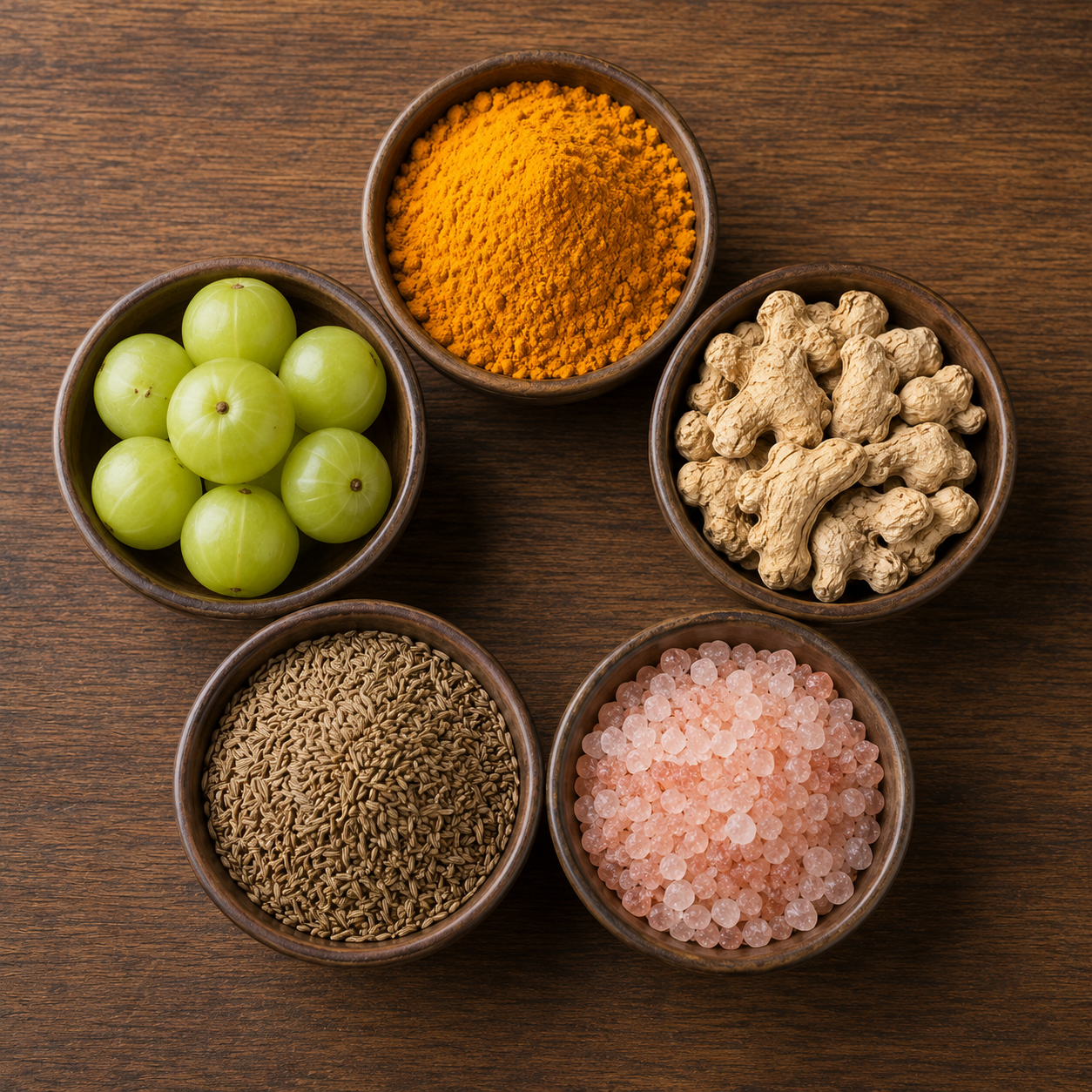
1. Turmeric   The number one supplement that you need in your life is nothing but turmeric.     You may have heard people saying, especially people in the west, talking about having turmeric in the form of teas, in the form of turmeric lattes, or sometimes even in the form of supplements.   You don’t need all of these pills and supplements to get your adequate amount of turmeric to help with all the benefits that it is going to give us.   Our traditional Indian way of cooking where we add the good fats and the spices, along with that we add turmeric, that is the most bioavailable form of turmeric and that helps with better digestion, better absorption, and better assimilation of all the good things that turmeric has to give us.   Now let us understand what turmeric does in our body. For this we have to understand what the properties of turmeric are as per Ayurveda.   Ayurveda says every food has certain properties, like there is a specific taste to a particular food item, a particular post-digestive taste.   Ayurveda also talks about a property called Prabhava or special characteristic.   One special characteristic or Prabhava of turmeric is that it is antimicrobial and anti-inflammatory.   For example, somebody is having a viral condition like chickenpox, we ask our patients to take shower with water boiled with turmeric because it is antimicrobial.   When it comes to food poisoning, if you consume more of turmeric paste throughout the day, you are helping your body to reduce inflammation.   Even if you have acne, you can use turmeric boiled water to wash your face because of its antimicrobial properties, you don’t need any antibacterial face washes.   All bitter tasting herbs are good for your liver. So, if you want to detoxify your liver, don’t go for supplements and medicines that detoxify your liver. Instead, just add a little bit more turmeric to your diet.   Adding turmeric to your dishes can help you improve your digestive fire, reduce gas, and bloating.   If you have children at home who constantly get bronchitis, cough, cold, fever, etc., turmeric helps you to improve their immunity. Make sure that you add turmeric to your cooking every day.   Even in traditional Indian cooking, we have so many dishes like haldi chawal, haldi doodh, haldi ka achar, turmeric lettuce soup. All of these are very good for improving your digestive system.     2. Dry Ginger     Number two is dry ginger.     I am talking about dry ginger and not wet ginger. Wet ginger is extremely heating, extremely pitta increasing. Dry ginger is also warm; it is much less heating compared to wet ginger.   When you buy ginger, make sure that you leave it outside and don’t keep it in the fridge so that it gets a little dry and then you can use it for cooking.   Just like how we said turmeric was anti-microbial and anti-inflammatory because of its prabhava, ginger also has a prabhava.   And what is that?   Dry ginger is anti-emetic. That means if somebody feels like vomiting, dry ginger is what we give.   It’s also good for improving digestion, absorption, and assimilation of food. It helps in reducing gas and bloating. It helps in subsiding Vata gently.   Just like how I told you about turmeric, don’t take dry ginger as a pill or a supplement. Instead, make sure that you have dry ginger in a cooked form along with other spices and good fats.   I personally add dry ginger every day to my cooking. However, one special indulgence that I really love doing is to have dry ginger wali masala chai.   After heavy meals, if for example, you had a biryani and you’re now feeling very heavy, very bloated, or you have this guilt feeling that you shouldn’t have had it because you can’t even think of the digestive problems that may come, then have dry ginger powder mixed with a little bit of rock salt, add a little bit of water and consume it.   That will help you subside the gas and bloating. It will also help you improve the digestion.   And if you’re somebody who feels constipation, you can have a glass of dry ginger water in the morning.   Make sure that you add two glasses of water, add one piece of dry ginger and reduce to one glass to get the maximum essence of dry ginger. And drink this water. This can ease your bowel movements.     3. Amla   This one is my favorite.     If you don’t want to have any supplement at all in this world, then one supplement that you need in your life is amla or amla powder.   This is something that you must include in your life.   Whether it is in the form of amla powder, amla juice, as amla murabba, amla candy, whatever it is, amla has to go into your system every single day.   Every house should have some form of amla ready to be served every day because amla helps in a lot of ways beyond what you can imagine.   There is a particular practice in Ayurveda. We call it as Kuti Pravishika. It is for people who want to reverse aging. It is a complete process. And the one thing that is given to people who wants to reverse their aging is Amla.   Amla has rejuvenating or anti-aging properties which can actually reverse your aging.   It is amazing for your skin, amazing for your heart, amazing for your hair, amazing for your digestive system, your liver, your intestine, and it’s good for your eyes.   So, if you want to take that one supplement every day, take Amla.   How can you consume Amla?   You can have Amla juice. Again, Amla juice, don’t have it as a… Continue reading 5 Natural Supplements You Should Add To Your Diet Every Single Day