
Ayurveda Does Not Need Modernization. It Needs to Be Understood.

Biology concept with retro science cartoon icons set vector illustration

People often ask me if Ayurveda is finally catching up with modern science. I understand why they ask this. But the question itself is backwards.   Ayurveda was never behind. It has always offered its own framework for understanding health. What has changed is the way we explain those principles today.   What we are seeing now, across nutrition science, sleep research, and gut health, is not Ayurveda catching up to modern medicine. It is modern research increasingly exploring ideas that Ayurveda has emphasized for centuries.   Ayurveda has spent generations being misunderstood, explained badly, or not explained at all, which left people assuming it was outdated. And that is really the whole problem.   Before going into the specifics, we need to understand why this has happened. Modern medicine, especially over the last century, has often focused on identifying specific biological mechanisms and treating individual disease processes.   This approach has led to remarkable advances. But it can sometimes overlook the broader interactions between systems that shape overall health.   When research focuses on one mechanism at a time, it can sometimes miss the larger patterns connecting multiple systems.   Ayurveda approached the body from the opposite direction.   Instead of isolating single mechanisms, it observed the whole person, their digestion, their sleep, their energy, their mood, and looked for patterns across all of it. This is why Ayurveda often sounds broad or general when compared to the extensive tests and diagnosis of modern medicine.   It was never trying to explain one molecule. It was trying to explain a whole living person.   Let’s start with food, for example, because this is where the pattern is easiest to see.   Personalized Nutrition Is Not a New Idea   Right now, precision nutrition is one of the fastest growing fields in medical research. Scientists have found that two people can eat the exact same meal and have completely different reactions to it.   This has led to a shift away from generic diet advice and toward plans built around a person’s genetics, metabolism, and gut bacteria.   One of the most important principles of Ayurveda is built on this very idea, and it is called Prakriti.   Prakriti describes a person’s unique constitution, the combination of physical and mental characteristics that influences how they respond to food, environment, and disease. And this is not just a philosophical idea.   Researchers have also explored possible biological correlates of Prakriti including genes associated with metabolism and immune function.   Much of this research is still developing. But it does show that the idea behind Prakriti reflects something real in human biology.   Circadian Rhythm and the Ayurvedic Daily Routine   Another area getting a lot of attention in medicine today is circadian rhythm, the internal body clock that controls sleep, digestion, hormone release, and energy levels throughout the day. Researchers have found that eating late at night, sleeping at irregular hours, or ignoring the body’s natural rhythm can affect metabolism and long term health.   Though this field of study is fairly young in modern medicine, Ayurveda addressed this through Dinacharya, a daily routine built around the sun, the seasons, and the body’s natural rhythm.   I think this is one of the easiest ideas for people to test in their own lives.   Most people already know, from personal experience, that eating dinner very late at night leaves them feeling heavier and sleeping worse than eating dinner a few hours earlier.   You can also notice how waking up at a different time every day affects your energy levels. You feel more tired than waking up at a consistent time, even if the total hours of sleep are the same.   Ayurveda took these everyday observations seriously enough to build them into a structured daily practice, long before modern science had language like circadian rhythm or clock genes to describe what was happening.   The value here is not that Ayurveda predicted modern chronobiology in exact scientific terms. It did not. But it recognized that timing matters just as much as what you eat or how you move.   Gut Health and the Concept of Agni   Gut health has become one of the most talked about topics in wellness and medicine today. Scientists are studying how the trillions of bacteria living in our digestive system affect everything from immunity to mood.   There is a lot we do not yet understand about how food interacts with the body at this level.   Ayurveda approached digestion differently, through the concept of Agni, often translated as digestive fire. Agni refers to the body’s ability to break down food, absorb nutrients, and convert them into energy. When Agni is weak, Ayurveda considers it a root cause of many health problems, not just digestive ones. This idea predates any understanding of gut bacteria or the microbiome. It came from observing how people responded to food, and how digestion connected to their overall health.   Where the Real Gap Actually Is   None of this means Ayurveda has all the answers or that it should replace modern medicine. It has its own limits. But it needs better understanding.   Ayurveda has always encouraged us to observe ourselves. It asks us to pay attention to how we eat, how we sleep, how we respond to the seasons, and how our daily choices shape our health over time. These are not complicated ideas. They are practical ones.   Ayurveda does not need to become modern. It needs to be understood.

5 Natural Supplements You Should Add To Your Diet Every Single Day

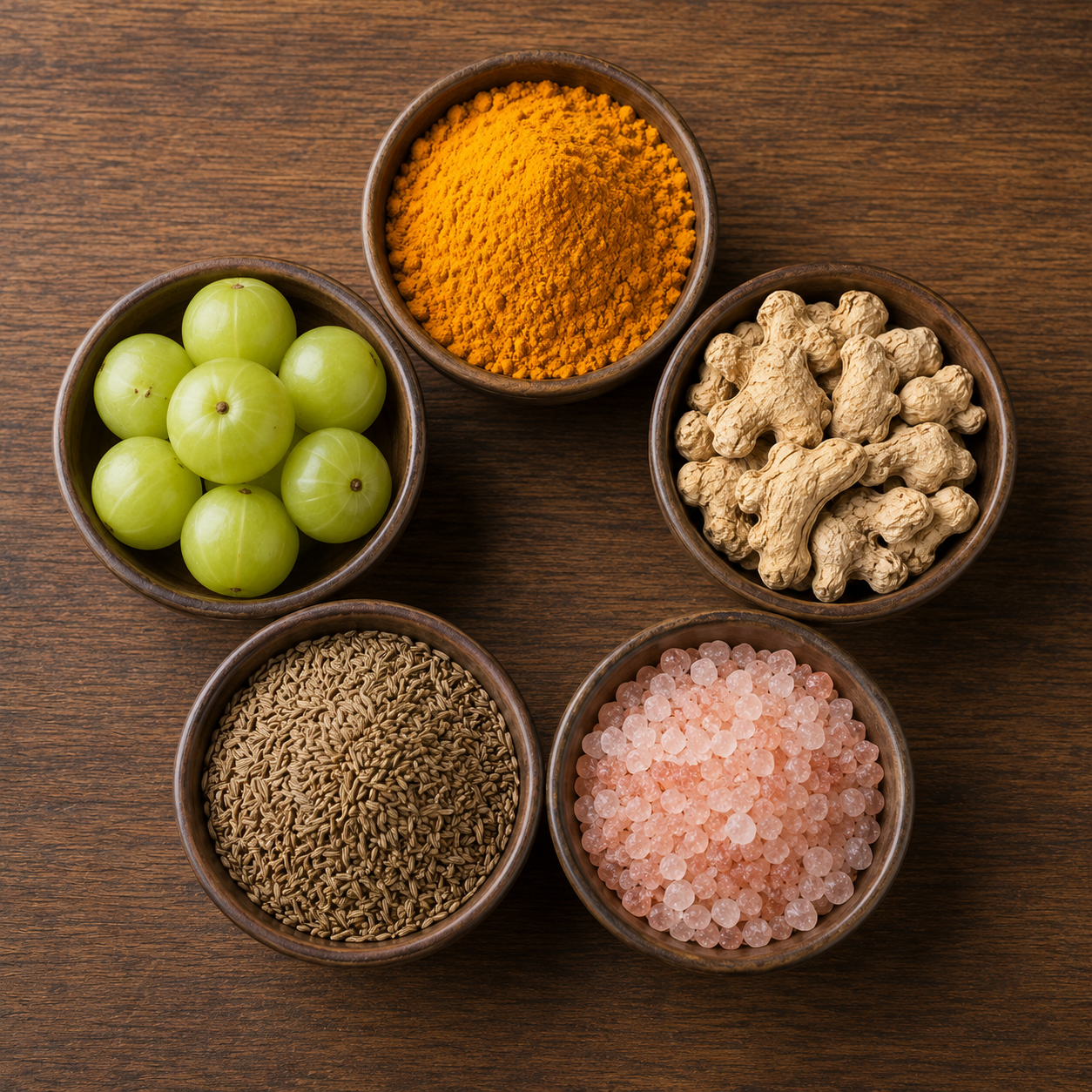
1. Turmeric   The number one supplement that you need in your life is nothing but turmeric.     You may have heard people saying, especially people in the west, talking about having turmeric in the form of teas, in the form of turmeric lattes, or sometimes even in the form of supplements.   You don’t need all of these pills and supplements to get your adequate amount of turmeric to help with all the benefits that it is going to give us.   Our traditional Indian way of cooking where we add the good fats and the spices, along with that we add turmeric, that is the most bioavailable form of turmeric and that helps with better digestion, better absorption, and better assimilation of all the good things that turmeric has to give us.   Now let us understand what turmeric does in our body. For this we have to understand what the properties of turmeric are as per Ayurveda.   Ayurveda says every food has certain properties, like there is a specific taste to a particular food item, a particular post-digestive taste.   Ayurveda also talks about a property called Prabhava or special characteristic.   One special characteristic or Prabhava of turmeric is that it is antimicrobial and anti-inflammatory.   For example, somebody is having a viral condition like chickenpox, we ask our patients to take shower with water boiled with turmeric because it is antimicrobial.   When it comes to food poisoning, if you consume more of turmeric paste throughout the day, you are helping your body to reduce inflammation.   Even if you have acne, you can use turmeric boiled water to wash your face because of its antimicrobial properties, you don’t need any antibacterial face washes.   All bitter tasting herbs are good for your liver. So, if you want to detoxify your liver, don’t go for supplements and medicines that detoxify your liver. Instead, just add a little bit more turmeric to your diet.   Adding turmeric to your dishes can help you improve your digestive fire, reduce gas, and bloating.   If you have children at home who constantly get bronchitis, cough, cold, fever, etc., turmeric helps you to improve their immunity. Make sure that you add turmeric to your cooking every day.   Even in traditional Indian cooking, we have so many dishes like haldi chawal, haldi doodh, haldi ka achar, turmeric lettuce soup. All of these are very good for improving your digestive system.     2. Dry Ginger     Number two is dry ginger.     I am talking about dry ginger and not wet ginger. Wet ginger is extremely heating, extremely pitta increasing. Dry ginger is also warm; it is much less heating compared to wet ginger.   When you buy ginger, make sure that you leave it outside and don’t keep it in the fridge so that it gets a little dry and then you can use it for cooking.   Just like how we said turmeric was anti-microbial and anti-inflammatory because of its prabhava, ginger also has a prabhava.   And what is that?   Dry ginger is anti-emetic. That means if somebody feels like vomiting, dry ginger is what we give.   It’s also good for improving digestion, absorption, and assimilation of food. It helps in reducing gas and bloating. It helps in subsiding Vata gently.   Just like how I told you about turmeric, don’t take dry ginger as a pill or a supplement. Instead, make sure that you have dry ginger in a cooked form along with other spices and good fats.   I personally add dry ginger every day to my cooking. However, one special indulgence that I really love doing is to have dry ginger wali masala chai.   After heavy meals, if for example, you had a biryani and you’re now feeling very heavy, very bloated, or you have this guilt feeling that you shouldn’t have had it because you can’t even think of the digestive problems that may come, then have dry ginger powder mixed with a little bit of rock salt, add a little bit of water and consume it.   That will help you subside the gas and bloating. It will also help you improve the digestion.   And if you’re somebody who feels constipation, you can have a glass of dry ginger water in the morning.   Make sure that you add two glasses of water, add one piece of dry ginger and reduce to one glass to get the maximum essence of dry ginger. And drink this water. This can ease your bowel movements.     3. Amla   This one is my favorite.     If you don’t want to have any supplement at all in this world, then one supplement that you need in your life is amla or amla powder.   This is something that you must include in your life.   Whether it is in the form of amla powder, amla juice, as amla murabba, amla candy, whatever it is, amla has to go into your system every single day.   Every house should have some form of amla ready to be served every day because amla helps in a lot of ways beyond what you can imagine.   There is a particular practice in Ayurveda. We call it as Kuti Pravishika. It is for people who want to reverse aging. It is a complete process. And the one thing that is given to people who wants to reverse their aging is Amla.   Amla has rejuvenating or anti-aging properties which can actually reverse your aging.   It is amazing for your skin, amazing for your heart, amazing for your hair, amazing for your digestive system, your liver, your intestine, and it’s good for your eyes.   So, if you want to take that one supplement every day, take Amla.   How can you consume Amla?   You can have Amla juice. Again, Amla juice, don’t have it as a… Continue reading 5 Natural Supplements You Should Add To Your Diet Every Single Day

Prakriti and Dosha Balance: The Key to Health in Ayurveda

Ayurveda teaches that true health starts with understanding who you are at a constitutional level. When you know your Prakriti, or inherent body–mind type, you can care for yourself in a way that supports balance, resilience and long term wellbeing.   Many people try to follow general wellness advice and feel confused when it does not work for them. From an Ayurvedic perspective, this happens because the advice does not match their Prakriti, or natural constitution. When you first understand your Prakriti and the way Vata, Pitta and Kapha behave in your system, your choices start making sense. Diet, sleep, exercise and even the way you handle stress can then align with who you truly are rather than forcing you into a one size fits all model.   What Prakriti Really Means   Prakriti is your unique constitution; it is the “nature” you are born with. It reflects the combined state of Vata, Pitta and Kapha present at that exact moment, influenced by parental constitution, health, diet, lifestyle, climate and even emotional states.   In simple terms, Vata governs movement and communication, Pitta governs transformation and metabolism, and Kapha governs structure and stability.   All three must be present for life to exist, and nobody can function if even one dosha is completely absent. What changes from person to person is which dosha dominates and how these three interact to create your physical traits, mental tendencies and disease patterns.   Although Prakriti is fixed at conception, its outer expression becomes clearer only after growth and hormonal changes settle. Before around eighteen to twenty years of age, strong Kapha influence of childhood can mask or exaggerate certain features, which is why identifying exact Prakriti in very young people can be difficult and only becomes more reliable once development stabilizes.   How Ayurveda Organizes Knowledge: Prakaranas   Ayurvedic texts carry vast amounts of information, so teachers arrange them into Prakaranas, or thematic sections. These are meaningful categories that help students and practitioners study specific topics such as constitution, disease, diet or treatment in a structured way, rather than getting lost in scattered details.   Types of Prakriti: Single, Dual and Sama   Ayurveda describes different constitutional patterns based on the relative predominance of Vata, Pitta and Kapha. Single dosha Prakriti means one dosha is overwhelmingly dominant across body, physiology, psychology and disease tendency, while the other two express minimally.   This kind of pure Vata, Pitta or Kapha type exists in theory and appears occasionally, but in real life it is rare because genetics are mixed, parents rarely share identical dominance and modern diet, stress and lifestyle modify expression from birth.   Most people show dual dosha dominance, known as Dwidoshaja, for example Vata Pitta, Pitta Kapha or Vata Kapha. In such constitutions one dosha leads and the second supports, while the third remains present at a subordinate level, just enough to sustain essential functions but not enough to display strong traits.   Sama dosha Prakriti, where Vata, Pitta and Kapha exist in near equal proportions, is considered the most ideal state. Here none of the doshas dominate and each contributes roughly one third of the total constitutional makeup, creating a high potential for balance, stability and good health.   Sama, Uttama, Nindya and Hina: Quality of Constitutions   Classical texts use qualitative terms to describe the relative strength and stability of different Prakriti. Sama dosha Prakriti is called the absolute best because an equal presence of Vata, Pitta and Kapha gives the greatest harmony and adaptability.   Kapha Prakriti is described as having good quality, especially in terms of strength, stability and longevity. Kapha relates to creation, structure, lubrication and immunity, so individuals with Kapha dominance often have better natural reserves and resilience, even though Vata and Pitta are also present in lower proportions.   Vata Prakriti is referred to as lower quality, not because Vata is unimportant but because it is the most unstable of the doshas. It has qualities of dryness, coldness and constant movement, and while it is the hero of movement and change, it also drives depletion and destruction when not contained.   Dwidoshaja constitutions are termed less desirable compared to pure or Sama types. This does not mean any dosha is missing. It reflects the complexity of having two strongly dominant forces that can easily conflict and disturb each other, making balance more challenging to maintain over time.   Do We Ever Have Only Two Doshas?   Every person always has all three doshas present. Even in a Vata Pitta constitution, Kapha does not disappear. It simply remains in the background, present only to the degree required for basic survival and structural stability.   That background Kapha can still become imbalanced if diet, lifestyle or environment repeatedly promote Kapha qualities such as heaviness, coldness and stagnation.   The same logic applies to all combinations. Vata Pitta people can still develop Kapha disorders, and Kapha types still have Vata and Pitta operating in their systems. Constitution talks about dominance, not exclusivity.   Why Sama Prakriti Is Rare Today   Sama dosha constitutions are most often described in individuals born in regions where climate, land and lifestyle remain naturally balanced without a marked dominance of any single dosha. Parents with relatively balanced constitutions further support the chance of such offspring.   In the modern world, most regions and lifestyles lean toward one or two doshas. Irregular routines, processed food, chronic stress and disturbed sleep aggravate doshas and disturb nutrition from early life. These factors make perfectly balanced Sama Prakriti very uncommon today.   Can Parents Create the Best Prakriti through Rituals?   Traditional Ayurvedic culture includes various preparatory rituals for conception. These do not change the fundamental rule that Prakriti forms at the specific moment of union and cannot be chosen or redesigned through will alone.   However such practices play an important supportive role. They help parents purify, stabilize and balance their own doshas at the time of conception, which prevents extreme dominance and supports the… Continue reading Prakriti and Dosha Balance: The Key to Health in Ayurveda