
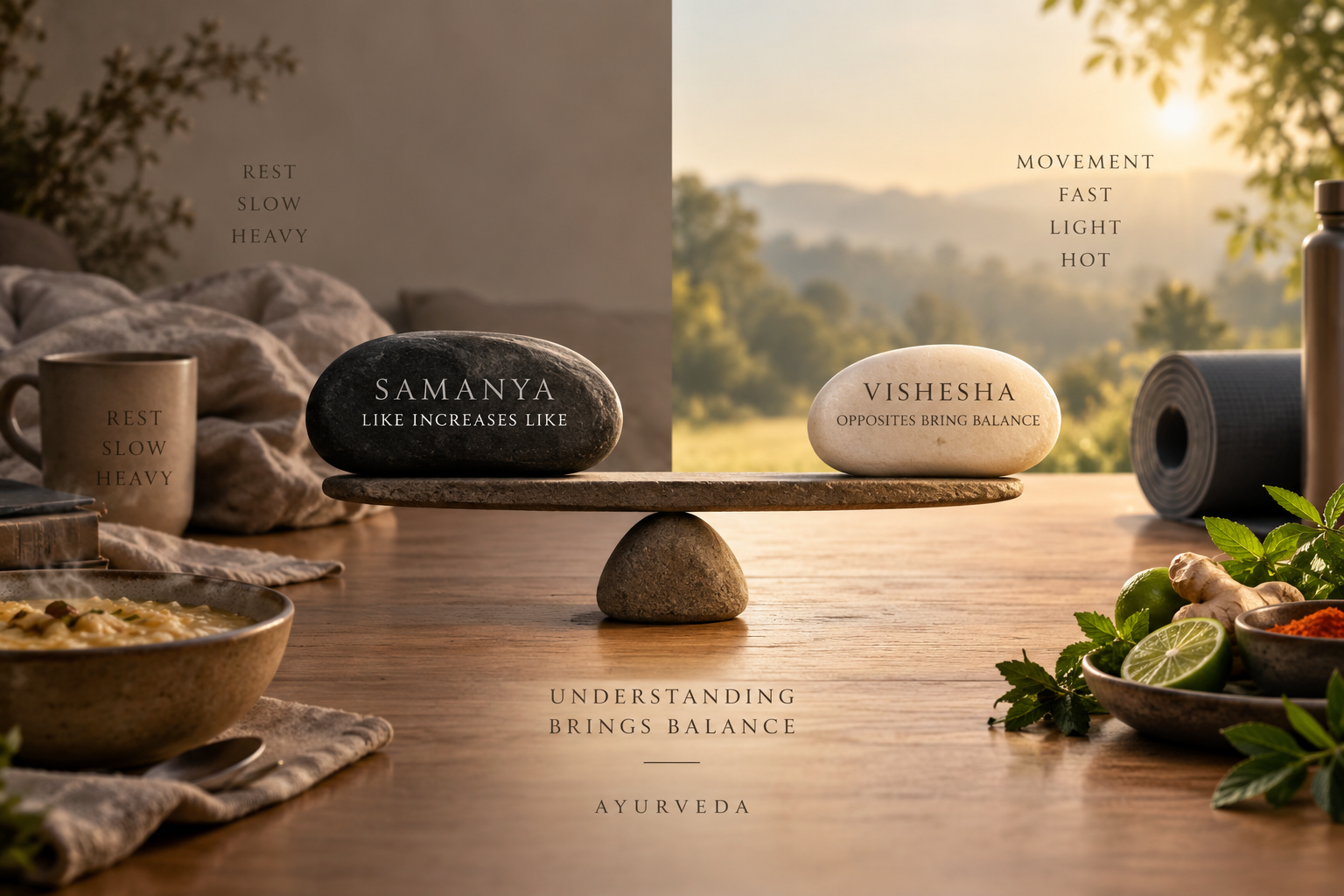
Think of this situation, you probably find it familiar. You come home tired, and instead of hitting the gym or going for a walk, all you want to do is sleep. So, you lie down but when you get up instead of feeling refreshed, you feel even more tired. There might also be days when you feel jittery and restless instead. So, you go for a walk or hit the gym hoping it will help. But rather than feeling energised, you end up feeling even more wired than when you started. You must have noticed that nobody has really taught us this. We just vaguely assume that rest will fix our tiredness, or movement will fix our restlessness, without actually stopping to think about whether they really do. Interestingly, Ayurveda has actually talked about this phenomenon. The Charaka Samhita has a verse that describes this very pattern. सामान्यमेकत्वकरं, विशेषस्तु पृथक्त्वकृत् । तुल्यार्थता हि सामान्यं, विशेषस्तु विपर्ययः ॥ It can be roughly translated to Samanya brings things together, Vishesha pulls them apart. Samanya is sameness of quality; Vishesha is its opposite. This verse introduces us to two words. One is samanya, which means sameness or similarity. The other is vishesha, which means difference or distinction. And the principle the text is pointing towards is that things that are similar to each other tend to increase each other, while things that are opposite to each other tend to reduce each other. It’s almost like fields, where one thing can either reinforce what is already there or counter it. Rest is slow. So, if you are already feeling heavy and slow, more rest isn’t necessarily going to rebalance you. It only reinforces that feeling of heaviness and sluggishness. On the other hand, restlessness is hot and fast. So, if you respond to that feeling with more movement, you might end up feeling even more hot and wired rather than actually calming the restlessness. You’re reinforcing the qualities that are already present. Now that we think about it, it sounds obvious. But we rarely think about our own habits in these terms. This principle can also be applied to the food we consume and our body’s internal balances, what Ayurveda calls the doshas. It’s quite simple. Whatever quality is already present in excess, you don’t add more of it. You reach for its opposite instead. On a cold day, for example, if you’re already feeling stiff, dry and cold you naturally want to add some warmth. Similarly, if you’re feeling sluggish or heavy after a meal, you probably don’t want to eat something even heavier, right? You want something lighter. In fact, the very first chapter of the Charaka Samhita, called Dirghanjivitiya, which is about the desire for long life, talks about exactly which tastes can calm which imbalances. It goes through all six rasas, or tastes, and explains their qualities and what can be used to pacify different states. Take Vata, for example. Vata is dry and is associated with movement. So, it is calmed by substances with opposite qualities. If you’re feeling dry and cold, if you’re in a Vata state, you would reach for sweet, sour and salty tastes because these carry qualities of moisture, warmth and weight. Or if you feel like your Pitta is rising, you’re overheated or you’re feeling short-tempered, bitter and sweet tastes can help cool things down. And this is important: none of the six tastes are universally good or universally bad. It’s not that sweet is unhealthy and bitter is healthy. Each taste has its place whether it is helpful or unhelpful depends entirely on the state it is meeting. There is no fixed list where cold foods are always bad or sweet foods are always bad. It depends entirely on the person, the place, the timing, and the state of the body, not just the substance itself. This is one of the core ideas of Ayurveda. It is individualistic. The same food or medicine can be helpful for one person but not for another. If you must have also noticed, even for the same person, something that suits them one day may not suit them on another day. It depends on what qualities they are already carrying in excess at that particular time. Ayurveda says that even a well-known poison, used with the right knowledge, at the right dose, for the right person, can become the best possible medicine. And a substance that’s technically medicine, used without that understanding, can do as much damage as poison. The substance alone is never the whole story. You have to look at what you’re giving, who you’re giving it to, why you’re giving it, how much you’re giving, and under what circumstances. And this brings us back to samanya and vishesha. Because the real question isn’t simply, “Is this food good?” Ayurveda’s answer is rarely just about the thing itself. It is about the relationship between the thing and the person receiving it. If this way of looking at Ayurveda interests you, you might enjoy our courses on the Charaka Samhita and Ashtanga Hridayam, where we go deeper into the texts and the ideas behind them. Sometimes, going back to the original texts can change the way you understand Ayurveda, and even the way you look at your own life.