
WHO Recognises Ayurveda. So Why Isn’t It Covered by Insurance?

Biology concept with retro science cartoon icons set vector illustration

Ayurveda has gained global recognition from the World Health Organization. But in most countries, patients still have to pay for treatment entirely out of pocket. Why?   Over the past few years, Ayurveda has reached several important milestones.   The World Health Organization (WHO) has recognized Ayurveda as an important part of traditional and integrative healthcare. India has also established the WHO Global Traditional Medicine Centre in Jamnagar, backed by significant government investment, to strengthen research, collaboration, and innovation in traditional medicine.   These achievements are important.   They show that Ayurveda is receiving increasing attention at the global level.   But if someone living in London, New York, or Berlin wants Ayurvedic treatment, they’re probably paying for it themselves.   Even if Ayurveda is recognized, it is still not covered by most health insurance plans.   Recognition and access are not the same thing.   Recognition Is Only the First Step   The WHO Global Traditional Medicine Strategy (2025–2034) encourages countries to strengthen research, improve safety and regulation, and integrate traditional medicine into healthcare systems where appropriate.   This is an important step forward.   It gives traditional medicine, including Ayurveda, greater visibility in global health discussions.   However, recognition by the WHO does not automatically mean that a treatment becomes part of a country’s healthcare system.   Every country has its own rules for licensing practitioners, approving medicines, and deciding what treatments insurance companies will pay for.   That is where Ayurveda still faces significant challenges.   What the Current Situation Looks Like   India’s own report, Strategic Roadmap for Making Ayurveda Global, prepared by NITI Aayog and PwC, highlights this gap.   According to the report:   Ayurveda currently has formal recognition in only a limited number of countries. In many international markets, Ayurvedic products are still classified as dietary supplements rather than medicines. Insurance coverage for Ayurvedic treatment remains very limited outside India.   This means that although awareness of Ayurveda is growing, access to affordable treatment has not kept pace.   For many patients, cost remains a major barrier.   India Has Already Shown That Insurance Can Work   Interestingly, this challenge has already been addressed within India.   Health insurance regulations now require insurers to provide coverage for AYUSH treatments, including Ayurveda, under specific conditions.   Many insurance policies now reimburse eligible Ayurvedic treatments in the same way they reimburse conventional medical care.   Hospitals that meet the required standards can offer insured Ayurvedic treatments to patients.   This demonstrates that insurance coverage for Ayurveda is possible.   The systems already exist.   The question is how similar models can be developed internationally.   Why Insurance Matters   Insurance does more than reduce healthcare costs.   It also builds trust.   When an insurance company agrees to cover a treatment, it usually means that the treatment has passed careful reviews related to safety, effectiveness, practitioner qualifications, and clinical evidence.   Without insurance coverage, many patients simply cannot afford long-term care, regardless of how beneficial a treatment may be.   That limits access and slows wider adoption.   Traditional Chinese Medicine Offers an Important Example   Traditional Chinese Medicine (TCM) has made greater progress in this area.   In countries such as Switzerland, certain TCM treatments are included within the national health insurance system when provided by appropriately qualified medical professionals.   This did not happen overnight.   It was the result of years of research, standardized education, practitioner certification, and collaboration with healthcare regulators.   Ayurveda has not yet reached the same stage in most countries.   In many places, it is still classified alongside wellness services rather than integrated into mainstream healthcare.   Why This Gap Still Exists   Insurance providers make decisions based on evidence.   They want answers to questions such as:   Does the treatment improve patient outcomes? Is it safe? Does it reduce long-term healthcare costs? Are practitioners properly trained and regulated?   While research in Ayurveda continues to grow, India’s own policy roadmap acknowledges that larger international clinical studies and stronger evidence are still needed.   This is one of the biggest reasons insurance coverage remains limited.   Recognition creates awareness.   Evidence creates confidence.   Insurance depends on confidence.   What Needs to Happen Next   The good news is that the path forward is becoming clearer.   Several steps could help Ayurveda become more widely accepted by healthcare systems and insurance providers around the world.   These include: Conducting more high-quality clinical research that meets international standards. Generating cost-effectiveness data to demonstrate how Ayurvedic care may reduce long-term healthcare expenses. Creating internationally recognized credentialing systems for qualified Ayurvedic physicians. Expanding the proposed Global Ayurveda Register so practitioner qualifications can be easily verified. Working with governments and insurers to launch pilot insurance programs in countries with growing interest in Ayurveda.   These efforts would provide the evidence and infrastructure that insurers need before expanding coverage.   Recognition Is Important. Access Is the Goal.   The WHO’s recognition of Ayurveda is an important milestone.   It reflects growing international respect for one of the world’s oldest healthcare systems.   But recognition alone does not make treatment affordable.   Patients benefit most when qualified practitioners are accessible, treatments are properly regulated, and insurance makes care financially possible.   India has already shown that this model can work domestically.   The next challenge is building similar systems internationally.   If research, regulation, and professional standards continue to improve, Ayurveda will be in a much stronger position to become part of mainstream healthcare systems around the world.   Recognition opened the door.   The next step is making sure patients can actually walk through it.  
Government Report Confirms What Many Ayurvedic Practitioners Have Been Saying for Years

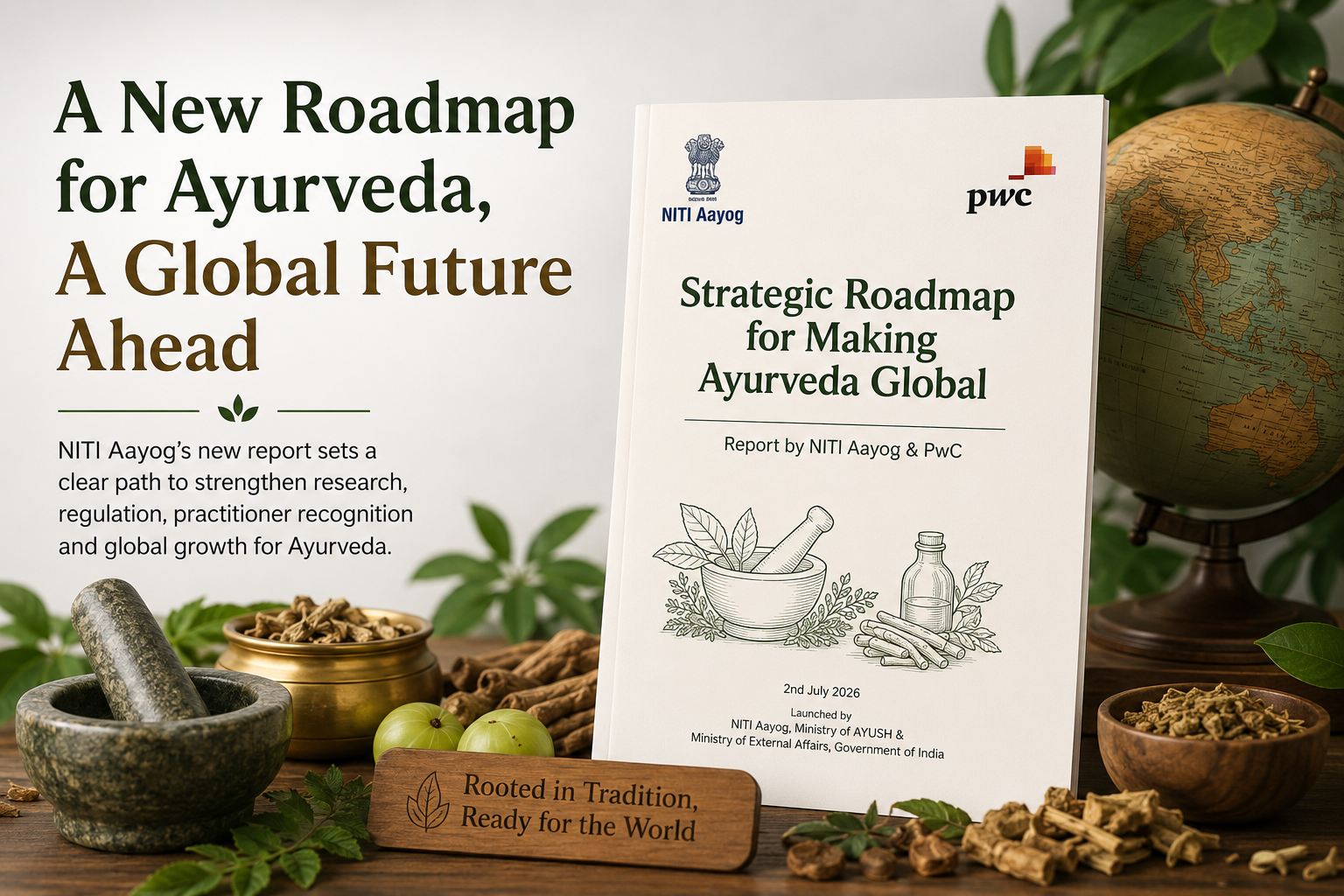
Ayurveda has immense potential to become a global healthcare system. But for that to happen, it needs stronger infrastructure, better international recognition, and clear global standards.   The new government report says exactly that.   On 2 July 2026, NITI Aayog, in collaboration with PwC, released a report titled “Strategic Roadmap for Making Ayurveda Global.”   It’s an official policy document launched by senior leaders from NITI Aayog, the Ministry of AYUSH, and the Ministry of External Affairs.   One of the report’s biggest messages states clearly that Ayurveda has a strong foundation in India, but it still lacks the systems needed to succeed globally.   For many Ayurvedic practitioners, this isn’t surprising. These challenges have been discussed for years. The difference is that they have now been formally acknowledged in a national policy document.     What the Report Says     The report recognizes that Ayurveda has made significant progress, but it also points out several important gaps that continue to limit its international growth.   One of its key observations is that Traditional Chinese Medicine (TCM) has built a much stronger global ecosystem than Ayurveda.   China has invested heavily in overseas medical centers, international partnerships, standardized regulations, research, and global quality standards.   As a result, TCM has become far more integrated into healthcare systems around the world.   Ayurveda, despite having a rich history and a strong presence within India, has not yet achieved the same level of international recognition.     India Has the Expertise     India has one of the largest traditional medicine workforces in the world.   There are more than 355,000 qualified Ayurvedic practitioners, along with hundreds of thousands of other AYUSH professionals.   Ayurvedic products are now exported to nearly 150 countries, and exports have grown significantly over the past decade.   These are encouraging signs.   However, the report points out that in many countries Ayurvedic products are still sold as dietary supplements rather than recognized medicines.   Likewise, many qualified Ayurvedic physicians are unable to practice internationally because clear licensing and recognition systems do not yet exist.   In other words, India has the expertise.   What it still needs is stronger international infrastructure.     Why This Matters     Recognition is about much more than reputation.   It affects whether qualified Ayurvedic doctors can practice abroad, whether treatments are covered by insurance, whether products receive medical approval, and whether patients know how to identify properly trained practitioners.   Today, many people outside India struggle to distinguish between someone who has completed a five-and-a-half-year BAMS medical degree and someone who has only completed a short certification course.   That creates confusion for patients and makes it harder for qualified professionals to gain the recognition they deserve.     What the Roadmap Proposes     Perhaps the most encouraging part of the report is that it doesn’t just identify problems.   It also outlines a plan for addressing them.   Over the next several years, the roadmap recommends: Developing internationally recognized standards for Ayurvedic education and clinical practice.   Creating a Global Ayurveda Register where qualified practitioners can be verified.   Expanding government-supported Ayurveda centers in key international markets.   Increasing clinical research to strengthen the evidence base for Ayurveda.   Supporting international recognition of Ayurvedic medicines.   Working toward insurance coverage for Ayurvedic treatments in selected countries.   Creating professional pathways that allow qualified Ayurvedic physicians to practice abroad.   Together, these initiatives aim to make Ayurveda more accessible, more credible, and easier to integrate into healthcare systems worldwide.     Why the Global Ayurveda Register Is Important     Among all the recommendations, one stands out.   The proposal to create a Global Ayurveda Register could become one of the most important developments for the profession.   A verified international registry would allow patients, hospitals, employers, and healthcare regulators to confirm that a practitioner has completed recognized medical training.   It would also make it much easier to distinguish fully qualified Ayurvedic physicians from individuals with limited or informal training.   This kind of transparency builds trust, and trust is essential for any healthcare system.   A Roadmap Is Only the Beginning     While the report is an important milestone, it is still only a roadmap.   The real measure of success will be how much of it is actually implemented.   Previous initiatives have introduced valuable programs such as AYUSH Information Cells, international partnerships, academic collaborations, and medical tourism initiatives.   These have all contributed to Ayurveda’s growth.   However, the report also acknowledges that important challenges remain, including international licensing, insurance integration, standardized education, and regulatory alignment.   The next few years will determine whether this roadmap leads to lasting change.     The Future Looks Promising     For many practitioners, this report represents an encouraging shift.   The conversation is no longer focused only on promoting Ayurveda.   It is now focused on building the systems that allow Ayurveda to grow responsibly around the world.   If the proposed initiatives are implemented successfully, they could make it easier for qualified practitioners to work internationally, improve confidence in Ayurvedic products, strengthen research, and provide patients across the world with greater access to authentic Ayurvedic care.     Looking Ahead     Ayurveda has always had the knowledge, the history, and the practitioners needed to make a global impact.   What it has needed is stronger infrastructure.   This new roadmap recognizes that reality and provides a clear direction for the future.   Now the focus shifts from planning to action.   The coming years will show whether these recommendations become meaningful reforms that strengthen Ayurveda’s place in global healthcare.   That is the opportunity ahead.  

Why Most Ayurvedic Doctors Never Practice Outside India, and Why That Needs to Change

Ayurveda has one of the largest trained healthcare workforces in the world. Yet very few Ayurvedic doctors ever practice outside India.   The problem isn’t a lack of talent. It’s a lack of global recognition.   When people talk about taking Ayurveda to a global audience, the conversation often revolves around awareness.   International interest has largely focused on wellness and herbal products.   But they overlook a much bigger challenge.   If qualified Ayurvedic doctors cannot easily practice outside India, how can Ayurveda truly become a global healthcare system?   The answer lies in something far less exciting than marketing.   It lies in regulation, recognition, and infrastructure.     India Has Thousands of Qualified Ayurvedic Doctors     India has built an impressive educational system for Ayurveda.   According to government data, the country has more than 379,000 registered Ayurveda practitioners and over 750,000 registered AYUSH professionals overall.   These aren’t hobbyists or wellness influencers.   Most Ayurveda physicians complete the Bachelor of Ayurvedic Medicine and Surgery (BAMS), a government-regulated medical degree that takes five and a half years to complete.   Their education includes subjects such as anatomy, physiology, pathology, pharmacology, diagnostics, surgery, gynecology, ENT, ophthalmology, and clinical training, alongside classical Ayurvedic principles.   In other words, these are highly trained healthcare professionals.   Yet despite having such a large workforce, very few ever practice outside India.   Inside India, a BAMS degree is a recognized medical qualification regulated by the National Commission for Indian System of Medicine.   Outside India, the situation changes dramatically.   In many countries, the degree has little or no official recognition.   A BAMS-qualified physician moving to countries such as the United States cannot simply continue practicing as a doctor.   Instead, they often have to register through voluntary professional associations that do not grant medical licenses, prescribing rights, or hospital privileges.   This creates an unfortunate situation.   A physician who spent more than five years completing formal medical education may appear no different, from a legal standpoint, than someone who completed a short certification course in Ayurveda.   For patients, employers, and healthcare regulators overseas, distinguishing between the two becomes difficult.     Recognition Builds Trust     Healthcare systems rely on trust.   That trust comes from clear educational standards, licensing systems, and professional regulation.   When hospitals hire doctors or governments approve healthcare providers, they need reliable ways to verify qualifications.   This is where Ayurveda faces an important challenge.   There is currently no widely recognized international system that allows foreign regulators to quickly verify whether someone has completed an accredited BAMS program.   As a result, every country has to assess qualifications independently. Many simply choose not to create formal licensing pathways for Ayurvedic practitioners at all.   Without a straightforward verification process, expanding professional recognition becomes much more difficult.     Traditional Chinese Medicine Took a Different Approach     Traditional Chinese Medicine (TCM) offers an interesting comparison.   China invested heavily in creating international systems that support its practitioners. Government-backed TCM centers operate in numerous countries through official partnerships.   Training standards are clearly defined. Foreign governments have established mechanisms to recognize qualified practitioners.   This doesn’t necessarily mean TCM has better practitioners. It means the profession has stronger international infrastructure supporting those practitioners.   That infrastructure makes global mobility possible.     Why Credentials Matter     As Ayurveda grows in popularity around the world, more people are offering Ayurvedic consultations, wellness coaching, and lifestyle advice.   Some are formally trained physicians. Others have completed shorter courses or self-directed study.   For the average patient, it can be extremely difficult to tell the difference.   That creates confusion. It also affects the credibility of the profession as a whole.   When inaccurate information is shared publicly by someone presenting themselves as an Ayurveda expert, the reputation of qualified practitioners is often affected as well.   Without internationally recognized credentials, patients have no easy way to identify who has completed years of medical education and who has not.     Ayurveda Needs Better Global Infrastructure     The challenge isn’t producing skilled practitioners.   India has already done that. The challenge is building systems that allow those practitioners to be recognized internationally.   Several important steps could help move Ayurveda in that direction.   A globally accessible registry of accredited BAMS graduates would allow patients, hospitals, employers, and healthcare regulators to verify qualifications with confidence.   Mutual recognition agreements between governments could make it easier for qualified Ayurvedic physicians to practice in countries where there is growing demand.   Clear international credentialing standards would also help distinguish fully trained doctors from wellness practitioners with shorter certifications, creating greater transparency for patients.   India could continue working with international organizations such as the World Health Organization to develop consistent benchmarks for Ayurvedic education and professional practice.   Government-supported clinical partnerships overseas could further strengthen the profession by allowing experienced Ayurvedic physicians to work within recognized healthcare institutions abroad.   None of these ideas are unprecedented.   Many healthcare professions already use similar systems to support international mobility and recognition.     The Future of Ayurveda Depends on Its Practitioners     Ayurveda’s global future isn’t limited by a lack of knowledge or skilled professionals.   India already has hundreds of thousands of qualified Ayurvedic doctors who have undergone years of structured education and clinical training.   The real challenge is ensuring that the rest of the world can recognize those qualifications with confidence.   When patients can easily verify a practitioner’s credentials, when healthcare systems understand what a BAMS degree represents, and when governments create clear pathways for qualified physicians to practice internationally, Ayurveda will have a much stronger foundation for global growth.   The medicine has always been ready.   Now it’s time to build the systems that allow the people practicing it to be recognized around the world.  

Why Ayurveda Needs Evidence, Not Excuses!

Some people believe asking Ayurveda for evidence is disrespectful.   I disagree.   Evidence does not weaken Ayurveda. It protects Ayurveda.   It separates real practice from misinformation. It helps the world understand what our teachers preserved for centuries.   The Question of Evidence   Like any other traditional system of medicine, Ayurveda has also faced this criticism and scrutiny over the question of evidence.   As modern healthcare has become increasingly evidence driven, Ayurveda has often been judged against standards developed for the biomedical framework.   This has led many people to dismiss it as unscientific, not because of a lack of knowledge, but because the knowledge has been traditionally generated, preserved, and communicated in a different way from the standards of modern medicine.   To understand this, we need to look at how Ayurvedic knowledge has evolved.   For centuries, Ayurveda was taught through the gurukula system, where learning was transferred from the guru to the disciple.   Students did not simply memorize texts. They observed patients alongside their teachers. Most of the knowledge was practical rather than purely theoretical, and knowledge was often refined through observation and experience.   Ayurveda therefore had its own framework for validating knowledge. It relied on its own set of parameters. What it did not develop was the kind of biomedical research framework that has formed the foundation of modern healthcare today, and this is important.   Ayurveda is one of the world’s most extensively documented traditional medical systems. Classical texts like the Charaka Samhita, Sushruta Samhita, and Ashtanga Hridayam have preserved its principles for centuries.   However, while the core philosophy and knowledge have been documented, clinical practice was never recorded in the systematic manner expected today. Individual case studies, long-term treatment outcomes, and standardized datasets are all part of modern clinical culture.   Where the Gap Actually Comes From   As a result, this historical gap explains why Ayurveda has entered the modern scientific era with a wealth of classical wisdom but comparatively limited research documentation. In recent decades, significant efforts have been made to bridge this gap. Institutions working under the AYUSH framework have invested in research on Ayurvedic formulations, therapies, and clinical practices.   This brings us to another challenge.   Much of this research has been expected to conform to the language and methodology of biomedical science, including its full set of protocols. These are valuable tools, but they were never part of the traditional system of Ayurveda.   Presenting Ayurveda through this different scientific language is not just a challenge; it can lead to gaps in both evidence and translation.   Hence, to address this gap, significant efforts are being made.   Addressing The Gap   In May 2025, the World Health Assembly adopted the WHO Global Traditional Medicine Strategy 2025 to 2034, a ten-year roadmap built specifically to strengthen the evidence base for traditional medicine systems including Ayurveda.   India’s Ministry of Ayush has signed a three-million-dollar agreement with WHO to bring Ayurveda into the International Classification of Health Interventions, the same global data framework biomedicine uses to track treatment outcomes worldwide.   WHO is also building a Traditional Medicine Global Library, already holding over 1.5 million records of evidence maps, clinical journals, and policy documents.   None of this happens for a system that has nothing to prove. It happens because global health authorities have recognized that Ayurveda’s outcomes are real and worth documenting properly.   The medicine was never the problem. The documentation was.   And documentation is not a threat to Ayurveda. It is its greatest opportunity.   Evidence does not exist to replace classical knowledge. It exists to preserve it, strengthen it, and make it accessible to a healthcare system that increasingly relies on measurable outcomes. If Ayurveda is to serve future generations across the world, its principles must be communicated in a language that researchers, physicians, policymakers, and patients can understand.   Authentic knowledge should never be afraid of scrutiny. If a treatment consistently produces positive outcomes, documenting those outcomes only strengthens confidence in that practice.   At the same time, we must also recognise that not every aspect of Ayurveda fits neatly into conventional biomedical research models.   Ayurveda is fundamentally personalised. Two patients with the same diagnosis may receive different treatment plans because their constitution, digestive capacity, lifestyle, stage of disease, and overall health are different. Standardised clinical trial designs often attempt to minimise variation between patients, whereas Ayurveda intentionally incorporates individual variation into treatment decisions.   This means Ayurveda deserves research methods that respect the complexity of whole-system, personalised care rather than forcing every principle into a framework originally designed for modern healthcare standards.   The goal should never be to make Ayurveda imitate modern medicine.   The goal should be to develop rigorous methods that can evaluate Ayurveda on its own principles while maintaining the scientific standards expected in global healthcare.   This is where the future lies.   After treating thousands of patients across the world, one thing has become clear to me. I do not see evidence and tradition as competitors. I see them as two generations of the same commitment: the commitment to helping the person in front of you and being honest about what works.   Our teachers built Ayurveda on direct observation of patients over centuries. Evidence based research is simply the modern language for continuing that same observation, at a scale and rigor our teachers never had access to.   The future of Ayurveda needs both. The wisdom of our ancient texts. And the language of modern validation. One without the other is incomplete.