Government Report Confirms What Many Ayurvedic Practitioners Have Been Saying for Years

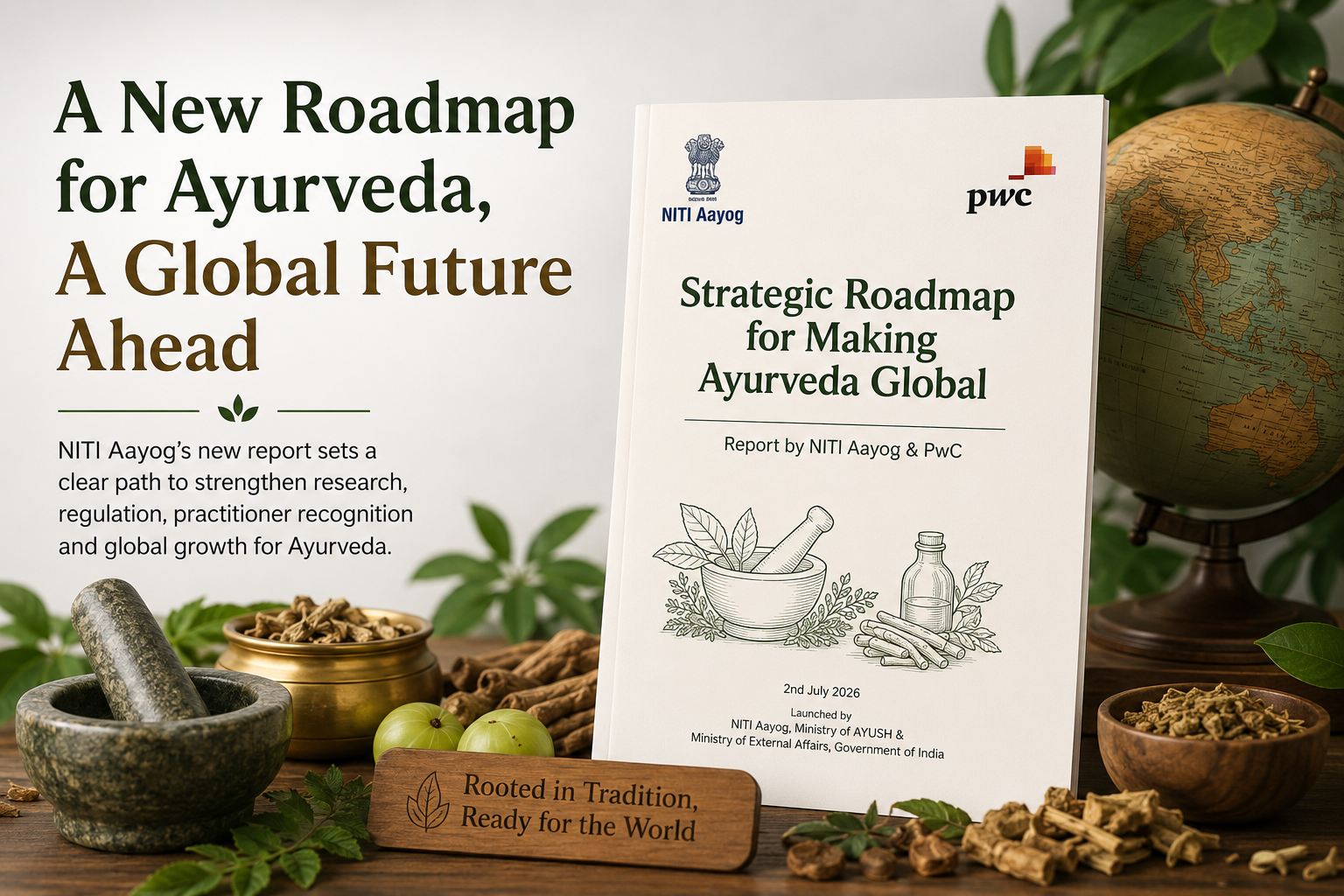
Ayurveda has immense potential to become a global healthcare system. But for that to happen, it needs stronger infrastructure, better international recognition, and clear global standards.   The new government report says exactly that.   On 2 July 2026, NITI Aayog, in collaboration with PwC, released a report titled “Strategic Roadmap for Making Ayurveda Global.”   It’s an official policy document launched by senior leaders from NITI Aayog, the Ministry of AYUSH, and the Ministry of External Affairs.   One of the report’s biggest messages states clearly that Ayurveda has a strong foundation in India, but it still lacks the systems needed to succeed globally.   For many Ayurvedic practitioners, this isn’t surprising. These challenges have been discussed for years. The difference is that they have now been formally acknowledged in a national policy document.     What the Report Says     The report recognizes that Ayurveda has made significant progress, but it also points out several important gaps that continue to limit its international growth.   One of its key observations is that Traditional Chinese Medicine (TCM) has built a much stronger global ecosystem than Ayurveda.   China has invested heavily in overseas medical centers, international partnerships, standardized regulations, research, and global quality standards.   As a result, TCM has become far more integrated into healthcare systems around the world.   Ayurveda, despite having a rich history and a strong presence within India, has not yet achieved the same level of international recognition.     India Has the Expertise     India has one of the largest traditional medicine workforces in the world.   There are more than 355,000 qualified Ayurvedic practitioners, along with hundreds of thousands of other AYUSH professionals.   Ayurvedic products are now exported to nearly 150 countries, and exports have grown significantly over the past decade.   These are encouraging signs.   However, the report points out that in many countries Ayurvedic products are still sold as dietary supplements rather than recognized medicines.   Likewise, many qualified Ayurvedic physicians are unable to practice internationally because clear licensing and recognition systems do not yet exist.   In other words, India has the expertise.   What it still needs is stronger international infrastructure.     Why This Matters     Recognition is about much more than reputation.   It affects whether qualified Ayurvedic doctors can practice abroad, whether treatments are covered by insurance, whether products receive medical approval, and whether patients know how to identify properly trained practitioners.   Today, many people outside India struggle to distinguish between someone who has completed a five-and-a-half-year BAMS medical degree and someone who has only completed a short certification course.   That creates confusion for patients and makes it harder for qualified professionals to gain the recognition they deserve.     What the Roadmap Proposes     Perhaps the most encouraging part of the report is that it doesn’t just identify problems.   It also outlines a plan for addressing them.   Over the next several years, the roadmap recommends: Developing internationally recognized standards for Ayurvedic education and clinical practice.   Creating a Global Ayurveda Register where qualified practitioners can be verified.   Expanding government-supported Ayurveda centers in key international markets.   Increasing clinical research to strengthen the evidence base for Ayurveda.   Supporting international recognition of Ayurvedic medicines.   Working toward insurance coverage for Ayurvedic treatments in selected countries.   Creating professional pathways that allow qualified Ayurvedic physicians to practice abroad.   Together, these initiatives aim to make Ayurveda more accessible, more credible, and easier to integrate into healthcare systems worldwide.     Why the Global Ayurveda Register Is Important     Among all the recommendations, one stands out.   The proposal to create a Global Ayurveda Register could become one of the most important developments for the profession.   A verified international registry would allow patients, hospitals, employers, and healthcare regulators to confirm that a practitioner has completed recognized medical training.   It would also make it much easier to distinguish fully qualified Ayurvedic physicians from individuals with limited or informal training.   This kind of transparency builds trust, and trust is essential for any healthcare system.   A Roadmap Is Only the Beginning     While the report is an important milestone, it is still only a roadmap.   The real measure of success will be how much of it is actually implemented.   Previous initiatives have introduced valuable programs such as AYUSH Information Cells, international partnerships, academic collaborations, and medical tourism initiatives.   These have all contributed to Ayurveda’s growth.   However, the report also acknowledges that important challenges remain, including international licensing, insurance integration, standardized education, and regulatory alignment.   The next few years will determine whether this roadmap leads to lasting change.     The Future Looks Promising     For many practitioners, this report represents an encouraging shift.   The conversation is no longer focused only on promoting Ayurveda.   It is now focused on building the systems that allow Ayurveda to grow responsibly around the world.   If the proposed initiatives are implemented successfully, they could make it easier for qualified practitioners to work internationally, improve confidence in Ayurvedic products, strengthen research, and provide patients across the world with greater access to authentic Ayurvedic care.     Looking Ahead     Ayurveda has always had the knowledge, the history, and the practitioners needed to make a global impact.   What it has needed is stronger infrastructure.   This new roadmap recognizes that reality and provides a clear direction for the future.   Now the focus shifts from planning to action.   The coming years will show whether these recommendations become meaningful reforms that strengthen Ayurveda’s place in global healthcare.   That is the opportunity ahead.  
Why Most Ayurvedic Doctors Never Practice Outside India, and Why That Needs to Change

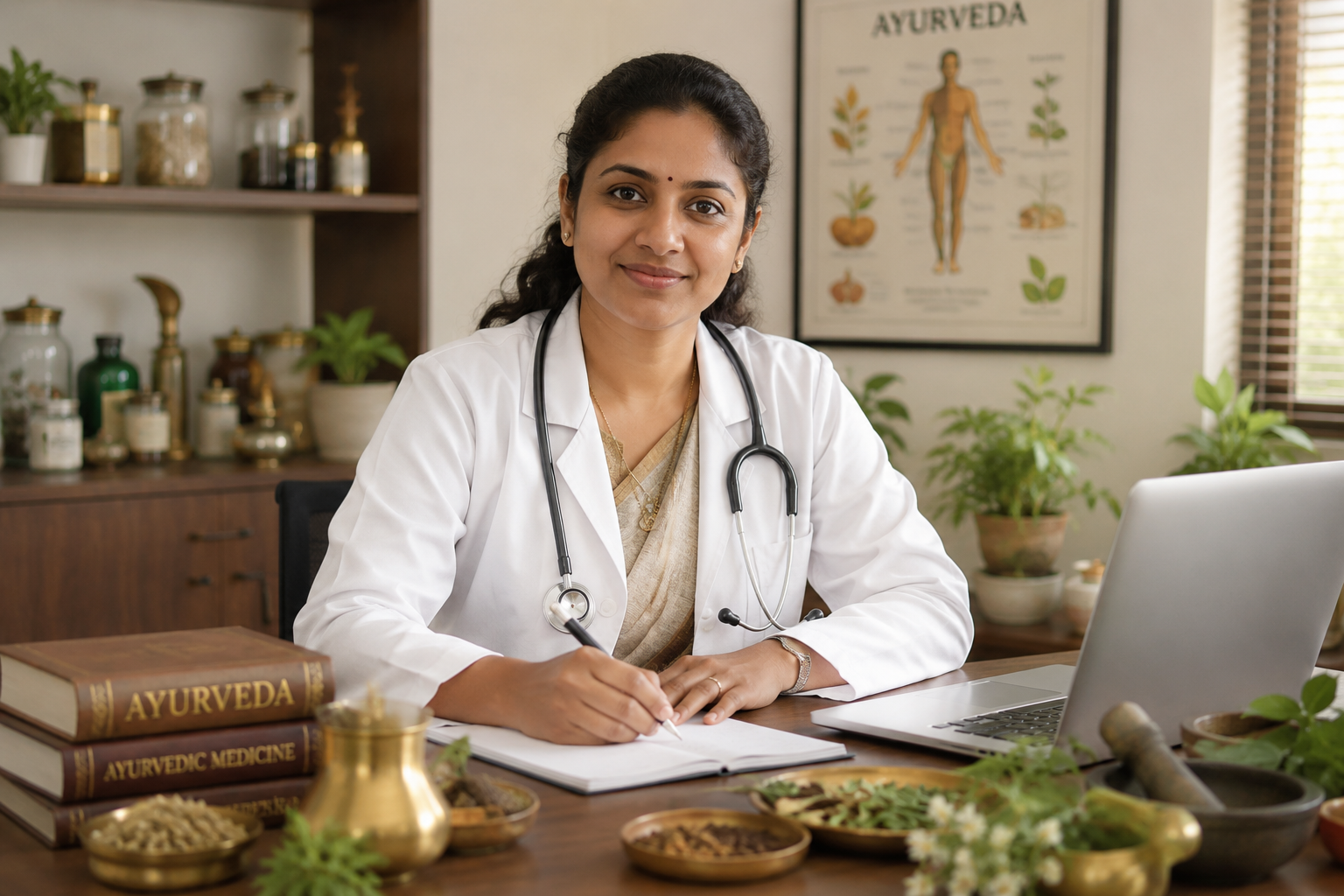
Ayurveda has one of the largest trained healthcare workforces in the world. Yet very few Ayurvedic doctors ever practice outside India.   The problem isn’t a lack of talent. It’s a lack of global recognition.   When people talk about taking Ayurveda to a global audience, the conversation often revolves around awareness.   International interest has largely focused on wellness and herbal products.   But they overlook a much bigger challenge.   If qualified Ayurvedic doctors cannot easily practice outside India, how can Ayurveda truly become a global healthcare system?   The answer lies in something far less exciting than marketing.   It lies in regulation, recognition, and infrastructure.     India Has Thousands of Qualified Ayurvedic Doctors     India has built an impressive educational system for Ayurveda.   According to government data, the country has more than 379,000 registered Ayurveda practitioners and over 750,000 registered AYUSH professionals overall.   These aren’t hobbyists or wellness influencers.   Most Ayurveda physicians complete the Bachelor of Ayurvedic Medicine and Surgery (BAMS), a government-regulated medical degree that takes five and a half years to complete.   Their education includes subjects such as anatomy, physiology, pathology, pharmacology, diagnostics, surgery, gynecology, ENT, ophthalmology, and clinical training, alongside classical Ayurvedic principles.   In other words, these are highly trained healthcare professionals.   Yet despite having such a large workforce, very few ever practice outside India.   Inside India, a BAMS degree is a recognized medical qualification regulated by the National Commission for Indian System of Medicine.   Outside India, the situation changes dramatically.   In many countries, the degree has little or no official recognition.   A BAMS-qualified physician moving to countries such as the United States cannot simply continue practicing as a doctor.   Instead, they often have to register through voluntary professional associations that do not grant medical licenses, prescribing rights, or hospital privileges.   This creates an unfortunate situation.   A physician who spent more than five years completing formal medical education may appear no different, from a legal standpoint, than someone who completed a short certification course in Ayurveda.   For patients, employers, and healthcare regulators overseas, distinguishing between the two becomes difficult.     Recognition Builds Trust     Healthcare systems rely on trust.   That trust comes from clear educational standards, licensing systems, and professional regulation.   When hospitals hire doctors or governments approve healthcare providers, they need reliable ways to verify qualifications.   This is where Ayurveda faces an important challenge.   There is currently no widely recognized international system that allows foreign regulators to quickly verify whether someone has completed an accredited BAMS program.   As a result, every country has to assess qualifications independently. Many simply choose not to create formal licensing pathways for Ayurvedic practitioners at all.   Without a straightforward verification process, expanding professional recognition becomes much more difficult.     Traditional Chinese Medicine Took a Different Approach     Traditional Chinese Medicine (TCM) offers an interesting comparison.   China invested heavily in creating international systems that support its practitioners. Government-backed TCM centers operate in numerous countries through official partnerships.   Training standards are clearly defined. Foreign governments have established mechanisms to recognize qualified practitioners.   This doesn’t necessarily mean TCM has better practitioners. It means the profession has stronger international infrastructure supporting those practitioners.   That infrastructure makes global mobility possible.     Why Credentials Matter     As Ayurveda grows in popularity around the world, more people are offering Ayurvedic consultations, wellness coaching, and lifestyle advice.   Some are formally trained physicians. Others have completed shorter courses or self-directed study.   For the average patient, it can be extremely difficult to tell the difference.   That creates confusion. It also affects the credibility of the profession as a whole.   When inaccurate information is shared publicly by someone presenting themselves as an Ayurveda expert, the reputation of qualified practitioners is often affected as well.   Without internationally recognized credentials, patients have no easy way to identify who has completed years of medical education and who has not.     Ayurveda Needs Better Global Infrastructure     The challenge isn’t producing skilled practitioners.   India has already done that. The challenge is building systems that allow those practitioners to be recognized internationally.   Several important steps could help move Ayurveda in that direction.   A globally accessible registry of accredited BAMS graduates would allow patients, hospitals, employers, and healthcare regulators to verify qualifications with confidence.   Mutual recognition agreements between governments could make it easier for qualified Ayurvedic physicians to practice in countries where there is growing demand.   Clear international credentialing standards would also help distinguish fully trained doctors from wellness practitioners with shorter certifications, creating greater transparency for patients.   India could continue working with international organizations such as the World Health Organization to develop consistent benchmarks for Ayurvedic education and professional practice.   Government-supported clinical partnerships overseas could further strengthen the profession by allowing experienced Ayurvedic physicians to work within recognized healthcare institutions abroad.   None of these ideas are unprecedented.   Many healthcare professions already use similar systems to support international mobility and recognition.     The Future of Ayurveda Depends on Its Practitioners     Ayurveda’s global future isn’t limited by a lack of knowledge or skilled professionals.   India already has hundreds of thousands of qualified Ayurvedic doctors who have undergone years of structured education and clinical training.   The real challenge is ensuring that the rest of the world can recognize those qualifications with confidence.   When patients can easily verify a practitioner’s credentials, when healthcare systems understand what a BAMS degree represents, and when governments create clear pathways for qualified physicians to practice internationally, Ayurveda will have a much stronger foundation for global growth.   The medicine has always been ready.   Now it’s time to build the systems that allow the people practicing it to be recognized around the world.