Ayurveda has immense potential to become a global healthcare system. But for that to happen, it needs stronger infrastructure, better international recognition, and clear global standards.
The new government report says exactly that.
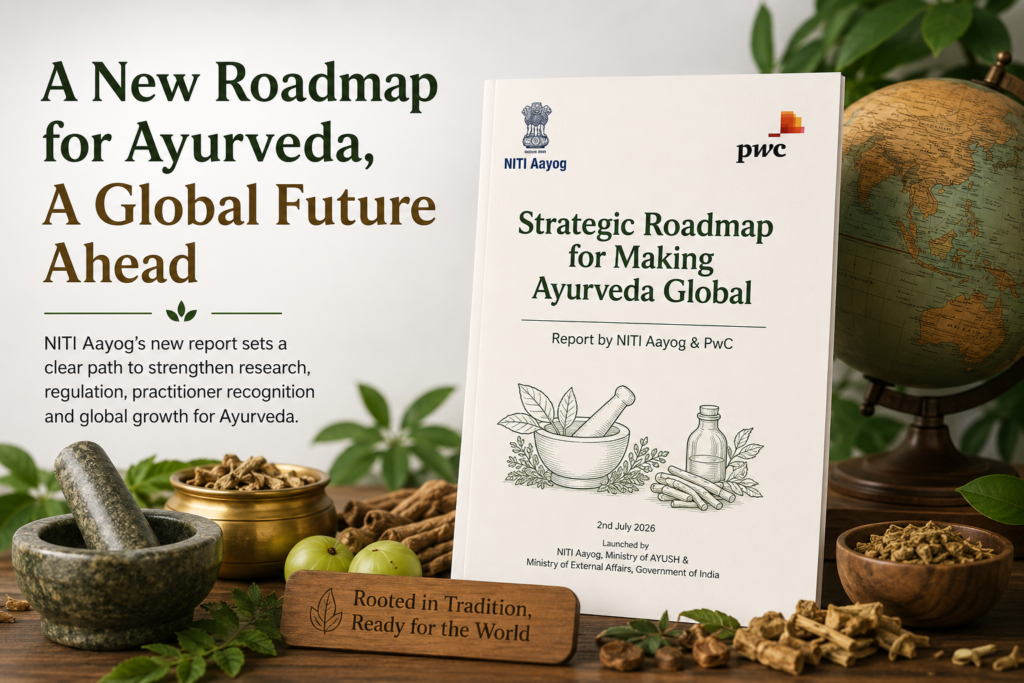
On 2 July 2026, NITI Aayog, in collaboration with PwC, released a report titled “Strategic Roadmap for Making Ayurveda Global.”
It’s an official policy document launched by senior leaders from NITI Aayog, the Ministry of AYUSH, and the Ministry of External Affairs.
One of the report’s biggest messages states clearly that Ayurveda has a strong foundation in India, but it still lacks the systems needed to succeed globally.
For many Ayurvedic practitioners, this isn’t surprising. These challenges have been discussed for years. The difference is that they have now been formally acknowledged in a national policy document.
What the Report Says
The report recognizes that Ayurveda has made significant progress, but it also points out several important gaps that continue to limit its international growth.
One of its key observations is that Traditional Chinese Medicine (TCM) has built a much stronger global ecosystem than Ayurveda.
China has invested heavily in overseas medical centers, international partnerships, standardized regulations, research, and global quality standards.
As a result, TCM has become far more integrated into healthcare systems around the world.
Ayurveda, despite having a rich history and a strong presence within India, has not yet achieved the same level of international recognition.
India Has the Expertise
India has one of the largest traditional medicine workforces in the world.
There are more than 355,000 qualified Ayurvedic practitioners, along with hundreds of thousands of other AYUSH professionals.
Ayurvedic products are now exported to nearly 150 countries, and exports have grown significantly over the past decade.
These are encouraging signs.
However, the report points out that in many countries Ayurvedic products are still sold as dietary supplements rather than recognized medicines.
Likewise, many qualified Ayurvedic physicians are unable to practice internationally because clear licensing and recognition systems do not yet exist.
In other words, India has the expertise.
What it still needs is stronger international infrastructure.
Why This Matters
Recognition is about much more than reputation.
It affects whether qualified Ayurvedic doctors can practice abroad, whether treatments are covered by insurance, whether products receive medical approval, and whether patients know how to identify properly trained practitioners.
Today, many people outside India struggle to distinguish between someone who has completed a five-and-a-half-year BAMS medical degree and someone who has only completed a short certification course.
That creates confusion for patients and makes it harder for qualified professionals to gain the recognition they deserve.
What the Roadmap Proposes
Perhaps the most encouraging part of the report is that it doesn’t just identify problems.
It also outlines a plan for addressing them.
Over the next several years, the roadmap recommends:
- Developing internationally recognized standards for Ayurvedic education and clinical practice.
- Creating a Global Ayurveda Register where qualified practitioners can be verified.
- Expanding government-supported Ayurveda centers in key international markets.
- Increasing clinical research to strengthen the evidence base for Ayurveda.
- Supporting international recognition of Ayurvedic medicines.
- Working toward insurance coverage for Ayurvedic treatments in selected countries.
- Creating professional pathways that allow qualified Ayurvedic physicians to practice abroad.
Together, these initiatives aim to make Ayurveda more accessible, more credible, and easier to integrate into healthcare systems worldwide.
Why the Global Ayurveda Register Is Important
Among all the recommendations, one stands out.
The proposal to create a Global Ayurveda Register could become one of the most important developments for the profession.
A verified international registry would allow patients, hospitals, employers, and healthcare regulators to confirm that a practitioner has completed recognized medical training.
It would also make it much easier to distinguish fully qualified Ayurvedic physicians from individuals with limited or informal training.
This kind of transparency builds trust, and trust is essential for any healthcare system.
A Roadmap Is Only the Beginning
While the report is an important milestone, it is still only a roadmap.
The real measure of success will be how much of it is actually implemented.
Previous initiatives have introduced valuable programs such as AYUSH Information Cells, international partnerships, academic collaborations, and medical tourism initiatives.
These have all contributed to Ayurveda’s growth.
However, the report also acknowledges that important challenges remain, including international licensing, insurance integration, standardized education, and regulatory alignment.
The next few years will determine whether this roadmap leads to lasting change.
The Future Looks Promising
For many practitioners, this report represents an encouraging shift.
The conversation is no longer focused only on promoting Ayurveda.
It is now focused on building the systems that allow Ayurveda to grow responsibly around the world.
If the proposed initiatives are implemented successfully, they could make it easier for qualified practitioners to work internationally, improve confidence in Ayurvedic products, strengthen research, and provide patients across the world with greater access to authentic Ayurvedic care.
Looking Ahead
Ayurveda has always had the knowledge, the history, and the practitioners needed to make a global impact.
What it has needed is stronger infrastructure.
This new roadmap recognizes that reality and provides a clear direction for the future.
Now the focus shifts from planning to action.
The coming years will show whether these recommendations become meaningful reforms that strengthen Ayurveda’s place in global healthcare.
That is the opportunity ahead.