
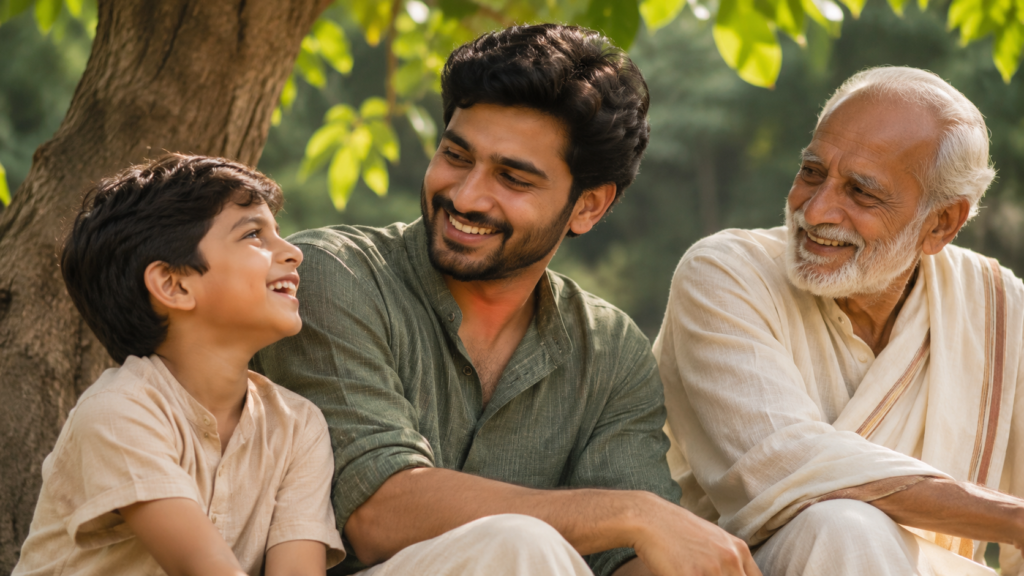
Have you ever looked at an old photograph of yourself and wondered how different you were back then?
Not just how you looked, but how you lived. How much energy you had, how quickly you recovered after a long day, the things you enjoyed eating, the way you slept and even how you thought about the world.
As we grow older, a lot of things change. Some changes are obvious, like our physical appearance. Others happen so gradually that we barely notice them.
Ayurveda has always considered age an important factor when understanding a person’s health.
In fact, the classical texts don’t look at the human body as something that remains the same throughout life. They describe different stages of life, each with its own characteristics, strengths and requirements.
This is explained through a concept called Vaya.
And Ayurveda connects these stages with the three Doshas: Kapha, Pitta and Vata.
Let’s understand what this means.
What is Vaya in Ayurveda?
Vaya refers to age or the different stages through which a person progresses during their lifetime.
In Charaka Samhita, Acharya Charaka explains that age is broadly divided into three stages:
- Bala: Childhood
- Madhya: Middle age
- Jirna: Old age
But this isn’t simply a classification based on the number of years a person has lived.
Charaka also considers what happens to the body during these stages. How the tissues develop, how strength changes, how the senses function and how our mental faculties evolve.
And this is where the three Doshas become important.
Ayurveda associates childhood with Kapha, adulthood with Pitta and old age with Vata.
Let’s look at each stage individually.
- Bala Avastha: The stage of childhood (Kapha predominance)
The first stage is Bala Avastha, or childhood.
If you think about the way a child grows, you’ll notice how much development happens during these years.
The body is constantly changing. Bones develop, muscles grow, the sense organs mature and the child gradually acquires new abilities.
Even the way children learn and understand things changes significantly as they grow.
Ayurveda associates this stage with Kapha Dosha.
Now, why Kapha?
Think about the qualities of Kapha: stability, heaviness, structure, nourishment and growth.
These qualities are closely associated with the development and formation of bodily tissues.
In Ayurveda, Kapha is considered particularly important during childhood because this is the stage when the body is still developing.
Charaka describes childhood as a period in which the Dhatus, or bodily tissues, are not yet fully mature. Physical strength is still developing, and the body is comparatively delicate.
This is also why Ayurvedic texts emphasise appropriate nourishment and care during childhood.
A child’s requirements are not the same as those of an adult. Their food, sleep, physical activity and overall routine need to support the process of growth.
- Madhya Avastha: The stage of adulthood (Pitta predominance)
The second stage is Madhya Avastha, which broadly refers to adulthood and middle age.
This is generally considered the stage when the body has developed its strength and the different tissues have reached maturity.
Charaka describes this period as one in which physical strength, energy, understanding, memory, retention and other faculties are well developed.
And this stage is associated with Pitta Dosha.
Pitta is connected with transformation, digestion, metabolism and the processing of different substances.
The qualities associated with Pitta are heat, sharpness and transformation.
These are traditionally understood as important qualities during the stage of life when the body is at its functional maturity.
This is also the period when people generally take on greater responsibilities. Work, relationships, family, ambitions and the demands of everyday life begin occupying a significant part of their attention.
The body has developed, its capacities are more established, and the individual is navigating a different set of demands.
But there’s another interesting detail here.
Charaka describes the period up to thirty years as a phase during which the bodily tissues are still developing, even though childhood, in the narrower sense, is described as lasting until sixteen.
So, the transition from childhood to adulthood isn’t treated as an overnight change. Development continues beyond the early years.
- Jirna Avastha: The stage of old age (Vata predominance)
And finally, we come to Jirna Avastha, or old age.
This is the stage when the body gradually begins experiencing changes associated with ageing.
The strength that we once took for granted may not remain the same. Recovery may take longer, the sense organs may become less sharp, and physical endurance may gradually decline.
Charaka describes this stage as one in which the Dhatus, strength, energy, sensory abilities, memory, retention and other faculties undergo gradual diminution.
This stage is associated with Vata Dosha.
And when you think about the qualities of Vata, the connection becomes interesting.
Vata is associated with movement, dryness, lightness, roughness and variability.
Ayurveda relates these qualities to several changes that occur during ageing.
For instance, dryness of the skin, reduced physical strength, changes in mobility and the gradual decline of certain bodily functions are discussed in the context of Vata predominance.
The body may not respond to everything in the same way it did earlier in life.
And the idea is not to fight every change that comes with ageing, but to understand the changing needs of the body and care for it accordingly.
Does this mean everyone ages in exactly the same way?
Not necessarily.
Your constitution, environment, lifestyle, health and several other factors influence how you experience these stages.
However the larger principle remains the same: the body changes with age, and our approach to maintaining health should take those changes into consideration.
What can we learn from this?
We often follow the same routines for years without considering whether they still suit us.
The same exercise routine, the same eating habits, the same sleeping schedule and sometimes even the same expectations we place on our bodies.
But the body we had at fifteen isn’t the body we have at thirty. And the body we have at thirty may not have the same requirements when we are sixty.
Our needs change, and perhaps our understanding of health should change with them.
A growing child needs nourishment that supports development. An adult needs to maintain strength and manage the demands of everyday life. An older person may need greater attention to mobility, recovery, nourishment and rest.
This doesn’t mean that we should start associating every change with a Dosha imbalance or assume that ageing is something that can be prevented.
Ageing is a natural part of life.
What Ayurveda offers is a way of understanding these changes and adapting our approach to health rather than expecting the body to remain exactly the same.
If you’d like to understand how these stages of life and their associated Doshas are explained in the original classical texts, with their Sanskrit verses and commentaries, you can explore our Charaka Samhita and Ashtanga Hridayam courses.