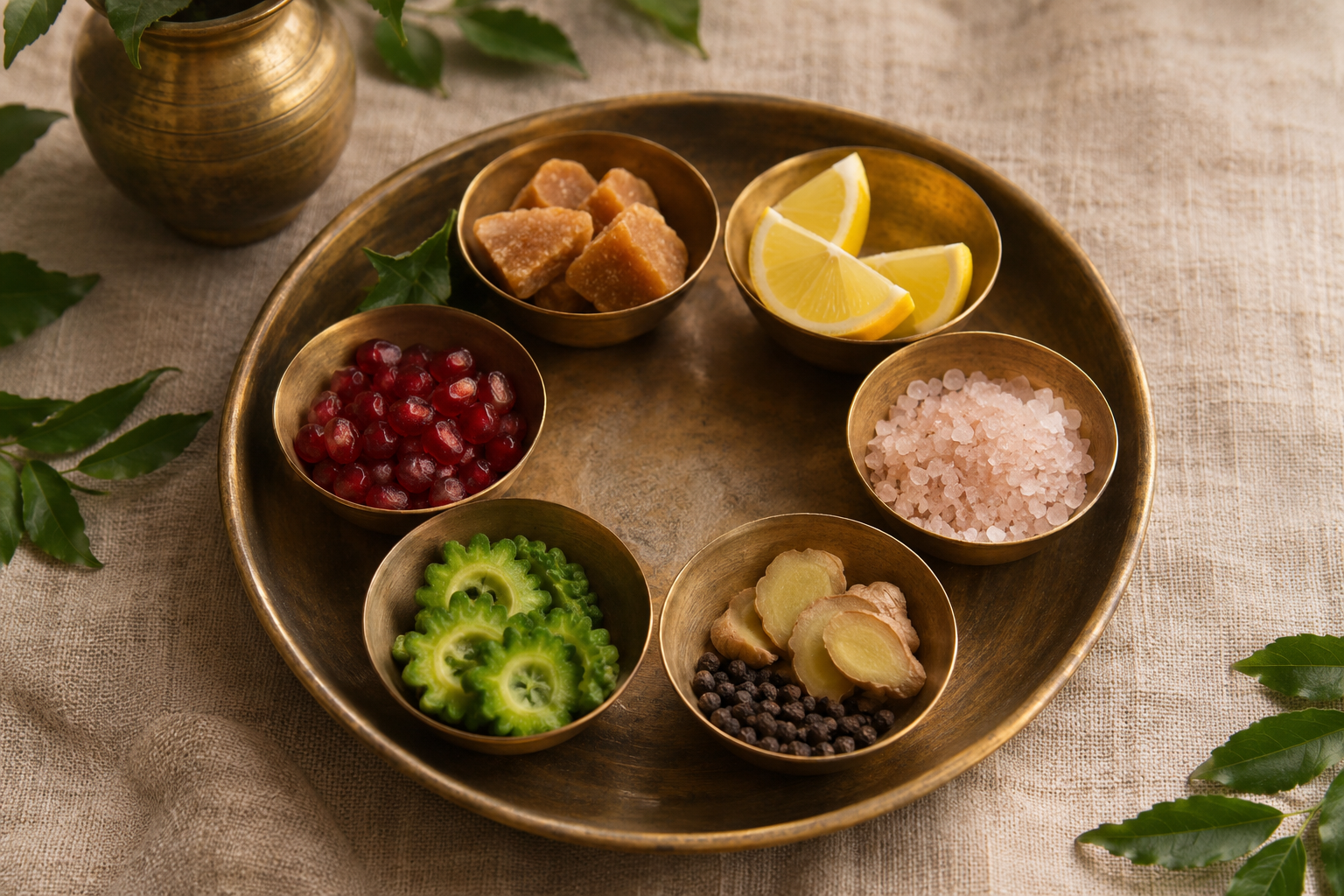
Why Ayurveda Believes Every Taste Has a Purpose: Understanding the Six Rasas

Think about your favourite meal for a moment.   Maybe it’s something sweet, something spicy, or a combination of flavours that you simply cannot get enough of. Now think about the foods you usually avoid. Perhaps you don’t enjoy bitter vegetables, or you find certain sour foods too strong.   We all have our preferences when it comes to taste. But have you ever wondered why Ayurveda places so much importance on the different tastes we experience through food?   In fact, the classical Ayurvedic texts describe six distinct tastes, known as Shad Rasa. And what’s interesting is that these tastes aren’t simply classified according to how they feel on your tongue. Each one is associated with particular qualities and effects on the body.   Ayurveda even considers the balance of these six tastes important when deciding what and how we should eat.   Let’s understand what these six tastes are and why they matter.   What are the six Rasas?   In Ayurveda, the word Rasa refers to taste, which is perceived through the tongue.   Charaka Samhita, in Sutrasthana 26, describes a rather interesting discussion among several sages about how many tastes actually exist.   Some believed there were four, others suggested five, seven or even innumerable tastes.   But Acharya Punarvasu Atreya eventually established that there are six primary tastes.   These are:   Madhura: Sweet Amla: Sour Lavana: Salty Katu: Pungent Tikta: Bitter Kashaya: Astringent   Ayurveda doesn’t consider these tastes interchangeable. Each has its own qualities, and each interacts differently with the three Doshas.   Let’s take them one by one.   Madhura Rasa: The sweet taste   Let’s start with the one most of us are familiar with.   Madhura means sweet, and it is associated with satisfaction and a sense of fullness.   But when Ayurveda talks about sweet taste, it isn’t referring only to sugar, chocolates or desserts.   Rice, wheat, milk, dates and many other foods also fall under the broad category of Madhura Rasa.   According to Ayurveda, sweet taste is generally heavy and cooling in nature.   It is traditionally associated with nourishment and the development of bodily tissues. It also helps pacify Vata and Pitta.   Think about how a simple meal of rice and milk or a bowl of cooked grains can feel satisfying and comforting.   That’s the kind of nourishing quality associated with Madhura Rasa.   However, Ayurveda also emphasizes against excessive consumption.   Too much sweet taste can aggravate Kapha and is associated with heaviness, excessive nourishment and accumulation.   So, while sweet taste has an important place in the diet, more of it doesn’t necessarily mean better nourishment.   Amla Rasa: The sour taste   Next comes Amla, or sour taste.   Squeezing a lemon over your food, eating a piece of tamarind or tasting a raw mango, that immediate sourness, the way your mouth begins watering and your cheeks almost tighten, is what Amla Rasa feels like.   Ayurveda describes sour taste as warming, slightly oily and relatively light.   It is traditionally associated with stimulating appetite, increasing salivation and supporting digestion.   It also helps pacify Vata, but excessive sour taste can aggravate Pitta and Kapha.   This is why Ayurveda pays attention not just to the taste itself but also to how much of it we consume.   Something that makes food more enjoyable and stimulates the appetite in an appropriate amount may become unsuitable when consumed excessively.   Lavana Rasa: The salty taste   We can never imagine eating a meal without any salt.   Even if all the ingredients are perfectly cooked, something might feel missing.   That’s because salt plays a rather important role in how we experience food.   Lavana Rasa is the salty taste.   Ayurveda describes it as warming, heavy and unctuous. It is traditionally associated with enhancing taste, promoting salivation and supporting digestion.   It also helps pacify Vata.   But excessive consumption of salty foods is associated with aggravation of Pitta and Kapha.   The classical texts also describe excessive salt consumption in relation to thirst, water retention and certain other disturbances.   And this is a particularly relevant reminder today, considering how much salt can be hidden in packaged foods, sauces and processed snacks.   The idea isn’t to eliminate salt altogether. It is to understand the importance of moderation.   Katu Rasa: The pungent taste   This is for all those who enjoy spicy food.   Katu refers to pungent taste.   Think about biting into a piece of fresh ginger, tasting black pepper or eating something with a generous amount of chilli.   You can almost feel the heat spreading through your mouth.   Ayurveda describes Katu Rasa as light, dry and heating in nature.   It is traditionally associated with stimulating digestion, reducing excess Kapha and helping clear certain accumulations.   It also helps pacify Kapha, but excessive pungent taste can aggravate Vata and Pitta.   And here’s something worth remembering.   Just because a food makes you sweat or produces a strong sensation in your mouth doesn’t necessarily mean it is improving your digestion.   Ayurveda considers the overall qualities and quantity of the food, rather than assuming that stronger flavours always produce better results.   Tikta Rasa: The bitter taste   This is probably the taste many people try to avoid.   Bitter vegetables, neem leaves, certain medicinal herbs and some leafy greens are familiar examples of Tikta Rasa.   Unlike sweet or sour foods, bitter foods aren’t always particularly enjoyable to eat.   But Ayurveda gives bitter taste an important place.   It is described as light, dry and cooling in nature.   It is traditionally associated with reducing Pitta and Kapha, and is used in classical formulations for various purposes.   Excessive bitter taste, however, can aggravate Vata.   What’s interesting is that Ayurveda doesn’t judge the value of a food only by how pleasant it tastes.   Something doesn’t have to be… Continue reading Why Ayurveda Believes Every Taste Has a Purpose: Understanding the Six Rasas
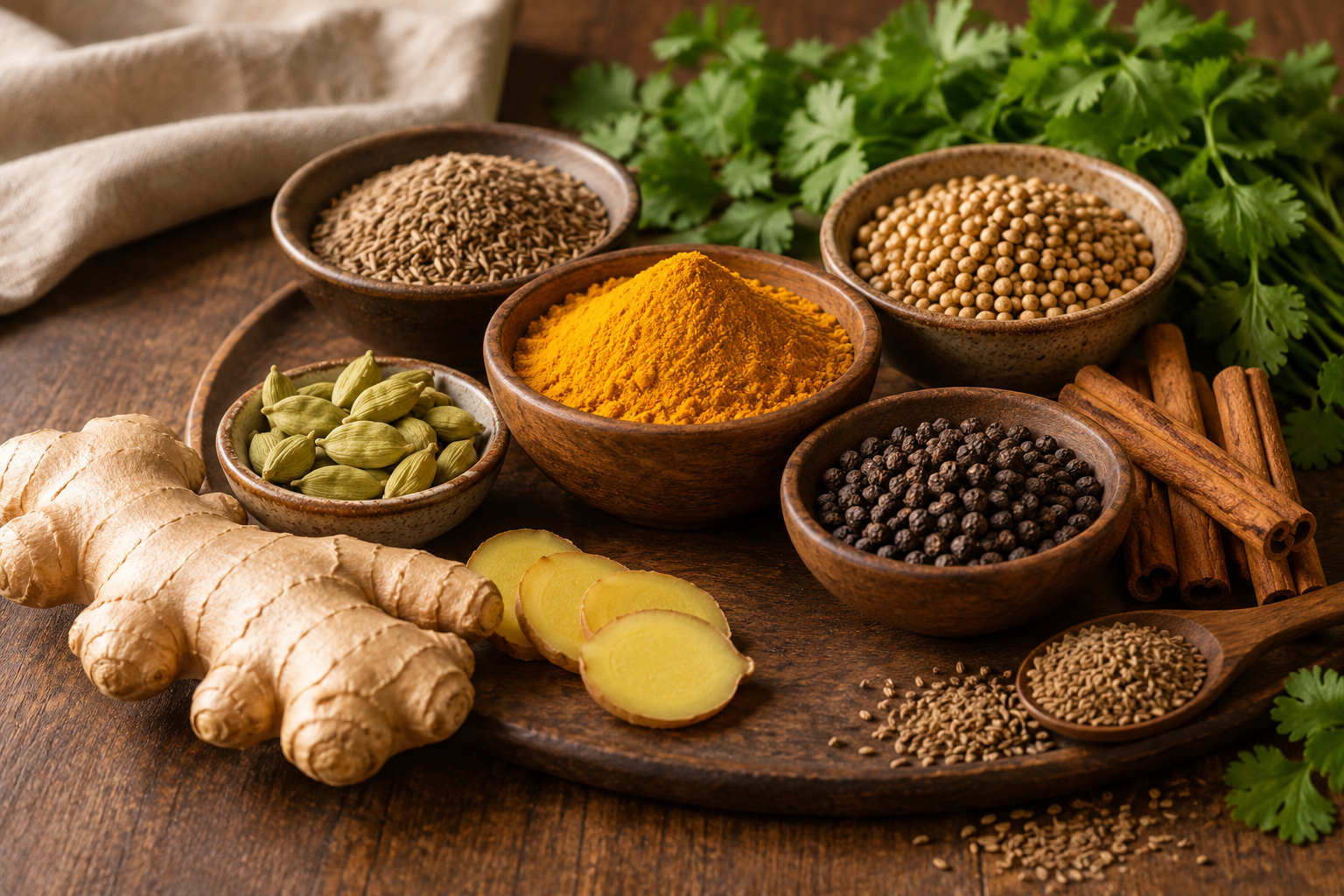
6 Everyday Spices Ayurveda Wrote About Centuries Ago

If you grew up in an Indian household, you’ve probably heard it at least once – “add some jeera, it’ll help you digest” or “have a bit of ginger, it’ll help settle your stomach.”   We all treated these as remedies our grandmothers just knew.   But a lot of these tips come from classical Ayurvedic texts, with specific reasoning attached. One of the best known is the Bhavaprakasha Nighantu, written by Bhavamishra around the 16th century. A Nighantu is basically a reference book of medicinal plants and foods, listing each one’s taste, qualities and what it does inside the body.   Even the Charaka Samhita and the Ashtanga Hridayam, two important classical Ayurvedic texts, discuss many of the ingredients we continue to use in everyday cooking. Their approach to food is particularly interesting because it looks beyond individual ingredients and considers how food is prepared, how it is digested, and whether it is suitable for the person eating it.   Here are a few things from the texts about our everyday kitchen spices that you would find interesting and surprising. Let’s take a look.   Turmeric (Haridra)   Known as Haridra in Sanskrit, turmeric is described as pungent, bitter, dry and hot, and it’s said to calm Kapha and Pitta. It also has a long set of uses, from skin problems to swelling, wounds and pallor.   Modern research has paid considerable attention to curcumin, one of the principal compounds found in turmeric. It has been studied for its anti-inflammatory and antioxidant properties.   You do not need to consume concentrated turmeric preparations to appreciate the spice. Sometimes, the most sensible way to use turmeric is simply to cook with it regularly, rather than treating it as a supplement.   Add it to your everyday cooking. Use it in vegetable dishes, lentils, soups, or rice. Pair it with other ingredients as you normally would when preparing a balanced meal.   Black Pepper (Maricha)   Black pepper is sharp, pungent and strong at stimulating digestion, and it is used mainly to balance Kapha.   It relieves breathlessness, colic and worms, and also increases Pitta. So its generally not recommended for everyone to use in large amounts.   Black pepper can be added freshly ground to soups, vegetables, lentils, and other savoury foods. It is also a source of piperine, a compound studied for several biological effects, including its ability to influence the absorption and metabolism of certain substances.   Ginger (Shunthi and Ardraka)   In Ayurveda, ginger is known as Ardraka when fresh and Shunthi when dried. Both have an important place in classical Ayurvedic literature, although their qualities are not considered identical.   The Charaka Samhita describes ginger using the following verse:   सस्नेहं दीपनं वृष्यमुष्णं वातकफापहम् ।   Sa-sneham dīpanam vṛṣyam uṣṇam vāta-kaphāpaham.   The verse describes ginger as slightly unctuous, warming, and Deepana, a term associated with kindling digestive fire or Agni.   Agni is one of those Ayurvedic concepts that deserves more attention. It refers to the processes of digestion and transformation, not simply the amount of stomach acid a person produces. Ayurveda considers the ability to digest food comfortably an important part of maintaining health.   So, how do you use ginger in everyday life?   Add freshly grated ginger to vegetable preparations, crush a little into your dal, or use it to flavour a warm drink. You do not need to turn it into an elaborate preparation to make it part of your diet.   If you are prone to acidity or experience discomfort with spicy foods, it is advised to limit your intake of ginger.   Cumin (Jiraka)   Cumin, or Jeeraka, is one of those ingredients that can change the flavour of an entire dish with just a small amount.   If you have ever heated cumin seeds in ghee before adding onions, vegetables, or lentils, you already know how much fragrance they release.   Ayurveda classifies cumin among ingredients associated with Deepana and Pachana. These terms refer, respectively, to supporting digestive activity and the processing of food and substances within the body.   Cumin is also considered Medhya, meaning supportive of the mind, and supports the cleansing of the uterus.   Cumin can also increase Pitta, which is worth remembering if you tend to run hot.   One of the easiest ways to use cumin is to add the seeds to warm ghee at the beginning of cooking. You can also dry-roast them and grind them into a powder for vegetables and buttermilk.   Coriander (Dhanyaka)   Coriander is particularly interesting because both its fresh leaves and dried seeds are used in Indian cooking, yet they bring very different qualities to a dish.   The seeds are described as light and astringent, with a diuretic quality. The fresh form  tastes sweet, and is especially good at calming Pitta.   So that handful of fresh coriander on top of your curry isn’t just garnish. In Ayurvedic terms, it’s quietly balancing the heat in the meal.   Try adding freshly crushed coriander seeds to a vegetable dish or using roasted coriander powder in a homemade spice mix. You can also use fresh leaves to lentils, curries and soups.   Ajwain (Yavani)   Ajwain, known as Yavani in Sanskrit, is often one of the first ingredients we think of when discussing traditional approaches to digestive discomfort.   Its strong, distinctive aroma comes partly from compounds such as thymol. In Indian kitchens, ajwain is used in preparations such as parathas, savoury snacks, and certain lentil dishes.   Ajwain aids digestion, improves appetite, and is sharp, hot, pungent and light. It helps with Vata and Kapha related abdominal issues, bloating and worms. Like pepper and cumin, though, it can increase Pitta, so a little goes a long way.   Looking at these six spices together, one thing becomes clear. Ayurveda does not ask us to think about food exclusively in terms of whether an ingredient is good or bad.   It asks us to consider… Continue reading 6 Everyday Spices Ayurveda Wrote About Centuries Ago