Maybe It Is Not Just What You Eat, But How Much

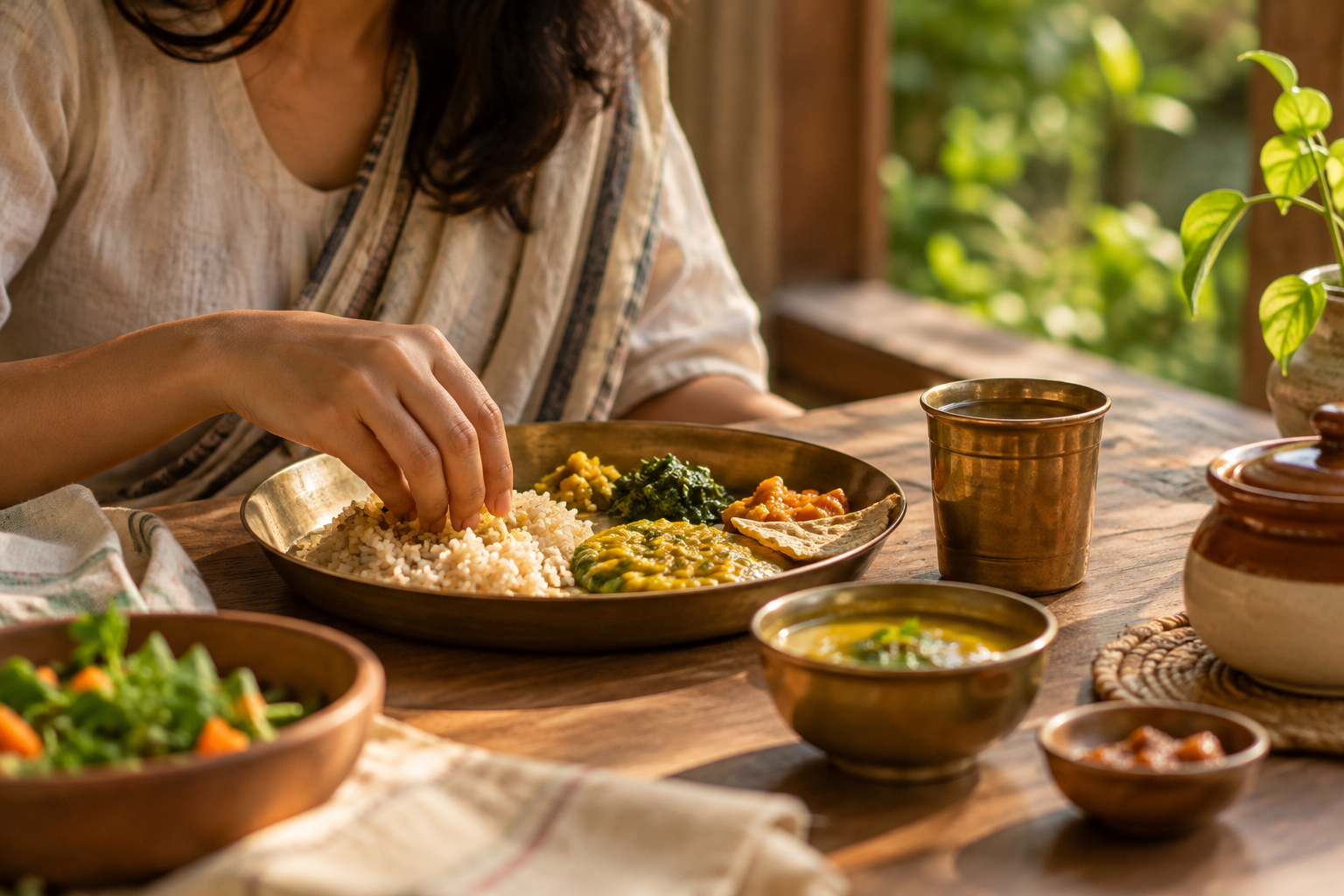
We have become very good at asking what we should eat.   What is the healthiest breakfast? Which oil should we use? Is rice better than roti? Should we have more protein? What should we eat for good digestion? There is always another food to add, remove, replace or worry about.   But there is one much simpler question that often gets lost: how much are you actually eating?   Ayurveda has been asking this question for a very long time. In the Matrashiteeya chapter of the Charaka Samhita, the discussion begins with something remarkably straightforward: matrashī syāt, essentially, one should eat in the right quantity.   And then comes the important part that quantity is not exactly the same for everyone. It depends on the strength of one’s digestion.   That immediately makes the conversation about food a little more interesting. Because we often speak about food as though the food itself is the whole story. We label something “light” or “heavy” and assume that its effect will be the same every time we eat it.   But even foods considered naturally light or heavy still depend on quantity. Something that is generally easy to digest can become difficult when eaten in excess, while a heavier food may be manageable in an appropriate amount depending on the person’s digestive capacity.   In other words, there is no point in asking only, “Is this food healthy?” without also asking, “Is this the right amount for me, at this time?”   Eat according to the proper measure; the proper measure of food depends on the strength of digestion. It sounds almost obvious when you hear it, but think about how rarely we actually apply this idea.   We eat because it is lunchtime even when we are not hungry. We continue eating because the food tastes good even after we are full. We finish everything on the plate because that is what we were taught to do.   We order more because we are out with friends. Sometimes we eat very little all day and then compensate with a huge dinner because we are exhausted and starving. The food may not necessarily be the problem. Sometimes it is simply the relationship we have with quantity.   The chapter makes another interesting distinction between foods that are naturally lighter and those that are naturally heavier. It mentions foods such as rice, green gram and certain meats among the lighter foods, while describing things such as preparations made from flour, sesame, black gram, milk and certain meats like fish as heavier.   But even here, food is not reduced to a simple good-food versus bad-food list. It repeatedly brings the discussion back to quantity and digestive strength. This is important because the idea is not to become afraid of foods that are described as heavy.   It is to understand that the same food can behave differently depending on how much of it you eat, how strong your digestion is and what else is happening in your body.   You do not have to create a permanent list of foods you are “allowed” to eat and foods you are not. You can instead become more attentive to what happens after you eat.   Do you feel comfortable? Does the meal digest without leaving you excessively heavy or sluggish? Are you hungry again at an appropriate time? Do you feel energised or do you feel like you need to lie down immediately? These observations are not meant to turn eating into another thing to obsess over. They are simply a way of becoming familiar with your own body.   The appropriate quantity of food often supports one’s strength, complexion, comfort and longevity. That is quite different from the way we often talk about food today, where every meal can start to feel like a calculation of calories, protein, carbohydrates, fats and restrictions.   Ayurveda’s concern here is much more functional: what does this food, in this amount, do to the person eating it?   And it does not just stop with food.   Health is maintained through small acts of care repeated regularly.   Take something as ordinary as brushing the teeth.   Your body is something you maintain, not something you only attend to when something goes wrong.   We have a strange relationship with self-care today. We can spend hundreds of rupees on a product marketed as a “self-care essential” and still forget the basics. We can have a complicated skincare routine but sleep four hours.   We can buy supplements while eating at completely irregular times. We can spend an hour researching the perfect shampoo and then ignore the fact that we are exhausted all week. Sometimes care becomes another form of consumption instead of something we actually practise.   The Matrashiteeya chapter offers a much quieter idea of care. Eat in the right quantity. Keep yourself clean. Take care of the senses. Pay attention to the body. Maintain routines. Do things regularly rather than waiting until a problem becomes severe. There is a sense of maintenance rather than constant correction.   And perhaps that is the part of this chapter that feels most relevant now.   Eating when we are actually hungry. Stopping before we have eaten far beyond what we need. Paying attention to how a meal makes us feel instead of blindly following a food trend. Keeping our bodies clean. Taking a few minutes to care for our skin, hair, feet and senses. Giving the body enough rest. Building routines that are sustainable rather than impressive for a week.   There is also something important in the way the chapter describes the body: almost as something that deserves regular attention and respect.   Maybe that is what we miss when we reduce healthy living to individual foods and isolated habits.   Because sometimes the most useful change is not finding a better food.   It is learning when enough is enough. Health does not always come from… Continue reading Maybe It Is Not Just What You Eat, But How Much


Agnimandya: What Ayurveda Says About Weak Digestion

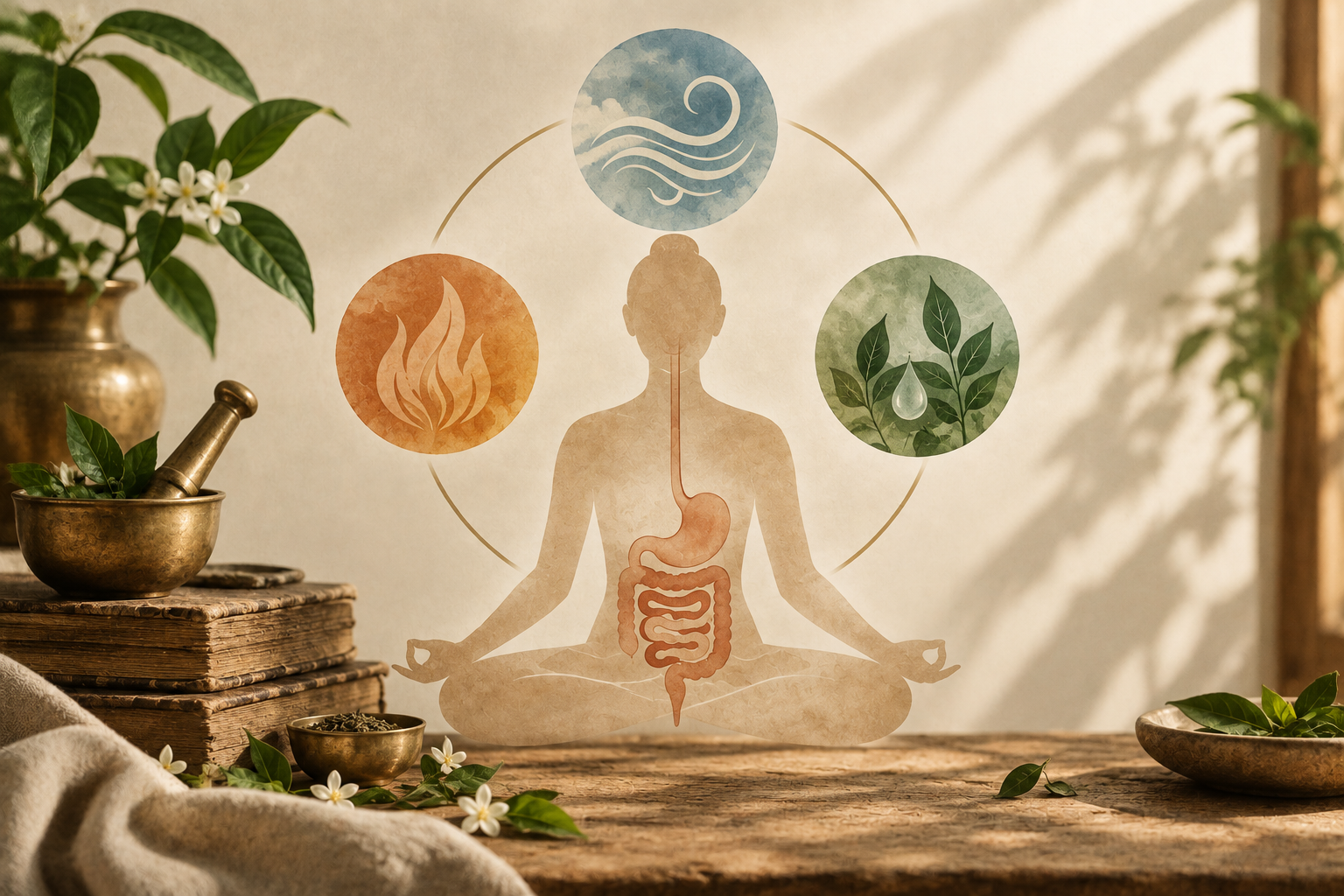
Have you ever noticed how two people can eat the exact same meal, and one feels perfectly fine while the other feels bloated, sluggish, or gassy an hour later? We usually attribute this to our different bodies but Ayurveda has a much more specific explanation for this, and once you understand it, a lot of your own digestive patterns start making sense.   It’s called Agnimandya, and the word itself tells you exactly what it means. Agni is digestive fire, Mandya means a lowered or weakened state. Put together, Agnimandya literally translates to lowered digestive capacity.   But before we get into what goes wrong, it’s worth understanding what Agni actually is, because I think this is where most people get it slightly wrong. Agni isn’t just “stomach acid” or metabolism. In Ayurveda, it’s considered one of the Panchamahabhuta, and its function mirrors that of Agni Mahabhuta in the universe at large, it’s the factor responsible for any transformation in matter.   It’s the same force behind a mango ripening on a tree, as it is behind the food in your stomach being broken down into something your body can actually use. Specifically, the Agni that governs digestion is called Jatharagni, because it resides in the Jathara, the stomach.   Whenever the term Agni comes up in this context, it’s really Jatharagni being referred to, not Dhatvagni, which operates at the level of individual tissues.   And here’s the part most people fail to understand. Jatharagni’s real job isn’t just to “digest food.” It’s to convert the properties of food into the properties of your tissues.   Wheat, for instance, carries a heavy, stable quality, what Ayurveda calls Guru and Sthira. Once Jatharagni processes it properly, those same qualities get transferred into your Dhatus, your tissues, in a usable, assimilable form.   When this transformation happens cleanly, your tissues stay balanced. When it doesn’t, that imbalance shows up directly in your Dhatus, and eventually, as disease.   This is really the whole premise behind why Agni is treated with so much seriousness in Ayurveda. It’s not just about comfort after a meal, it’s about whether your body is actually building itself correctly from what you feed it.   Now, Ayurveda doesn’t describe Agni as one fixed, uniform thing. It actually breaks it down into four distinct states, based on how consistently and effectively it digests, and this classification alone tells you a lot about how this system really is.   The first is Sama Agni, balanced digestive capacity. This is the ideal state, where food taken in the right quantity, what’s called Sama Matra, enough to satisfy hunger, not more and not less, gets digested smoothly, without discomfort, without excess, without deficiency.   Ashtanga Sangraha even gives this a rough timeframe, food digesting within about four Yamas, roughly twelve hours. Sama Agni stays balanced as long as your conduct around food stays proper, and it’s our own poor habits that typically disturb it.   This single idea alone reframes a lot of digestive complaints, because it suggests that for most people, balanced digestion isn’t a fixed trait you either have or don’t, it’s a state that holds as long as you don’t actively work against it.   The second is Manda Agni, low digestive capacity, dominated by Kapha. This is the state where even a small meal feels heavy and takes far longer than it should to digest. What’s interesting is how intolerant this type is. Manda Agni can’t handle any deviation in eating habits, even minor missteps show up quickly as Aadhmana, bloating, Aasya Shosha, dryness in the mouth, Aatopa, abdominal distension, and Aantra Koojana, that gurgling sound in the intestines many of us have felt after a heavy meal we clearly shouldn’t have eaten.   If you’ve ever felt like your body “punishes” you disproportionately for one slightly indulgent meal, there’s a decent chance Manda Agni is part of that story.   Then there’s Teekshna Agni, sharp or excessive digestive capacity, dominated by Pitta. This is almost the opposite problem. Food gets digested fast, sometimes too fast, even when eaten in excess. It sounds like an advantage until you realize what happens when this type of Agni isn’t fed enough, it starts consuming the body’s own tissues instead, leading to Dhatu depletion over time.   Taken to an extreme, this becomes a condition called Bhasmaka, a state of such intense digestive capacity that a person feels perpetually hungry, no matter how much they eat, almost as if the fire is burning through fuel faster than it can be supplied.   What I find notable here is that Teekshna Agni can tolerate improper conduct around food far better than Manda Agni can, it just has a different kind of cost attached to that tolerance.   And finally, Vishama Agni, irregular digestive capacity, dominated by Vata. This is the most unpredictable of the four. Some days digestion is fine, other days the exact same meal sits like a stone.   Charaka specifically describes this as the direct opposite of Sama Agni, unstable, inconsistent, and a major contributor to Dhatu imbalance over time.   Interestingly, Vishama Agni can behave in two completely opposite ways depending on the amount eaten, food consumed beyond actual hunger may digest surprisingly fast, while food eaten in a reasonable, hunger-appropriate amount might digest very slowly instead.   This unpredictability is exactly what makes it so hard for people with this pattern to pin down what’s actually “wrong” with their digestion, because the pattern itself keeps shifting.   Out of all four, only Sama Agni is considered the healthy baseline, responsible for Dhatu Saamya, true balance across all seven tissues. The other three are classified as Vikrita, disturbed states, and this is really where Agnimandya comes in specifically.   Technically, Agnimandya refers to Manda and Vishama Agni, the Kapha-dominant and Vata-dominant disturbances, both of which share that core feature of reduced or inconsistent digestive strength, as opposed to Teekshna Agni, which is excessive rather than diminished.… Continue reading Agnimandya: What Ayurveda Says About Weak Digestion

Principles of Ayurveda: What Everything Else Is Built On

Today, let’s go back to the very beginning.   Before Doshas, before Agni, before all the specific topics we usually talk about, there is a bigger question. What is Ayurveda actually trying to do?   Most people think of it as a system to treat disease and yes, it does that. But that is only half of it.   Ayurveda comes from two Sanskrit words, Ayur meaning life and Veda meaning science. Therefore, Ayurveda translates to the science of life, and it cares just as much about keeping a healthy person healthy as it does about treating someone who is unwell.   In the Indian way of thinking, life has four goals. Dharma, Artha, Kama and Moksha.  And none of these are possible if your body and mind are struggling. So, health was never the end goal, it was what made everything else possible.   Now, to understand how Ayurveda looks at the body, you need to start with one idea. Pancha Mahabhuta.   We experience the world through five senses. Sight, touch, hearing, taste and smell. Ayurveda says everything around us can be understood through five elements that go with these: Akasha, Vayu, Agni, Jala and Prithvi. Space, air, fire, water and earth.   And this isn’t only about nature. Your body is made of these same elements, so is your food and so is your medicine. Even ordinary water isn’t just Jala. It carries all five, with one leading.   This is why Ayurveda never saw the body and the world as two separate things. What is outside you keeps becoming what is inside you, through food, water and air. And when the balance shifts within, your body tries to correct it. It lets go of what is in excess and asks for what is lacking. In a way, that is what a craving really is.   From these five elements come the three Doshas. Vata, Pitta and Kapha.   Vata is mostly space and air. It is movement. Breathing, speaking, and everything in your body that needs to be pushed forward.   Pitta is mostly fire. It is transformation. Digestion, forming blood, vision, memory, turning one thing into another.   Kapha is mostly water and earth. It is moisture and stability. It softens food for digestion, helps you taste, and nourishes the senses.   Something I always want people to understand is that these three are not sitting in separate corners of the body. They are everywhere but the concentration varies. Vata is mostly in the intestines and bones, Pitta is in the stomach and blood, Kapha in the chest and joints. When they are balanced, they hold you up. When they are disturbed, that is where disease begins.   Then come the Dhatus, the seven tissues that form the body’s structure. Rasa, Rakta, Mamsa, Meda, Asthi, Majja and Shukra. Plasma, blood, muscle, fat, bone, marrow and reproductive tissue.   And this matters because Doshas don’t affect the body randomly. The Dhatus are the first place they act. So, when you look at how a disease really develops, it almost always passes through them.   Which brings us back to Agni.   The food you eat comes from outside. It is unfamiliar to your body, and it has to be broken down and made into something your body can use.   Agni is what does that.   But there is not just one Agni. There is the main digestive fire in the gut. There are five Bhutagnis that turn the elements in your food into elements your body recognises. And there are seven Dhatvagnis, one for each tissue, turning nutrients into that specific tissue, step by step.   That is why Ayurveda treats Agni almost as the body itself. When someone comes in with a problem, a Vaidya often looks first at the state of their Agni. Because if that isn’t working well, nothing else will. Most Ayurvedic medicines are designed with this in mind.   Now here is the part I find the most personal.   Prakriti.   Ayurveda believes every person is unique, and Prakriti is the reason. At the time of conception, the Doshas present decide your natural constitution. It could be Vata, Pitta, Kapha, a mix of two, or a balance of all three. And it stays with you for life.   That is why Ayurveda says it treats the person, not the disease. Two people with the same illness may need very different treatment. Someone with a Vata Prakriti is more prone to Vata problems, so they are advised to avoid what aggravates Vata. A Pitta person is given cooling things. A Kapha person, warming things.   And the mind is part of this too. Prakriti is also described through Sattva, Rajas and Tamas, because Ayurveda never saw disease as only physical. The mind affects the body, and the body affects the mind. Which is why even a physical illness sometimes comes with steps for the mind.   Even medicines are understood this way. They carry the five elements as well, so Ayurveda looks at their taste, called Rasa, their qualities, called Guna, their potency, Virya, and their effect after digestion, Vipaka. And then there is something none of these can explain, the medicine’s special action, called Prabhava. Two medicines can be alike in every other way and still act differently because of this.   Now, none of this is meant to be memorised in one sitting. But if you step back, you can see how it all connects. The elements make the Doshas. The Doshas affect the tissues. Agni keeps the whole thing running. Prakriti decides how all of it shows up in you and the same logic carries over to food, medicine and even the mind.   That is what makes Ayurveda a system, and not just a collection of remedies.   And I think that is the real takeaway. When you understand these basics, you stop seeing Ayurvedic advice as random rules, like eat this, avoid that. You… Continue reading Principles of Ayurveda: What Everything Else Is Built On

Atman in Ayurveda: Understanding the Self, Mind, and Consciousness

Today, let’s talk about a concept in Ayurveda that is present in everything the system talks about, but not everyone gets into it or knows about it because the whole concept itself is too abstract on the surface.   I am talking about Atman, which translates to the self, the soul, or simply the knower.   Now, before jumping into what Atman really means, let’s start with something which we are more familiar with in terms of Ayurveda, which is the Manas, the mind.   So, mind is essentially the part of you that reacts. It takes in the stimulus and turns it into a response. It distinguishes between likes and dislikes. For example, if something you eat tastes good, you want to eat more of it, and if you experience pain, you pull away. You don’t want to experience it again.   This is what the Manas does.   However, Atman is something else entirely. It is a part of you that is aware that all of this is happening. It’s not the reaction itself, but it’s the one noticing the reaction.   While Manas distinguishes experiences into pain and pleasure, Atman is simply aware of the inside and outside, it is the very awareness of this experience.   Here’s a simple way of how I think about it.   When you’re feeling unwell, usually the food that you eat every time, or the food that you like, you don’t want to have it and it might even taste unpleasant to you.   But nothing about the food has changed. What changed is how it is being received by your body.   This shift, the change between you and your mind, is the job of Atman. It is adjusting your experiences based on what is happening inside you.   Now, Atman cannot itself be described the way we describe everything else in the body, because it has no color, no shape, no texture. Its presence is not known entirely or directly.   But even if you don’t see Atman, you infer it. How differently a person can respond to the same thing, and how something within them prompts them to respond in that particular way.   The whole Atman can also be understood through this perspective, from the whole idea of possession, how it naturally comes to us when we talk about our things.   When we say, “I am tired,” there is still this strange distinction between the one who is experiencing tiredness and the tiredness itself.   This distance implied between someone who possesses and something that is being possessed, is where the idea of Atman comes from.   All the parts of your body are what is possessed by you, the person. So, despite any changes or aging or anything, the one that is staying constant is me, my. The idea of the owner is what is Atma.   And this whole distinction isn’t just philosophical. There’s a real practical framework of diagnosis around it too.   In Ayurveda, illness comes in three severities. One is ordinary, one serious, and one that is heading to a very fatal outcome.   And the way you tell these apart isn’t just purely because of external signs, but how clearly the person can experience their own feeling.   How clearly can they experience things like their preference, discomfort, desire, how they feel, and if all of this is intact in a coherent way.   Because once illness starts to get serious, all of this starts to blur. The person struggles to clearly experience. Memory becomes hazy, and the coordination too falters.   And in most serious cases, the patients may not be able to experience anything at all. They might feel numb. They can’t tell you how they feel because the whole response, the whole connection between your Atma, Manas, and the senses has weakened and there’s only basic signs of life that’s left.   This is such a different way of thinking about diagnosis compared to how we actually imagine ancient medicine, which is reduced to something that is purely external, physical observation.   In Ayurveda, the presence of your mind and the clarity of your awareness itself is one of the most important ways to diagnose what is wrong inside you, and it is sometimes arguably more important than any physical sign.   Now, the takeaway from all of this is very simple, despite how abstract Atman sounds.   And before even Ayurveda gets into the details of the body, bones, tissues, or organs, it is first establishing that awareness that is present inside every one of us, and everything else is built on top of that basic confirmation.   Health is never only about visible, measurable parts of the body. It is always, at its core, something that is changing inside you.   And I think this is where Atman becomes much less abstract than it initially sounds.   Because when we hear words like soul or self, it can immediately feel like we’re entering a completely philosophical conversation, something very distant from the body and from medicine. But Ayurveda doesn’t really separate these things in the way that we might expect. The person who is experiencing the illness is not just the body that is carrying the illness.   There is the body, there are the senses, there is the mind, and there is this awareness that experiences all of it.   If ideas like this interest you, you can check out our courses on Charaka Samhita and Ashtanga Hridayam which talk in depth about how Ayurveda understands the self, the mind, and the body as one connected system and much more.

Why Your Body Isn’t Just “Tissues and Waste”

Most people, the moment they start reading about Ayurveda, land on this word, Dosha, almost immediately. Vata, Pitta, Kapha. And usually, the very first explanation they get is something like “Dosha means fault” or “Dosha means fluid,” and honestly, that explanation doesn’t help at all.   If anything, it makes the whole thing feel more confusing than before you started.   So let’s actually slow down and ask a more basic question first. What is the body even made of, according to Ayurveda?   Before we even get to Dosha, there are two other categories worth understanding, Dhatu and Mala, because once you see how these three relate to each other, Dosha suddenly makes a lot more sense.   Dhatu refers to everything in your body that’s meant to stay. Your blood, muscles, fat, bones, the fluid in your spinal cord, reproductive tissue, all of it.   These are structurally very different from each other, obviously, but they share one thing in common, none of them are meant to leave your body under normal circumstances.   When they do leave, by injury or bleeding or some other accident, your body doesn’t feel relieved. It feels depleted, anxious and weak. That’s the signature of a Dhatu, its presence sustains you, and its loss destabilizes you.   Mala is the exact opposite category. This is everything your body is meant to get rid of, stool, urine, sweat, and so on. And here’s the interesting part, getting rid of these isn’t a failure of the body, it’s actually a sign of it working properly.   Holding onto waste for too long doesn’t protect you, it burdens you. A Mala that overstays starts creating problems rather than preventing them.   So while Dhatu is defined by staying, Mala is defined by leaving, and both, in their own way, keep the body functioning.   Now here’s where it gets genuinely interesting, because Dosha doesn’t fit into either of these categories. It refuses to follow the rule.   Think about saliva for a second. It’s produced inside your body, moves through your salivary glands, briefly steps outside the boundary of your internal tissue system into your mouth, and then re-enters your body as you swallow it along with your food.   It doesn’t stay put like a Dhatu, and it doesn’t fully leave like a Mala either. It does something in between, and that “in between” behavior is exactly what defines a Dosha.   It moves out into contact with the world, and then brings something back in, and this back-and-forth movement is precisely what makes digestion, absorption, and basically your entire relationship with the outside environment possible.   This is such an important shift in how to think about Vata, Pitta, and Kapha. They’re not things that cause or lead up to a disease. They’re the functional bridges that let your body interact with everything you eat, breathe, and absorb from the world around you.   Vata handles movement, what you take in. Pitta governs transformation, converting of one thing into another. Kapha manages binding, lubrication, and the way things hold together and connect.   Without these three doing their job constantly, your Dhatus would never get built, and your Malas would never get properly separated out and removed.   And here’s something that genuinely surprised me the first time I really understood it, this dual-direction movement of the Doshas happens twice a day, in the gastrointestinal tract specifically.   If something you’re consuming regularly doesn’t actually suit your body, that excess starts getting expressed back out, sometimes as an unusually sour or pungent sensation, sometimes as a sweet, sticky feeling.   This isn’t randomness, it’s your body’s own feedback system, quietly telling you that whatever you keep feeding it in excess isn’t being absorbed the way you assume it is.   Most of us just don’t know how to read that signal.   This is also why identifying someone’s Prakriti, their natural constitutional dominance of one or two Doshas, matters so much in how Ayurveda actually treats a person. Two people can eat the exact same meal and metabolize it completely differently, purely because their underlying Dosha balance is different.   What nourishes one person can genuinely unsettle another. This is the entire logic behind why Ayurveda has never really believed in one-size-fits-all diet advice, it was never really about the food.   It was always about how well your Doshas are managing the exchange between what’s outside you and what needs to become a part of you.   So the next time someone tells you Dosha simply means “fault,” it’s worth remembering that it’s actually closer to the opposite. It’s not what goes wrong in the body. It’s the very mechanism that allows the body to keep working, keep exchanging, and keep staying alive in the first place.   If ideas like this interest you, our courses on Charaka Samhita and Ashtanga Hridayam go much deeper into how Dosha, Dhatu, and Mala work together as the foundation of the entire Ayurvedic system.  

Ama: When Digestion Is Incomplete

After you have had your meal, there might be times when you feel heavy. It is not exactly tiredness, but you do not feel nourished either. Your head feels foggy, there is a discomfort you cannot quite ignore, and yet it is not severe enough to feel like something is seriously wrong.   There may also be a feeling that you have not experienced complete satisfaction from the meal. It is almost as though something inside you is saying that the process is not finished, that the job has not been completed.   Today, we are going to talk about one of the widely spoken-about concepts in Ayurveda: Ama. When the accumulation of Ama is greater, it can give rise to a condition described as Amadosha.   To understand Ama, we have to go back to something we have spoken about before: Agni, our digestive fire.   What Is Ama?   Ashtanga Hridayam describes this state directly. When the digestive strength is low, the very first tissue formed from food, which remains undigested, becomes vitiated and gets lodged in the stomach as unprocessed matter. This is described as Ama.   When Agni is working the way it should, the food we consume gets properly digested, absorbed, and converted into Rasa Dhatu, the first and most essential tissue our body produces after digestion.   But when Agni is weak, this conversion does not happen cleanly. Your food is not entirely digested, but it is not entirely rejected either. Some of it remains half-processed, turning into something called Ama.   Ama is not exactly food. It is not waste either. It is something caught in between the two, the result of incomplete digestion and improper transformation.   What Causes Ama?   One of the causes is eating more than what your hunger can accommodate.   Ayurveda describes this as atimātrā āhāra, or consuming food in excessive quantity. When food is consumed in a quantity greater than what the digestive capacity can handle, it places a burden on Agni. This can lead to the aggravation of all three doshas and interfere with proper digestion.   But it is not exactly about quantity alone. The nature of the food also matters.   Food that is heavy, dry, or cold can contribute to the formation of ama, even when it is eaten in a reasonable amount.   And it is not just about food.   Your lifestyle, mental strain, and the mental state you carry throughout the day can also contribute. When your digestive capacity is compromised, even food that you consider light or harmless may not be processed properly.   When Agni is weak, food does not necessarily provide the nourishment your body requires. Instead, according to the Ayurvedic understanding of ama, incompletely processed material can behave like a slow-acting poison within the body.   What Happens When Ama Interacts With the Doshas?   As this undigested or improperly processed material interacts with the doshas, its effects can vary depending on how the body responds.   It may become trapped and cause a condition described in Ayurveda as Alasaka. Or it may be expelled violently from the body, which is described as Vishoochika.   Either way, the body is signalling that something has gone wrong in the process of digestion and assimilation.   The manifestation can also differ depending on which dosha is involved.   When Pitta is involved, you may see signs such as a burning sensation, excessive thirst, and disturbances in the mouth, reflecting more heat-related expressions.   When Kapha is involved, it can manifest differently, with congestion-type conditions, urinary disorders, and other Kapha-dominant patterns.   This is why Ayurveda does not look at digestion as simply a matter of what you eat. It considers the strength of Agni, the nature and quantity of food, the timing of meals, lifestyle, mental state, and the condition of the doshas together.   Ama, in this sense, is not simply about having eaten something unhealthy. It is about what happens when the body is unable to properly process what it has received.   What Are the General Properties of Ama?   Ayurveda describes Ama as having certain characteristic properties.   It is guru, meaning heavy and difficult to digest.   It is drava, meaning it has a liquid nature.   It is aneka-varṇa, meaning it can present in different colours.   And it is picchila, meaning slimy or sticky in nature.   The symptoms associated with ama are often the kind most of us have experienced at some point.   There may be a sense of blockage or obstruction, general exhaustion, heaviness in the head, dizziness, stiffness in the back and hips, unusual thirst, and that general feeling that whatever you eat is simply not sitting right.   Individually, none of these symptoms may seem particularly alarming.   But when several of them appear together, they can indicate that something is not functioning properly within the digestive system.   The answer is not always to simply eat less, eliminate one particular food, or ignore the discomfort and wait for it to disappear.   Ayurveda asks us to look deeper at Agni.   How strong is your digestion? Are you eating according to your hunger? Are you eating at regular times? Is the food appropriate for your digestive capacity? Is your lifestyle supporting digestion, or constantly working against it?   Because digestion is not merely about what happens to food after you swallow it. It is about how well the body is able to transform what it receives into nourishment.   If ideas like Ama and Agni interest you, our courses on Charaka Samhita and Ashtanga Hridayam go much deeper into understanding digestion, imbalance, and the way our body responds to what we eat, how we live, and how we care for ourselves.  

What Your Body Is Telling You Before You Ask It

There’s actually a lot we can tell about a person without asking them a single question.   If they are not feeling well, you can notice the way they look unusually pale, or that their voice sounds different, weaker than usual. Their eyes may look different, their skin may look dry, their lips may look chapped, or maybe they might just look exhausted.   These are just some observations.   Ayurveda actually has an entire section in the Charaka Samhita talking about this kind of observation called Indriya Sthana. The very first chapter is called Varṇasvarīyam Indriyam where Charaka describes how a physician should pay attention to changes in a person’s complexion, voice, and other signs when assessing an illness or the severity of a disease.   Because Ayurveda doesn’t look at the simple question of what disease this person is actually having. It instead goes a little deeper into asking what the body is telling us about the illness.   It is actually our body that gives out the first signs of illness before it becomes something more obvious. Disease isn’t always the beginning of the story. It is ultimately important to keep in check the signs that our body is giving away, always.   यच्चान्यदपि किंचिद्वर्णवैकृतमभूतपूर्वं सहसोत्पद्येतानिमित्तमेव हीयमानस्यातुरस्य शश्वत्, तदरिष्टमिति विद्यात्।   An abnormal change that was not present before, appears suddenly, and occurs in someone whose condition is already declining. Such a change, Charaka says, should be recognized as an ariṣṭa, an ominous prognostic sign.   Now, one of the most important ideas in the chapter is the distinction between Prakriti and Vikriti.   Prakriti refers to a person’s natural state, while Vikriti refers to the deviation from that state.   A person’s appearance may naturally vary depending upon their constitution, age, environment, and other individual characteristics. So we can’t just vaguely determine that one particular complexion may be healthy or unhealthy. We need to look a little deeper.   Charaka’s list of things to examine is very extensive. He not just mentions the complexion and voice, but also the smell, taste, touch, eyes, ears, nose, the mental state, and many more. The list goes on.   In fact, Charaka tells us that a person should be observed as a whole, because a single unusual sign doesn’t entirely tell the entire story.   A temporary change with an obvious explanation is different from a sudden change that appears without apparent reason in someone whose condition may already be deteriorating.   So generally, the whole idea is that observation becomes meaningful when it is placed in context.   The entire emphasis here is on the change that you witness within your body.   And I think this is where this idea becomes useful even outside the context of an Ayurvedic physician examining a patient.   Because most of us don’t necessarily pay attention to our own bodies or the signs they are giving out.   We know how we feel ultimately, whether our face is looking normal when we wake up, or if our skin is feeling as usual. We know our baseline.   But when you wake up feeling different we brush it off as, “Maybe I have not rested well.”   But you need to understand that the baseline is important.   Because if you suddenly feel unusually tired for several days, or maybe your appetite has changed, or there are other signs your body that are trying to tell you, then I think this is where we need to stop looking and start observing what is wrong.   Because from an Ayurvedic point of view, disease is never something that simply comes overnight. Long before it becomes serious, your body is already trying to protest against it through different signs.   None of those signs individually might feel like a big deal. And that is exactly why they get ignored.   But when you look at the whole picture, these small signs can slowly lead up to something more serious.   Disease isn’t the starting point, it is actually much closer to the end of the story that your body has already been trying to tell you for a while now.   We are often quick to notice when there is something wrong with our phones, our cars, or our laptops. We notice that the battery is draining faster than usual, or the screen is running slow, or the phone is lagging a bit.   But when it comes to our bodies, we often ignore the same signs.   And maybe it is because our lifestyle has changed. We sleep less, work more, eat at odd hours, and keep pushing ourselves through the day.   We think our body is adaptable, but it isn’t.   Your body is constantly giving you information. The question is whether you are paying enough attention to notice it.   You don’t have to become an expert at interpreting every single sign. You just need to know what your normal looks and feels like, so you can recognize when something starts to change.   If you want to understand your body a little more deeply, you can explore our courses on the Charaka Samhita and Ashtanga Hridayam, and learn how these texts approach the body, health, and the signs it gives us.

Samanya and Vishesha: The Ayurvedic Principle of Balance

Think of this situation, you probably find it familiar.   You come home tired, and instead of hitting the gym or going for a walk, all you want to do is sleep. So, you lie down but when you get up instead of feeling refreshed, you feel even more tired.   There might also be days when you feel jittery and restless instead. So, you go for a walk or hit the gym hoping it will help. But rather than feeling energised, you end up feeling even more wired than when you started.   You must have noticed that nobody has really taught us this. We just vaguely assume that rest will fix our tiredness, or movement will fix our restlessness, without actually stopping to think about whether they really do.   Interestingly, Ayurveda has actually talked about this phenomenon. The Charaka Samhita has a verse that describes this very pattern.   सामान्यमेकत्वकरं, विशेषस्तु पृथक्त्वकृत् । तुल्यार्थता हि सामान्यं, विशेषस्तु विपर्ययः ॥   It can be roughly translated to Samanya brings things together, Vishesha pulls them apart. Samanya is sameness of quality; Vishesha is its opposite.   This verse introduces us to two words. One is samanya, which means sameness or similarity. The other is vishesha, which means difference or distinction.   And the principle the text is pointing towards is that things that are similar to each other tend to increase each other, while things that are opposite to each other tend to reduce each other.   It’s almost like fields, where one thing can either reinforce what is already there or counter it.   Rest is slow. So, if you are already feeling heavy and slow, more rest isn’t necessarily going to rebalance you. It only reinforces that feeling of heaviness and sluggishness.   On the other hand, restlessness is hot and fast. So, if you respond to that feeling with more movement, you might end up feeling even more hot and wired rather than actually calming the restlessness. You’re reinforcing the qualities that are already present.   Now that we think about it, it sounds obvious. But we rarely think about our own habits in these terms.   This principle can also be applied to the food we consume and our body’s internal balances, what Ayurveda calls the doshas.   It’s quite simple. Whatever quality is already present in excess, you don’t add more of it. You reach for its opposite instead.   On a cold day, for example, if you’re already feeling stiff, dry and cold you naturally want to add some warmth. Similarly, if you’re feeling sluggish or heavy after a meal, you probably don’t want to eat something even heavier, right? You want something lighter.   In fact, the very first chapter of the Charaka Samhita, called Dirghanjivitiya, which is about the desire for long life, talks about exactly which tastes can calm which imbalances.   It goes through all six rasas, or tastes, and explains their qualities and what can be used to pacify different states.   Take Vata, for example. Vata is dry and is associated with movement. So, it is calmed by substances with opposite qualities. If you’re feeling dry and cold, if you’re in a Vata state, you would reach for sweet, sour and salty tastes because these carry qualities of moisture, warmth and weight.   Or if you feel like your Pitta is rising, you’re overheated or you’re feeling short-tempered, bitter and sweet tastes can help cool things down.   And this is important: none of the six tastes are universally good or universally bad. It’s not that sweet is unhealthy and bitter is healthy. Each taste has its place whether it is helpful or unhelpful depends entirely on the state it is meeting.   There is no fixed list where cold foods are always bad or sweet foods are always bad. It depends entirely on the person, the place, the timing, and the state of the body, not just the substance itself.   This is one of the core ideas of Ayurveda. It is individualistic. The same food or medicine can be helpful for one person but not for another. If you must have also noticed, even for the same person, something that suits them one day may not suit them on another day.   It depends on what qualities they are already carrying in excess at that particular time.   Ayurveda says that even a well-known poison, used with the right knowledge, at the right dose, for the right person, can become the best possible medicine. And a substance that’s technically medicine, used without that understanding, can do as much damage as poison.   The substance alone is never the whole story.   You have to look at what you’re giving, who you’re giving it to, why you’re giving it, how much you’re giving, and under what circumstances.   And this brings us back to samanya and vishesha.   Because the real question isn’t simply, “Is this food good?”   Ayurveda’s answer is rarely just about the thing itself.   It is about the relationship between the thing and the person receiving it.   If this way of looking at Ayurveda interests you, you might enjoy our courses on the Charaka Samhita and Ashtanga Hridayam, where we go deeper into the texts and the ideas behind them. Sometimes, going back to the original texts can change the way you understand Ayurveda, and even the way you look at your own life.

Your Gut, Brain, Blood and Breath Aren’t as Separate as You Think

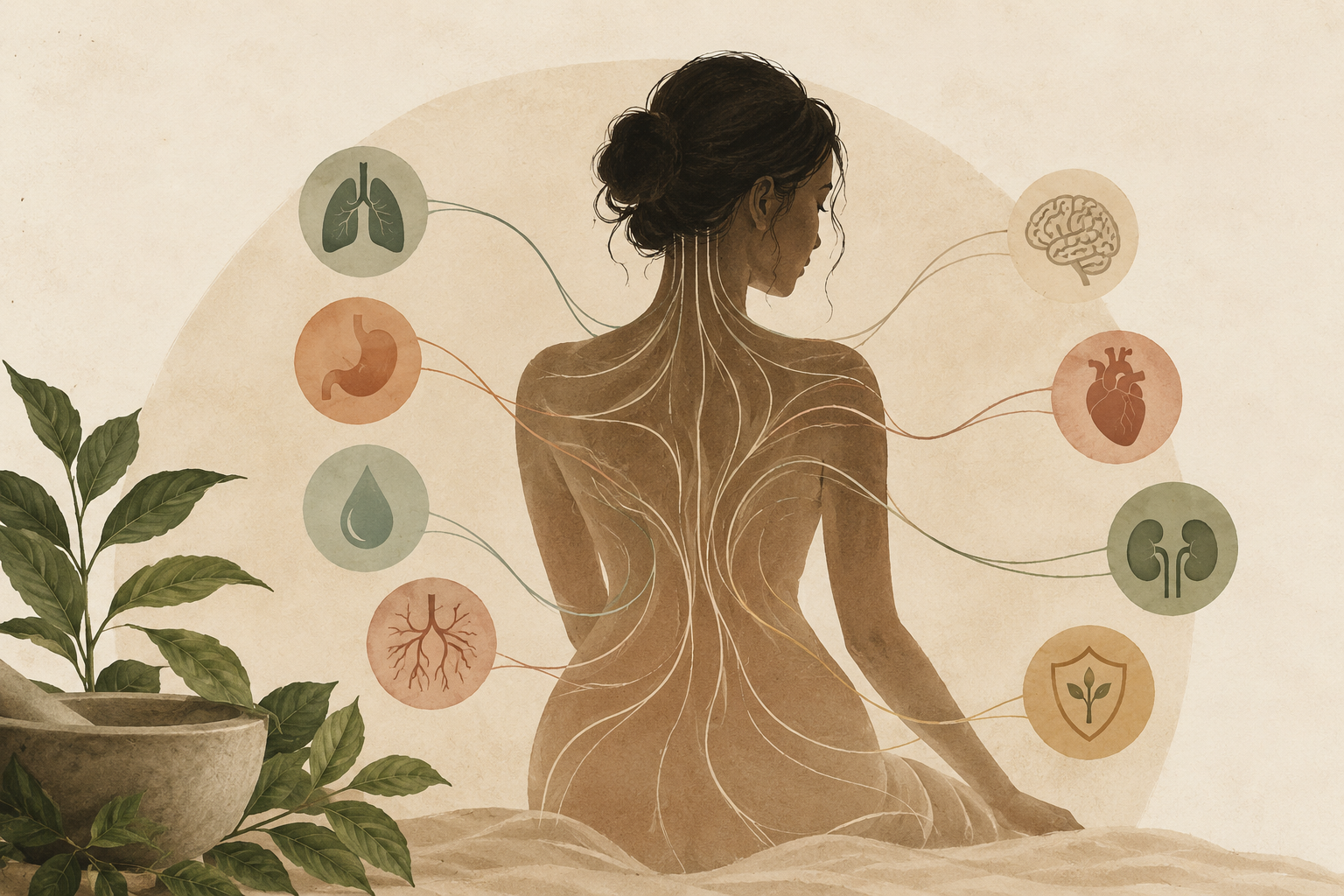
Think about everything your body has to move around all day.   Food, water, oxygen, nutrients, hormones, waste.   Nothing just sits there. Everything is constantly travelling somewhere, through something.   And when that movement gets disturbed, your body usually has a way of showing you. Bloating, sluggishness, poor digestion, congestion, changes in your skin, feeling unusually tired.   Ayurveda has a rather interesting way of explaining why this happens.   It’s called Srotas.   Srotas literally means channel, and the idea behind it is honestly pretty simple once you get it. Your body isn’t one solid block of tissue. It’s a network, an endless system of channels and pathways carrying stuff around, nutrients in and waste out.   And not just fluids, it also carries your thoughts, emotions and your immune responses.   Charaka mentioned that the human body is a pile of these channels, so many of them that you couldn’t hope to count them all. But he and Sushruta still tried to organise the important ones into thirteen main Srotas, each responsible for carrying something specific through the body.   Let me give you a sense of how detailed they are.   There’s Pranavaha Srotas, the channel for breath and oxygen, roughly matching what we’d now call the respiratory system. The Annavaha Srotas, carries food through digestion. Rasavaha and Raktavaha handle plasma and blood while Swedavaha Srotas for sweat, and Mutravaha for urine.   And then there’s the one I find most fascinating, Manovaha Srotas, the channel through which thoughts and emotions are believed to move.   Yes, your mind has its own channel too, right alongside your blood vessels and your gut.   Strotas aren’t just for moving things around, they also help us understand something we’ve all felt but never really questioned. Why does anxiety sit in your stomach? Why does a stressful week somehow show up as a breakout, or a headache, or a flare-up in your gut?   Ayurveda’s answer is that these channels aren’t separate systems running in isolation, they’re connected. A disturbance in one can easily spill into another.   Modern medicine, interestingly, is inching toward the same conclusion. There’s actual research now on the gut-brain axis, the idea that your digestive system and your nervous system are in constant conversation, influencing each other more than we ever gave them credit for.   Ayurveda was describing something remarkably similar centuries ago.   Here’s the part that really changes how you look at illness though.   Ayurveda believed most diseases begin the same way. Not with a sudden attack from nowhere, but with a Srotas getting disturbed. And it described this disturbance, called Srotodushti, in a few specific ways. A channel can get blocked, it can narrow. It can widen beyond what it should. It can even start carrying things in the wrong direction entirely.   I think this reframes a lot of things we brush off too quickly. That afternoon brain fog you get after a heavy meal? Ayurveda would say your Annavaha Srotas, the digestive channel, is overloaded, and that congestion is now affecting clarity elsewhere. Random skin flare-ups with no obvious trigger? Possibly a disturbance that finally found somewhere to surface.   None of this means Ayurveda had X-ray vision into the body, it didn’t have MRIs or blood panels. What it had was centuries of careful observation, watching how symptoms moved, repeated and connected across generations of patients. And through that, it built an entire model of the body based on flow, not fixed parts.   This is actually a pretty different way of thinking about health compared to how most of us were taught. We tend to think in terms of organs like the stomach handles digestion, the lungs handle breathing and the brain handles thinking, full stop. Ayurveda asked a slightly bigger question. Not just what does each part do, but how does everything stay connected, and what happens when that connection breaks down.   Keeping these channels clear was never treated as an afterthought in Ayurveda either. It’s actually one of the reasons practices like proper digestion, regular elimination, oil massage and even breathing exercises show up so often in Ayurvedic practices.  They were seen as basic maintenance for keeping the body’s channels open and functioning the way they’re meant to.   But once you actually understand Srotas, a lot of Ayurveda’s other ideas start clicking into place too. Why Dinacharya matters, why Ama, the toxin buildup we mentioned earlier, is taken so seriously, why treating one symptom in isolation was never really Ayurveda’s style to begin with.   Long before modern medicine started mapping out the gut-brain axis or the lymphatic system in real detail, Ayurveda had already sketched out its own map, one built entirely on the idea that nothing in the body works alone.   If ideas like this interest you, our guided courses on Charaka Samhita and Ashtanga Hridayam explore concepts like Srotas straight from the original texts.

Your Moods Have a Pattern Too, Here’s What Ayurveda Says

Ever had one of those days where you feel completely calm and clear-headed, like nothing can shake you?   And then there are days where you feel restless, edgy, almost itching to argue with someone over nothing?   And then, of course, there are the days where you don’t want to do anything at all. Not work, not talk, not even get off the couch.   If you’ve felt all three of these at different points in your life, you already understand the Trigunas, even if you’ve never heard the word before.   We talk a lot about Doshas when it comes to Ayurveda, Vata, Pitta, Kapha. But those three govern the body. What most people don’t know is that Ayurveda had a separate set of three for the mind. These are called the Trigunas: Sattva, Rajas and Tamas.   And honestly, I think this is one of the more underrated ideas in the whole system.   Let’s break it down simply.   Sattva is that calm, clear state of mind. Sharp focus, a settled heart, the kind of headspace where good decisions just come naturally.   Rajas is the restless one, driven, ambitious, a little impatient, always chasing the next thing.   Tamas is the heavy one, sluggish, foggy, the mental version of hitting snooze five times in a row.   Here’s the part I find genuinely interesting. Ayurveda didn’t treat these as personality types you’re stuck with. Unlike your Dosha, which is largely fixed from birth, your Guna shifts, sometimes within the same day.   You could wake up Sattvic, turn Rajasic by 3pm after back-to-back meetings, and end the night fully Tamasic on the couch, scrolling your phone with zero motivation to move. Same person, three different mental states, all in twelve hours.   That alone tells you something important. Ayurveda wasn’t describing who you are, it was describing where your mind happens to be, right now.   And that’s a much more useful way to think about your own moods, isn’t it?   We tend to label ourselves. “I’m just a lazy person.” “I’m always anxious.” “I’m just wired this way.”   Ayurveda would gently push back on that. It would say, you’re not permanently anything.   This is honestly a bit of a relief when you sit with it.   Ayurveda also didn’t leave you to just observe your Guna. It gave you actual levers to pull.   Food, for one.   Ever notice how a heavy, greasy meal makes you want to do absolutely nothing afterward? That’s Tamas showing up through your plate.   Ayurveda classified food the same way it classified minds: Sattvic, Rajasic and Tamasic, and it genuinely believed what you eat nudges your mental state, not just your waistline.   Sleep, company, the media you consume, even the pace of your day. Ayurveda considered all of it capable of tilting you toward one Guna or another.   This is where it gets a little uncomfortable, in a good way.   Because it means your 2am doom-scrolling isn’t just a habit. It’s actively feeding a Tamasic state.   And that overpacked schedule you’re proud of might be keeping you stuck in Rajas far more than you realise, wired, busy, but never actually at peace.   Ayurveda wasn’t saying Rajas or Tamas are bad, by the way.   You need Rajas to get out of bed and get things done. You need a bit of Tamas to actually rest. The goal was never to eliminate them. It was to notice which one you’re leaning on too heavily, and gently steer yourself back toward Sattva, the state Ayurveda considered closest to genuine wellbeing.   So why doesn’t this concept come up as often as Doshas do?   I think it’s because Doshas feel more “medical.” They explain digestion, body type, physical symptoms, things that are easy to point to.   Gunas are quieter. They live in your mood, your focus, your patience, things we’re used to blaming on stress or personality instead of actually examining.   But if you ask me, understanding your Guna day to day might be more useful than knowing your Dosha.   Because most of us aren’t struggling with our body type. We’re struggling with why we feel foggy, restless or completely unmotivated, and not knowing there was ever a name for it, or a way back to balance.   If ideas like this interest you, our guided courses on Charaka Samhita and Ashtanga Hridayam explore concepts like the Trigunas straight from the original texts.